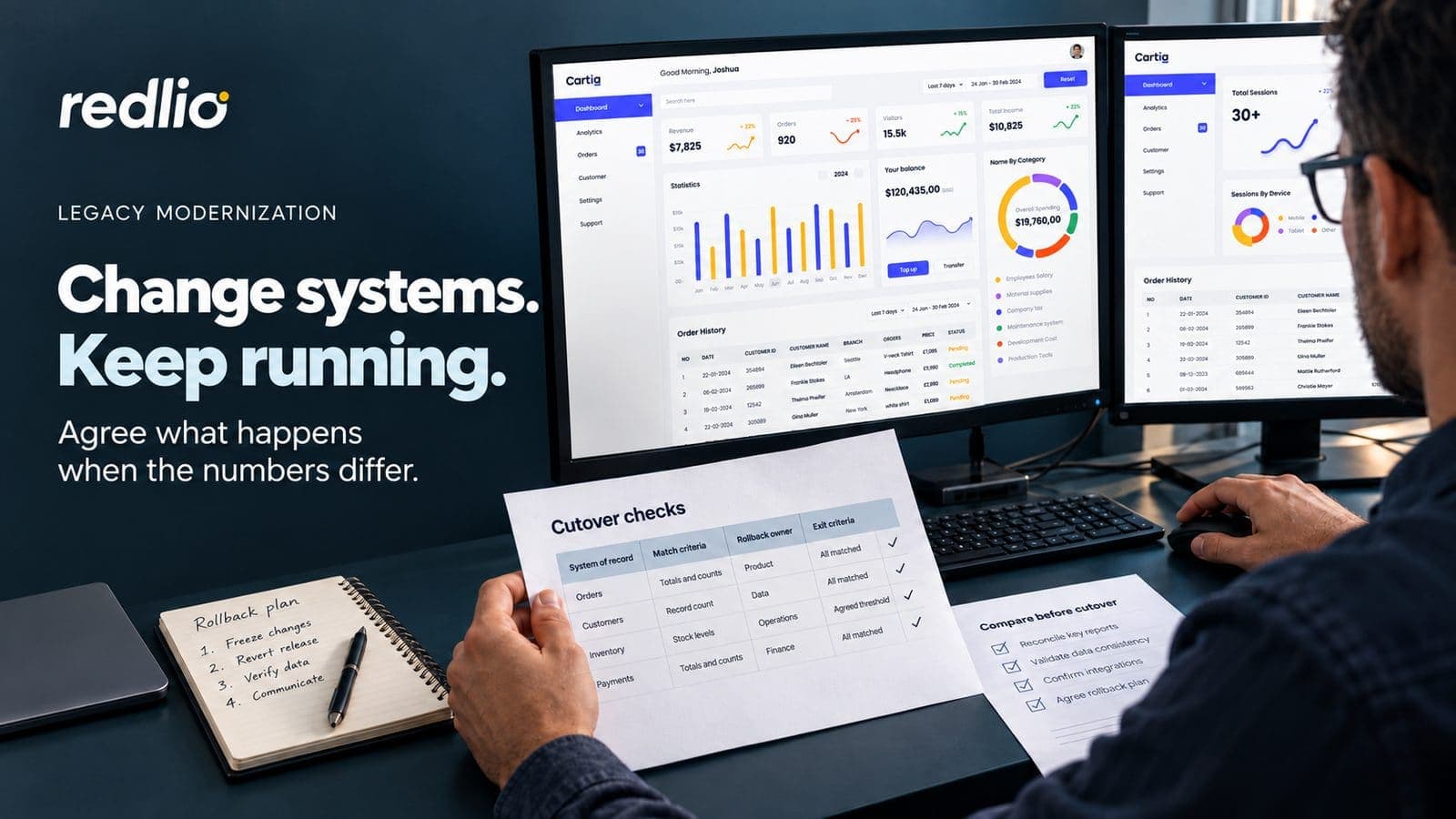
ERP software development services with a cutover planned around operations
Our ERP software development services are for organizations that cannot stop trading to replace spreadsheets and an outgrown system. As an ERP software development company, we bring finance, inventory, production and reporting into one custom ERP, delivered in stages against a scope and a price agreed before the build. The old system keeps running while each stage goes live.
We build an ERP around a business that cannot pause. Month-end still has to close, payroll still has to run on the twenty-eighth, and stock still has to ship while the program is under way.
In ERP system development the build is rarely the risk. The risk is the weekend when everything has to change at once, data that turns out dirtier than the export suggested, and a finance team asked to relearn its daily job mid-quarter. Those are what move a switchover date.
So we plan the going-live before we plan the building. We switch over one capability at a time, with the old system running beside the new one and a way back for a defined window. We set each go-live date against the calendar mapped during discovery.
01Your calendarWe map month-end, payroll, audit, and your peak season before anyone proposes a go-live date.
02Your dataWe check what the old system really holds after years of exceptions, whatever the schema promises.
03Your peopleWe bring the people who know the daily workarounds into scoping, instead of training them at the end.
Our ERP software development services
We deliver ERP work in six kinds, from adding one module to retiring the whole system. Most engagements are one of them, and a replacement is usually three in sequence.
01
Custom ERP development
Custom ERP software development is the right answer when the process is genuinely yours and configuring a package would cost more than building. We build the system around how your business runs, whatever a product expects of it.
02
ERP module development
ERP application development for a system that is staying: we build a new module, rebuild one, or add the part the package never covered. Each sits inside your existing ERP instead of replacing it.
03
Support and change after go-live
We keep the team that built your ERP on it after go-live. The real requests arrive in the second year, once people have used the system, and they go to engineers who already know your data model.
04
Integration and data migration
We connect the ERP to the systems that stay: your bank feed, your payroll platform, your warehouse, your CRM. We migrate with the flows reconciled daily during cutover, so drift shows up in hours rather than at month-end.
05
Reporting and analytics
We build the reporting layer that makes an ERP worth having. Your leadership gets the numbers it asks for each month, without somebody exporting to a spreadsheet first.
We replace a system that has run your business for a decade or more in planned stages. It stays live throughout, so the program does not depend on one switchover date.
“Redlio Labs successfully delivered the project within schedule; they met all of our requirements. Their quality designs and in-depth knowledge of technology were key elements of their work.”
Off-the-shelf, platform or custom ERP development: when each one wins
As an ERP development company, we set out all three routes below, including the two cases where we would advise against hiring us for a build.
Off-the-shelf ERP
Platform build
Custom ERP
Fits when
The process is close to standard and the business is willing to change to match the product
Most of the process is standard and a few parts are genuinely yours
The process is the business, and no product serves it
Under your control
Configuration, inside the vendor’s limits
Configuration plus the modules extended for you
All of it, including the roadmap
Cost shape
Per user, per month, forever, rising as headcount grows
Lower build cost, some license cost, extension cost where the process differs
Higher upfront, no per-seat license, cost falls after go-live
First live in
Weeks to months
Months
Months, one capability at a time
The real risk
The workaround becomes permanent and the process bends to the software
The platform’s assumptions surface late, in the parts that were extended
Scope drift, if the boundary was never priced
We advise buying and configuring a mature product where one fits. We will say so on the call, and we have. A custom ERP earns its cost where your process is a competitive advantage, where your integration surface is unusual, or where per-seat licenses have outgrown the price of owning the software outright.
What decides the cost of custom ERP software development
We do not quote an ERP before we understand the integration surface. A number given earlier is an opening position, and the gap to the real price is where ERP budgets go wrong. A figure you can defend comes out of scoping. Before then, we can say where the money goes on almost every project:
01Discovery and scoping, which is where the number becomes defensible
02The build itself, usually the part everybody plans for correctly
03Data migration from the systems being replaced
04Integration with every system that stays
05Training, and the productivity dip while teams switch over
06Support and change requests through the first year of live use
Two of these surprise buyers: data quality and integration. Migration estimates assume the old data is clean, and after a decade of exceptions it rarely is. Integration is where a fixed quote becomes an open one, because every system that stays has its own owner, its own format, and its own failure modes.
We advise asking every vendor to price integration separately, in writing, before comparing totals. We scope that boundary before we price the build. It is slower at the proposal stage and considerably faster everywhere after it.
ERP modules we build, and the question each one answers
We scope each ERP module around a question somebody in your business asks every week. These are the modules most engagements include, and the question each one exists to answer.
Finance and accounting
Where the money went, and whether the month can close without three people reconciling by hand.
Inventory and stock
What is actually in stock, where it is, and what is committed against it.
Production and operations
What is being made, what it is waiting on, and what it truly costs to produce.
Purchasing and suppliers
What was ordered, what arrived, and what was agreed as the price for it.
Sales and customers
What is quoted, what is invoiced, and what is still owed.
Reporting
All of the above in one place, on the day it is asked for rather than the week after.
We usually advise buying HR, payroll, and CRM and integrating them into the ERP, instead of building them into it. We will tell you which of your modules fall into that category. Where the CRM itself does not fit, our custom CRM development page covers that case.
A custom build is the wrong answer in three cases. Where one applies, we say so before you spend anything:
01
A package genuinely fits
Where the process is close to standard, a product will be cheaper to buy and cheaper to live with than anything we would write. We advise buying it and configuring it.
02
The process is still being decided
We advise waiting when a workflow will look different in six months. Building it now writes the wrong shape into code, so the process is settled first and built second.
03
Nobody internally owns it
An ERP program needs one person on your side who can decide and sign off stages. Without that person the build drifts whoever writes it, and the switchover date moves for reasons no vendor, us included, can fix.
Our ERP development process, from scoping to a staged switchover
Step 1 of 5
Discovery
We map your workflows, systems, and constraints with the people who use them every day, before anything is scoped. On an ERP, we add your close calendar and your peak season to that map.
Discovery
Workflow map
Systems inventory
Constraints and risks
Step 1 of 5
Step 2 of 5
Scope and plan
We write a scope, a timeline, and a price for that scope. Architecture decisions are made and documented before code starts. On an ERP, we price your integration boundary here, as its own line.
Scope and plan
Written scope
Timeline and milestones
A price for that scope
Architecture decisions
Step 2 of 5
Step 3 of 5
Build in stages
Senior engineers deliver in planned stages, with working software demonstrated at every step, not a reveal at the end.
Build in stages
Planned stages
Working software every step
Senior engineers on the code
Step 3 of 5
Step 4 of 5
Launch
Data migration, training, and a production cutover planned around your operations and your calendar, not ours. On an ERP, we take you live capability by capability, with the old system running in parallel and each step reversible for a defined window.
Launch
Data migration
Team training
Production cutover
Step 4 of 5
Step 5 of 5
Run and improve
The team that built your system stays on it: monitoring, support, and the next improvements on one roadmap.
Run and improve
Monitoring
Support
Improvement roadmap
Step 5 of 5
Why companies choose Redlio Labs for ERP software development
01
Integration priced before the build
We scope and price your integration boundary before we quote the build. The price is for a fixed scope, so change requests are the exception rather than the business model.
02
A reversible cutover
We take each capability live with the old path still open for a defined window, so your team can reverse a go-live inside that window.
03
Senior engineers, directly
We put you in direct contact with the senior engineers building your ERP. No account layer sits between you and the work.
04
Continuity in years
Our client relationships run past the first project. We keep the team that built your ERP on it, so in year five the system still has people who know it.
Services that pair with ERP software development
We also place ERP teams that stay on a system for years. That is a different engagement from a fixed-scope build: Dedicated software development team
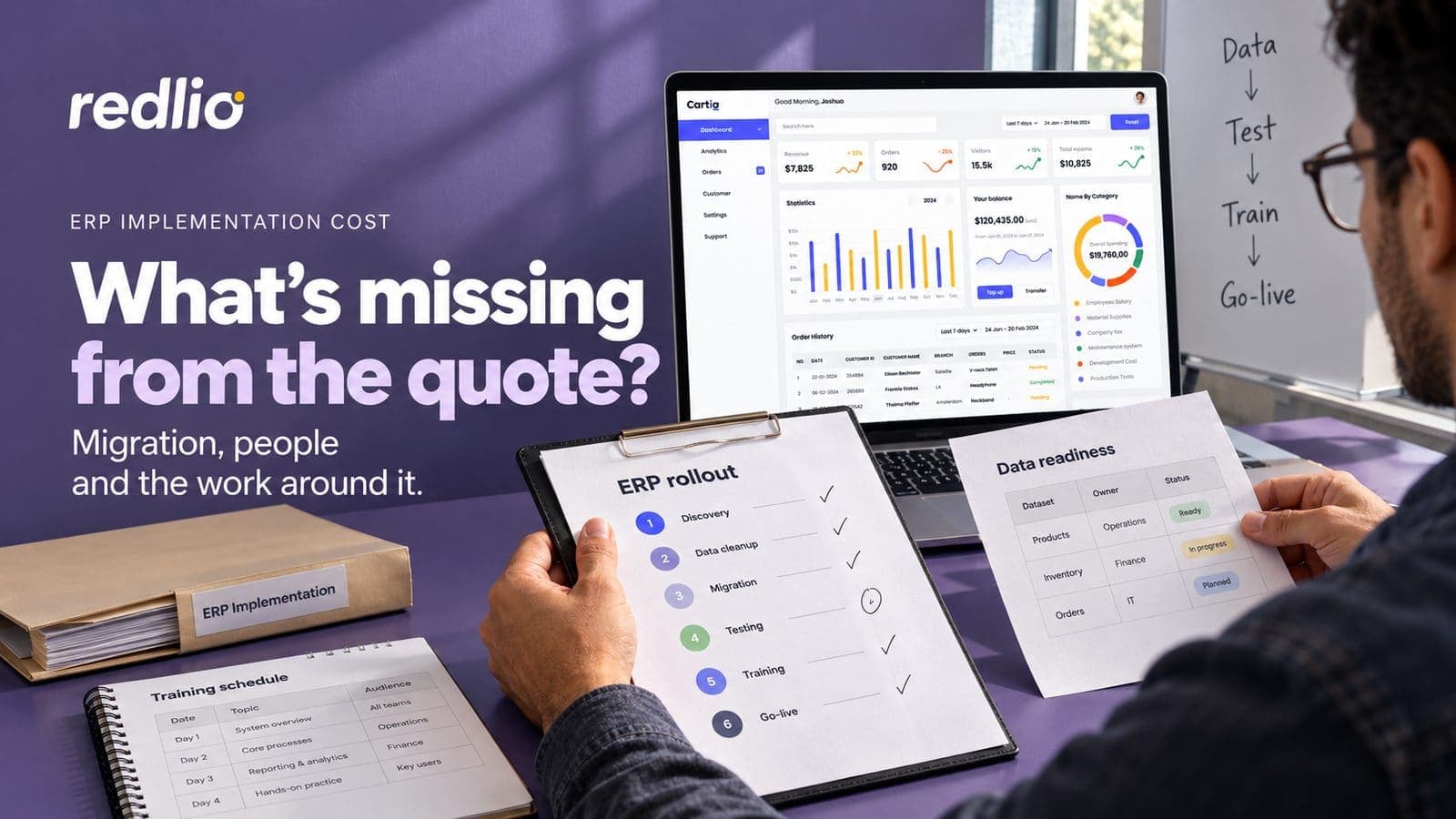
The eight lines on an ERP quote, then what is missing from it: the license, a benchmark you can trust, firm data and integration numbers, your own costs, and the payment dates.
The routes to modernizing legacy code, the strangler fig pattern, and the rules a staged migration needs in writing: what to do when the two systems disagree, when rollback expires, and what a facade never sees.
We quote ERP software development cost after scoping, because two things decide most of it: the state of the existing data and the number of systems to integrate. The rest of the money goes to the same places on almost every project: discovery, the build, migration, training, and the first year of live support.
We advise asking each vendor to price one more line that most quotes leave out: the weeks both systems run side by side, and the daily reconciliation between them. Our ERP implementation cost guide lists the costs that land on your side of the quote.
How long does it take to develop a custom ERP?
We take a custom ERP live one capability at a time, after a discovery and scoping stage that takes weeks. So the useful question is when your first capability goes live, and that comes before everything is finished. Your business gets value before the program ends, because each stage leaves a working capability in production.
Should we build a custom ERP or buy an off-the-shelf one?
We advise buying an off-the-shelf ERP where the process is close to standard. A mature product will be cheaper to purchase and cheaper to live with than anything custom, and we will tell you so.
We recommend building a custom ERP when the process is genuinely yours, when your integration surface is unusual, or when per-seat license costs have outgrown what owning the software would cost. Our build vs buy guide sets out where the seam between the two usually falls.
Do you build ERP software for manufacturers?
Yes, we build ERP software for manufacturers. The hard part for a manufacturer is usually the connection between the ERP and the shop floor: counts, scrap, downtime and lot traceability arriving in time to matter. Our manufacturing software development page covers that side.
How is ERP software developed?
As an ERP development company, we develop ERP software in stages, against a scope priced after the integration boundary is understood. Discovery maps your workflows and your calendar, and scoping fixes the price and the architecture. We then build each capability, demonstrate it, and move it into production while the old system runs beside it.
We avoid the alternative, one long build ending in a switchover weekend, because it is the pattern most failed ERP programs share.
Can you migrate our ERP data without stopping the business?
We migrate ERP data in stages so the business keeps trading, and it is the part we plan first. Both systems run in parallel through each stage, with data flows reconciled daily so drift is caught in hours. Each cutover stays reversible for a defined window before the old path is retired, so no single weekend carries the migration.
Who owns the code of a custom ERP?
We transfer the source code, the documentation, and the architecture decisions to you, so you own the code. The handover is part of the engagement rather than a separate negotiation at the end.
What happens after the ERP goes live?
We keep the team that built your ERP on it after go-live. The second year is when the real requests arrive, once people have used the system long enough to know what they need. So we run monitoring, support, and improvements on one roadmap, instead of handing them to a maintenance group that has to learn the system first.
Request a scoping call with the engineers who would build your ERP
Tell us what your ERP has to do and which systems it has to live with. In 30 minutes we give a straight answer on fit, from the people who would do the work. We reply within 12 hours and sign an NDA before the first call.
We reply within 12 hours
You talk to the people doing the work, never an account manager




 Verified review on Clutch





 Mayursinh Jadeja