Custom software development services, scoped and priced before the build
Redlio Labs is a custom software development company for mid-size and large organizations that have outgrown spreadsheets and packaged products. We build internal platforms, ERP and business systems to a fixed scope. We scope and price every integration before we quote, so the price already covers every system your software has to connect to.
What we scope before we price a custom software build
Custom software rarely fails on features. It fails where it meets the systems already in place, so that is where we start. We look for the payroll system that will not export cleanly, the warehouse process with four exceptions nobody documented, and the finance team that cannot go two days without a reconciliation.
Found after a quote is signed, each of these becomes a change request and a new date. Found during scoping, each one is a line in the quote.
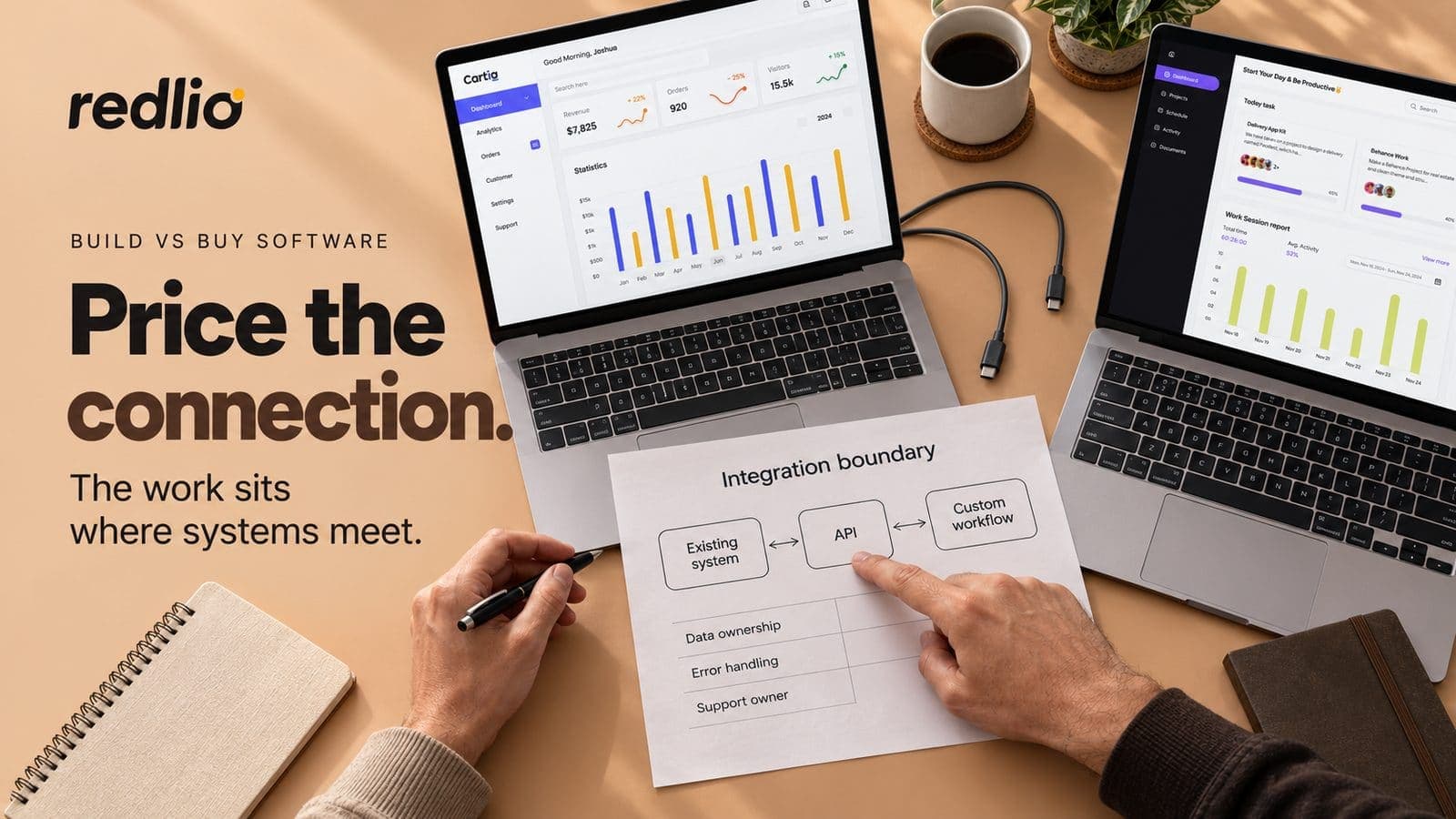
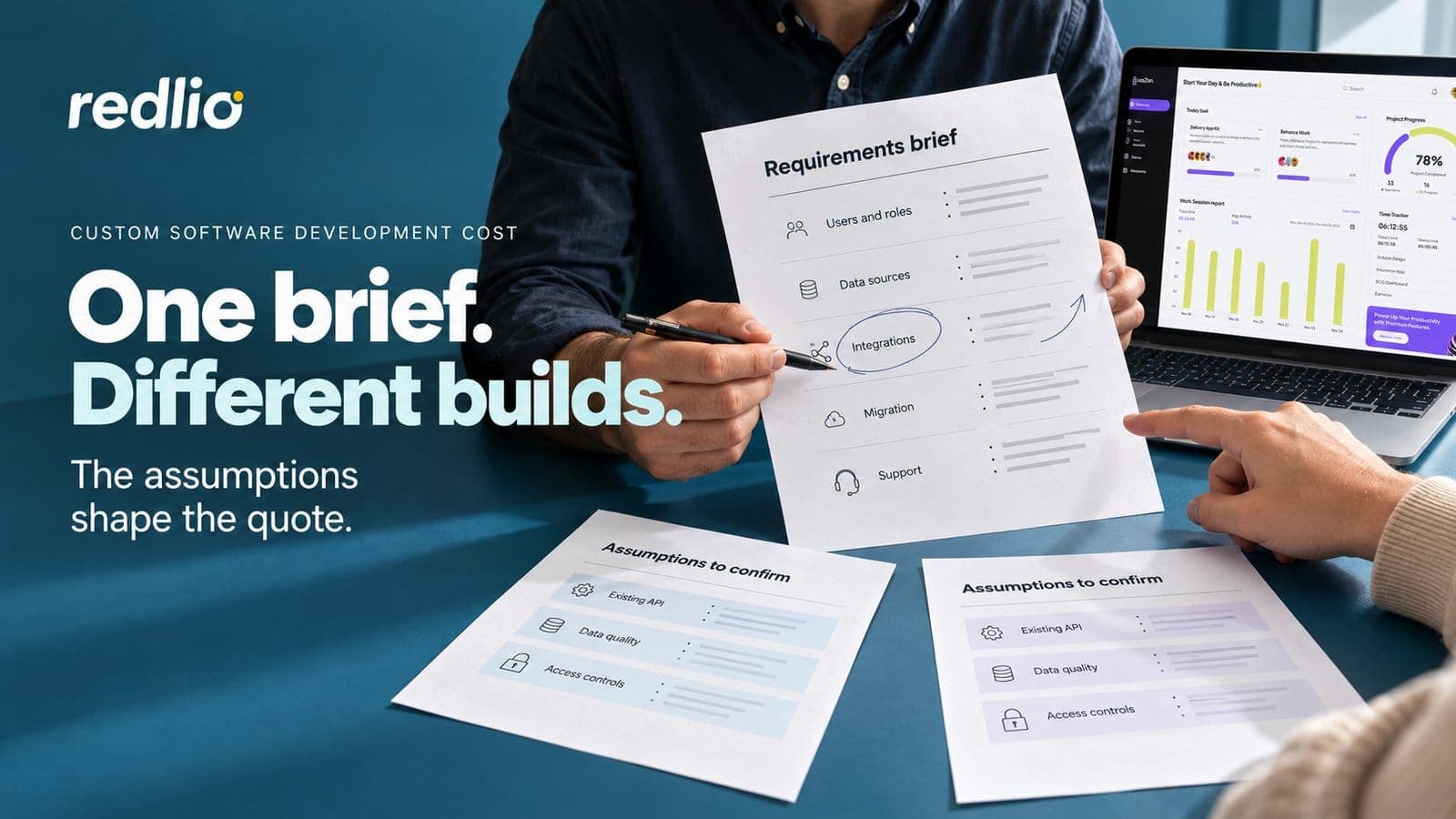
We scope that integration boundary before we price the build. Our proposal takes longer and everything after it moves faster, because the price you approve is for a fixed scope with the integrations already in it.
01The integration boundaryWe list every system that stays and who owns each one, so the quote covers every connection.
02The dataWe check what your export actually contains against what the schema promises, before migration is estimated.
03The exceptionsWe document the workarounds your team runs daily and never wrote down, so they are in the scope.
Our custom software development services
We deliver six kinds of custom business software development through one delivery process. Several engagements are two of them in sequence.
01
Custom business applications
Custom software application development fits a process that has outgrown spreadsheets, where an off-the-shelf product would need more configuration than code. We build the application around the workflow your business actually runs.
02
Enterprise platforms
We build internal platforms to hold up under enterprise load, security review and audit. Each one ships with the access controls and logging your governance team will ask for before go live.
We build ERP around how your business runs, whatever a packaged product expects of it. Finance, inventory, production and reporting come together in one place.
04
System integration and data migration
We build the APIs and data flows between your systems and migrate data from the platform being replaced. We reconcile the flows daily, so drift is caught in hours rather than at month end.
We replace aging systems in planned stages while they keep running. The work is sequenced so the business does not depend on a single switchover weekend.
06
Reporting and analytics
We build the dashboards and reporting layer that make your data usable. Each report is designed against the questions your leadership asks every month.
Custom software development case studies
Client projects are told from the client’s own review. Design work is shown as work, with no client result claimed.
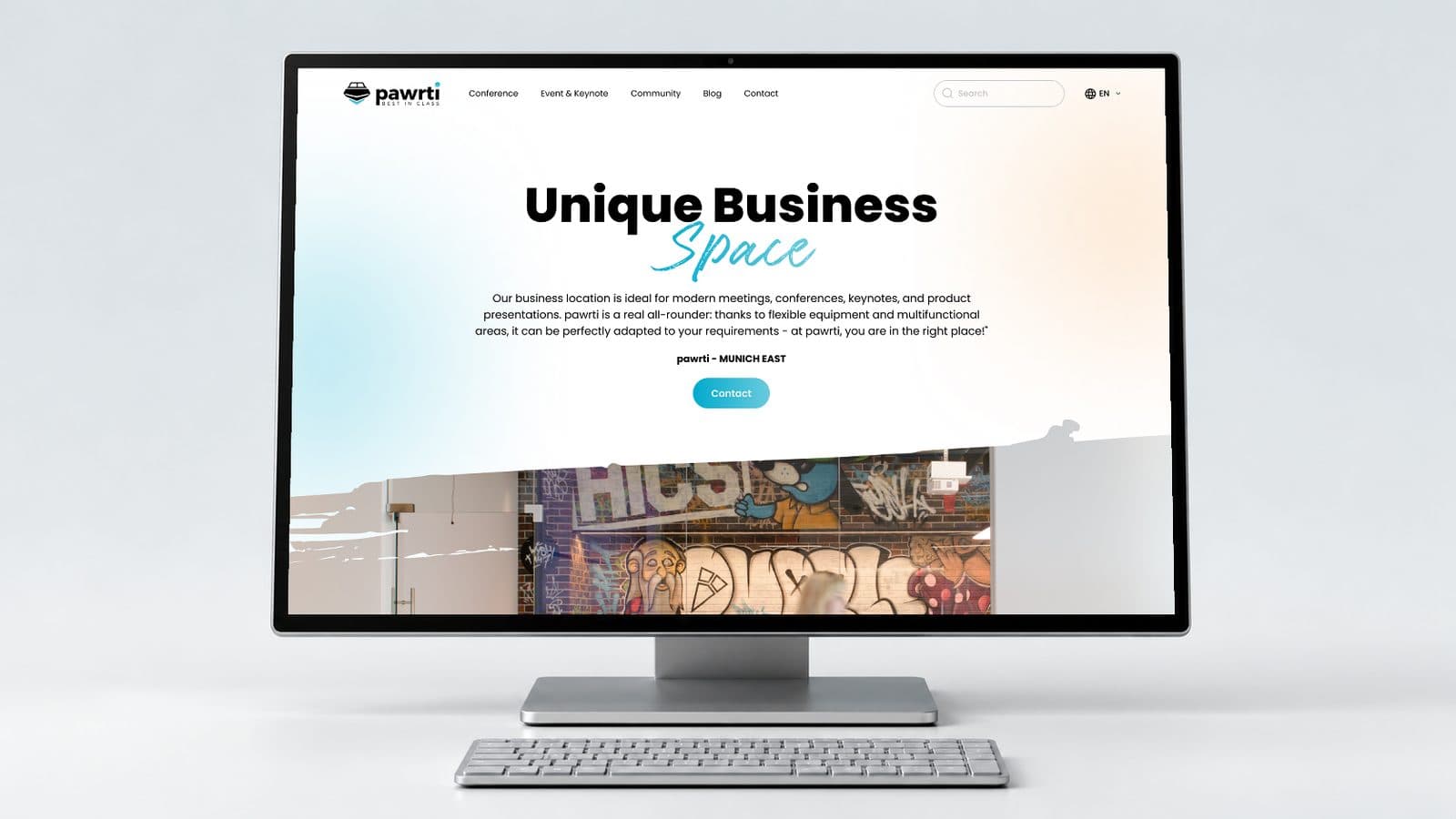
A new venue’s website and web services, scoped in stages before the build
A consulting firm in Munich was opening a business conference and event venue. It needed web services to present the venue and to manage it.
We did not start with a quote for a feature list. We started with three mockups so the firm could choose a direction, then a prototype, then short one-to-one sessions where its ideas were added while a change was still a conversation. Only then did five developers move to the responsive build.
Scope your custom software build with our engineers
We hold a 30 minute scoping call with the engineers who would build your system. We ask what it has to do, and we give a straight answer on whether we are the right fit.
Custom enterprise software development for large and mid-size organizations
We build for two kinds of enterprise buyer, and their concerns pull in opposite directions. A large organization needs a supplier that can pass its governance: a documented process, a stated compliance posture and continuity when one person leaves. A mid-size organization needs to know that its project gets the same senior engineers as the largest accounts.
We document architecture decisions, state our compliance posture at its honest strength, and measure continuity in years. The same engineers who work on our largest accounts work on yours.
Our custom enterprise software development services answer both the same way. We run multi-year work for organizations at the top of the market, and each client still talks directly to the people building its system.
When custom software is the wrong choice
Custom is not automatically the better option. We advise against building in three cases:
01
A mature product already fits
We recommend configuration when the process is close to standard and a proven platform covers it. It is cheaper to buy and cheaper to live with, and we have told buyers to go and configure the off-the-shelf option.
02
The process is still moving
We advise waiting when a workflow will look different in six months because the business is still deciding. Building it now fixes the wrong shape in code, so we ask clients to settle the process first.
03
Nobody internally owns it
Custom software needs one person on your side who can make decisions and sign off stages. Without that person the build drifts, whoever writes it. We advise naming them before asking anyone for a quote.
We recommend custom for the case nobody else can serve: the process that is genuinely yours, the integration nobody sells, and the system your competitors cannot buy.
How we deliver custom software, from scoping to production
Step 1 of 5
Discovery
We map your workflows, systems, and constraints with the people who use them every day, before anything is scoped.
Discovery
Workflow map
Systems inventory
Constraints and risks
Step 1 of 5
Step 2 of 5
Scope and plan
We write a scope, a timeline, and a price for that scope. Architecture decisions are made and documented before code starts.
Scope and plan
Written scope
Timeline and milestones
A price for that scope
Architecture decisions
Step 2 of 5
Step 3 of 5
Build in stages
Senior engineers deliver in planned stages, with working software demonstrated at every step, not a reveal at the end.
Build in stages
Planned stages
Working software every step
Senior engineers on the code
Step 3 of 5
Step 4 of 5
Launch
Data migration, training, and a production cutover planned around your operations and your calendar, not ours.
Launch
Data migration
Team training
Production cutover
Step 4 of 5
Step 5 of 5
Run and improve
The team that built your system stays on it: monitoring, support, and the next improvements on one roadmap.
Run and improve
Monitoring
Support
Improvement roadmap
Step 5 of 5
Why companies choose Redlio Labs for custom software development
01
Integrations priced before the quote
We scope and price the integration boundary before we quote the build. The price you approve is for a fixed scope, so change requests are the exception rather than the business model.
02
Senior engineers, directly
We put you in direct contact with the senior engineers building your system, from the first call. No account layer sits between you and the work.
03
Continuity in years
Our client relationships run past the first project. The engineers who build your system stay on it after launch, for support and the next improvements.
04
A compliance posture stated honestly
We peer-review releases and sign an NDA before your first call. We describe the practices we follow rather than borrow the name of a framework we have not been audited against.
Services that pair with custom software development
We also place dedicated teams that stay on a system for years. That is a different engagement from a fixed-scope build: Dedicated software development team
What custom software costs by Clutch’s 2026 data, what developers charge by the hour, what moves a system above the typical band, and the research on why quotes for the same brief differ so widely.
What one client who interviewed fifteen vendors chose on, why the usual checklist could not separate them, the three tests that can, and the eight questions to send every vendor in writing.
Is it better, or cheaper, to build or buy? The statistic the debate leans on, traced to its source. Then who publishes the advice, a real project that went custom, the boundary no comparison prices, and what it costs to change your mind.
We quote a custom software development cost only against a scope, and two line items decide most of it: data quality and the integration boundary. The boundary is every system that stays and has to connect. Migration estimates assume the old data is clean, and integration left as an allowance is where a fixed quote becomes an open one.
We scope that boundary before we price the build, and we advise asking every vendor to price integration separately, in writing, before comparing totals. Our guide to custom software development cost explains why quotes for the same system differ, and how to make them comparable.
How do you choose the right custom software development company?
We advise choosing a custom software development company by the systems it still has in production, more than by its launches. Four questions separate any custom software development agency or company quickly.
What have you built that is still running after five years? Who exactly will write our code, and will we speak to them? How is the integration boundary priced? What happens when scope changes mid-build?
The last one matters most, because the answer shows whether change requests are an exception or the commercial model. Our guide on how to choose a software development company covers the tests that separate vendors who all pass the usual checklist.
What is custom software development?
Custom software development is building an application around one organization’s process instead of adapting the organization to a product someone else designed. In our work it covers the workflow no packaged product serves, the integration nobody sells, and the reporting layer assembled from systems that were never meant to talk to each other.
When is custom software better than off the shelf?
We recommend custom software over off the shelf when the process is genuinely yours and configuring a product would cost more than building it. Where a mature platform covers the workflow, we advise buying it.
Custom earns its cost where the process is a competitive advantage, where the integration surface is unusual, or where license costs per user have outgrown the price of owning the software. Most organizations end up running both, and our build vs buy guide is about the boundary between them. The CRM is a common case, which our custom CRM development page covers.
How long does custom software development take?
We take a custom software build to production in stages rather than one release, so the date to ask for is when the first stage goes live. Discovery and scoping take weeks, not months. From there, we plan each stage to ship in months rather than years, which keeps a program cancellable without leaving a half-built system behind.
Who owns the source code of custom software?
We transfer ownership of the source code, the documentation and the architecture decisions to you, so you own the code. The handover is part of the engagement rather than a separate negotiation at the end.
Do you build custom software for regulated industries?
We keep the team that built your system on it after launch. We run monitoring, support and the next set of improvements on one roadmap, instead of handing them to a separate maintenance group that has to learn the system first.
Are you a custom software development company in India?
Yes, we build custom software from our office in Ahmedabad, India, for organizations in India and abroad. For clients abroad, the questions that matter are the working hours the team shares with theirs and who owns each decision. Our nearshore and offshore comparison works out the shared hours by region.
Request a scoping call for your custom software build
Tell us what the system has to do and which systems it has to live with. We give you 30 minutes with the engineers who would build it, and a straight answer on fit. We reply within 12 hours.
We reply within 12 hours
You talk to the people doing the work, never an account manager




 Read the review on Clutch

 Mayursinh Jadeja