Logistics software development
Logistics software built for the exceptions
Any system can move a shipment that goes to plan. Operators judge logistics software on the ones that do not: the partial delivery, the missed pickup, the status message from a carrier that arrives two days late. We design for those first.
- Peer-reviewed releases
- NDA before your first call

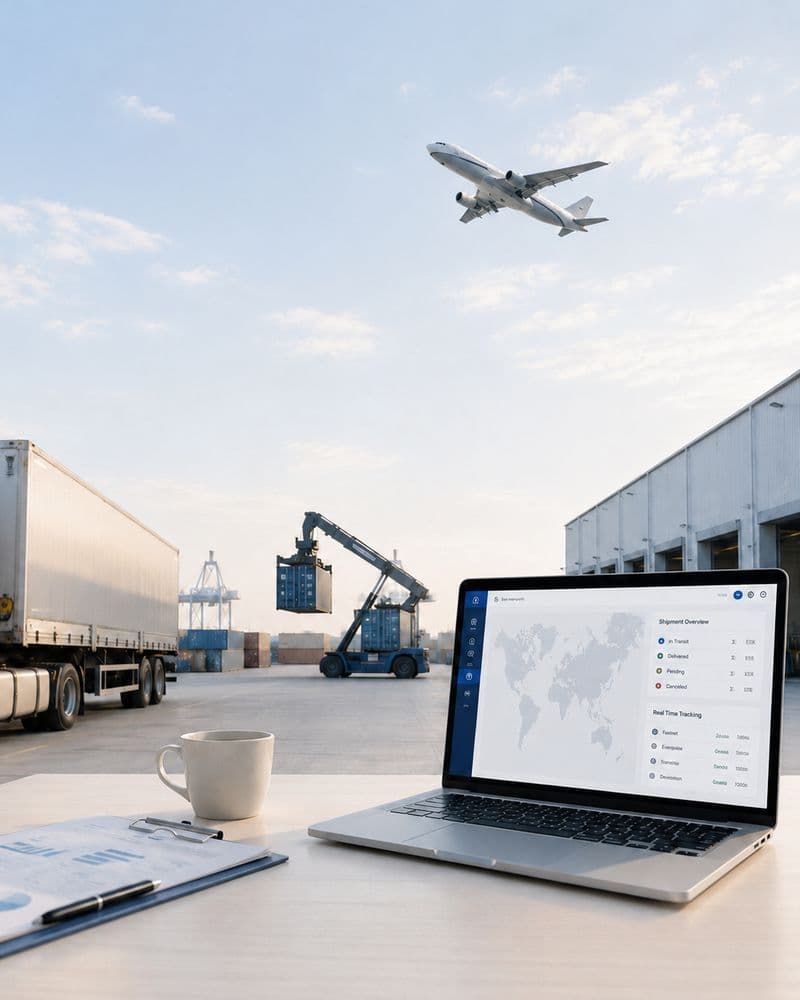


The happy path is the easy tenth
Most logistics software demos well. A shipment is created, tracked and delivered, and the dashboard turns green. Then it meets a real week: a pallet split across two trucks, a delivery refused at the door, a carrier that reports status by email, a warehouse that ran out of the item after the order was promised.
Operators then do what they always do. They keep a spreadsheet beside the new system, and the spreadsheet becomes the real one. The software is not wrong, it simply was never designed for the situations that take up most of their day.
We start logistics work by listing those situations with the people who handle them.
- 01
The exceptions
Every way a shipment, an order or a stock count can go off plan, and who handles it.
- 02
The partners
Every carrier, warehouse and customer that sends or needs data, and in what format.
- 03
The operators
The dispatchers, drivers and warehouse staff who must trust the system more than their spreadsheet.
What we build
Logistics software we develop
Six kinds of system, alone or connected to the platforms you already run.
- 01
Transportation management (TMS)
Load planning, carrier selection, tendering, tracking and freight audit, built around your lanes and your carriers.
- 02
Warehouse management (WMS)
Receiving, put-away, picking, packing and cycle counts, with the stock position you can promise from.
- 03
Dispatch and fleet tools
Assignment, routing, driver apps and proof of delivery, connected to telematics where you have it.
- 04
Customer and partner portals
Booking, tracking, documents and invoices for customers and 3PL partners, so fewer questions arrive by phone.
- 05
Order and inventory management
One view of orders and stock across warehouses, channels and suppliers.
- 06
Freight billing and reconciliation
Rating, invoicing and matching carrier invoices against what was agreed and delivered.
Integration
The systems a logistics build has to talk to
Logistics runs on other people’s data. These are the usual counterparts and the standard each one speaks.
| Counterpart | Usual standard | What goes wrong |
|---|---|---|
| Carriers and freight partners | EDI X12 (204 tender, 214 status, 210 invoice), carrier APIs | Status messages that arrive late, out of order, or not at all |
| Customers and retailers | EDI (850 order, 856 ship notice), APIs, portals | Each large customer with its own variation of the same standard |
| ERP and accounting | APIs, scheduled files | Orders and invoices that exist in one system before the other |
| Telematics and ELDs | Vendor APIs | Position data that is accurate but not in time to act on |
| Warehouse automation | Vendor interfaces for scanners, conveyors, robots | Hardware that keeps working while the software disagrees about the stock |
Integrations with partners deserve to be built first, not last. They take longest to test, and they are where the exceptions come from. That is how we run every custom software development project: integrations scoped and priced first.
Before you build
Exceptions to design before the first route
Seven situations to agree how the software handles, in writing, before any vendor builds it, including us. Each one is ordinary in logistics and expensive when it is left to a spreadsheet.
- 01A shipment split across several vehicles, or several shipments consolidated into one.
- 02A delivery refused, partly delivered or delivered damaged, and how the return is created.
- 03A partner’s status update that arrives late, twice or never.
- 04A stock count that disagrees with the system, and who is allowed to correct it.
- 05A re-route after pickup: new address, new carrier, or a missed connection.
- 06A carrier invoice that does not match the rate, the weight or the delivery that happened.
- 07A driver or warehouse device that goes offline mid-task, and how its work syncs back.
Every one of these will happen in the first month. The only question is whether the software handles it or a person works around it.
Rules, explained
What each rule changes in the build
Logistics is regulated in patches: by mode, by country and by what is being carried. These are the rules that most often shape the software.
- 01
Electronic logging devices (US)
Most US commercial drivers must record hours of service on a registered ELD. Dispatch software should read that data, not ask drivers to enter it twice.
- 02
EDI mandates from large customers
Many retailers and manufacturers require their suppliers and carriers to trade by X12 EDI. Their implementation guides, not the base standard, decide what your system must send.
- 03
Customs and trade documents
Cross-border shipments need the right documents and data in advance. Build them from the shipment record rather than retyping them into a separate tool.
- 04
Dangerous and controlled goods
Hazardous materials, cold chain and controlled goods add documentation and handling rules. The system should know what it is carrying and refuse the wrong combination.
Proof
Rated by the clients who have worked with us
Logistics is one of the sectors we have shipped systems into. We name clients only with their written permission, so our reviews live on Google and Clutch, where we cannot edit them.
When to buy a platform instead
Mature logistics software exists. Three cases where you should use it:
- 01
Your operation is standard
If a proven TMS or WMS fits your lanes, volumes and processes, configure it. Its carrier connections alone are worth years of work.
- 02
The gap is one integration
If the platform works but one partner or one report does not, build the integration or the report, not a new system.
- 03
You cannot support it at 3am
Logistics runs around the clock. If nobody can own the software out of hours, a supported platform is the safer choice.
Custom work pays where your exceptions, partners or service model are what set you apart, and off-the-shelf products keep pushing them back into spreadsheets.
How we work
From exceptions to a system operators trust
The same five stages we use for every engagement, with notes where logistics changes a stage.
Discovery
We map your workflows, systems, and constraints with the people who use them every day, before anything is scoped.
For logistics: time on the floor with dispatchers and warehouse staff, and every partner’s data format collected.
Scope and plan
You get a scope, a timeline, and a price that hold. Architecture decisions are made and documented before code starts.
Build in stages
Senior engineers deliver in planned stages, with working software demonstrated at every step, not a reveal at the end.
For logistics: partner integrations first, tested with real messages from each partner.
Launch
Data migration, training, and a production cutover planned around your operations and your calendar, not ours.
For logistics: go-live by site or lane, with the old process running until the new one is trusted.
Run and improve
The team that built your system stays on it: monitoring, support, and the next improvements on one roadmap.
FAQ
Questions buyers ask about logistics software development
What is logistics software development?
Building software that plans, moves, stores and tracks goods: transportation and warehouse management, dispatch and fleet tools, order and inventory systems, portals, and freight billing, integrated with carriers, customers and ERP.
What types of logistics software are there?
The main families are transportation management (TMS), warehouse management (WMS), fleet and dispatch, order management, inventory management, customer and partner portals, and freight audit and billing. Many operations need two or three working together.
How much does custom logistics software cost?
It depends on the number of partner integrations, the sites and devices involved, and how many exceptions the system must handle. We do not publish prices; our guide to what decides custom software cost explains the drivers.
How long does it take to build logistics software?
A focused tool, such as a customer portal or a dispatch app, can take a few months. A TMS or WMS takes longer, and most of the time goes on partner integrations and rollout across sites. We give a timeline after discovery.
Can you integrate with our TMS, WMS or ERP?
Yes, through APIs, files or EDI. Often the right project is not a new system but a better connection between the ones you already run.
Do you support EDI?
Yes. We work with X12 and EDIFACT messages and each trading partner’s implementation guide, which is where most of the real rules live.
Should we build custom or buy a TMS or WMS?
Buy when your operation is standard and a platform fits. Build, or extend, when your exceptions, partners or service model are what make you different. Our build vs buy guide covers the decision in depth.
Who owns the code and the data?
You should own both, written into the contract before the work starts, along with the partner connections and credentials.
Start with the exceptions,
then the routes
Tell us what goes wrong in a normal week and which partners you exchange data with. We will map the exceptions and the integrations before we estimate.