Staff augmentation vs dedicated teams, and how each one fails
Staff augmentation vs dedicated teams comes down to who directs the work each day: your own leads in augmentation, the team itself in a dedicated team. Augmentation fails when you have no direction to give, and a dedicated team fails when nobody on your side stays close enough to steer it.


The question that is not in the proposal
Any proposal for outside engineers can be sorted with one question, and it is rarely in the proposal: each morning, who decides what these engineers work on? If the answer is your own tech lead, you are being offered staff augmentation. If it is a lead the supplier provides, you are being offered a dedicated team. The headcount, the rates and the adjectives can be identical in both.
The question is more use than the label, because the labels are not standardized. One supplier sells an extended team or a team extension. Another calls the same thing a dedicated team, a managed team or a squad. The same phrase means different things at different companies.
Ask who sets the priorities each morning and who the engineers report to. The answer places any proposal on one side of the line, whatever it is called.
Both sides of the line work, and serious organizations use both well. They fail in opposite directions. Augmentation fails when you can absorb the capacity but have no direction to give it. A dedicated team fails when you have direction to give but no one close enough to give it. Choose the model whose failure your organization is equipped to prevent.
We checked what a buyer finds when they search for this comparison. Google returned nine pages for “staff augmentation vs dedicated team” on October 9, 2026, and eight of them opened. Seven of the eight are published by companies that sell one or both models. Only one says so in the text, and it says it as a sales line rather than a caveat.
Two publish an hourly rate, and neither names a source for it. Four say you can switch from one model to the other later. None says what switching costs or how it works, and none mentions worker classification or co-employment.
We are one of those sellers. We offer both models, as IT staff augmentation and as a dedicated software development team. We want you to buy one of them, and we gain nothing by steering you to either. The rest of this page takes the possible answers to the question in turn, then covers what those eight pages leave out.
Staff augmentation vs dedicated teams, side by side
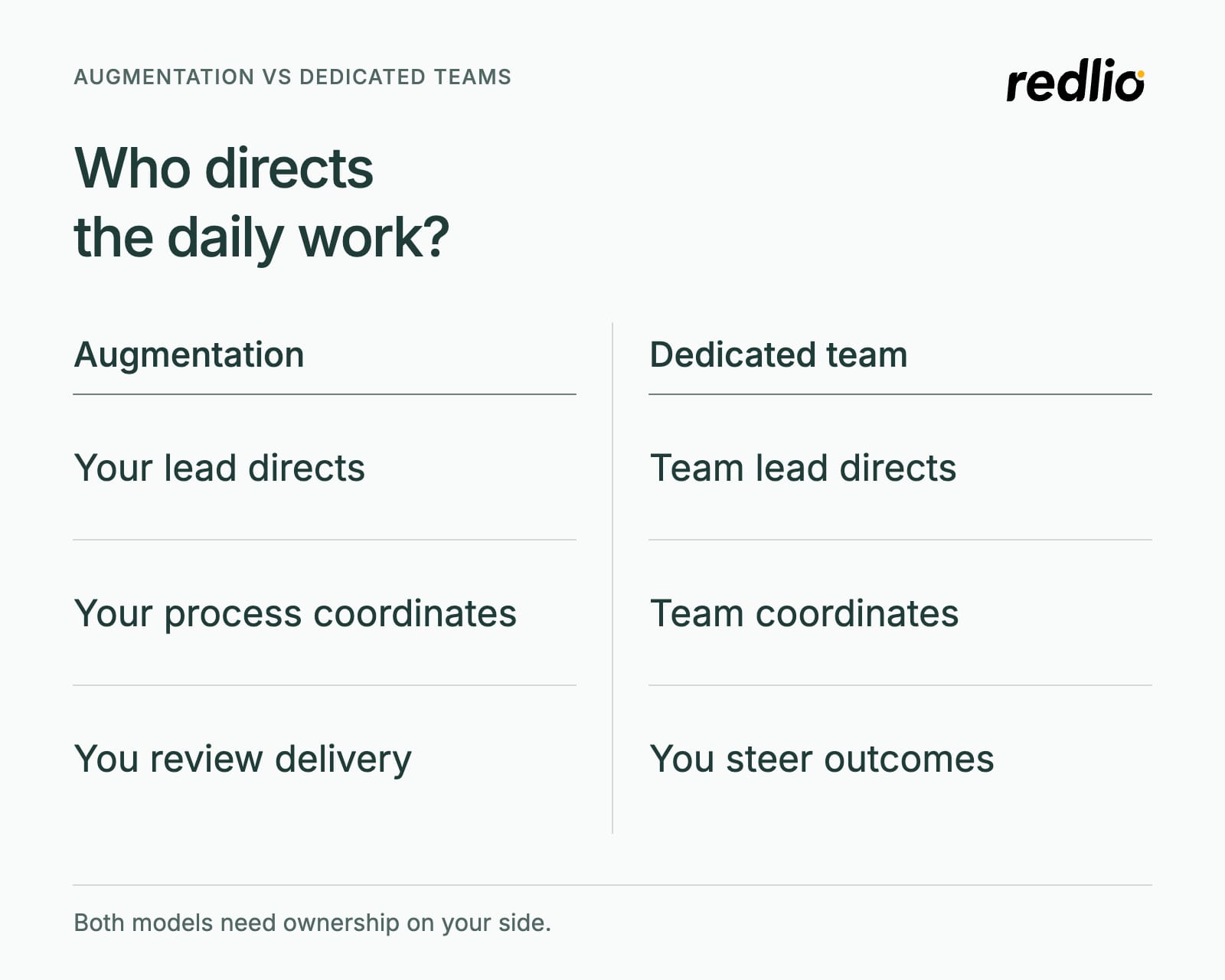
Staff augmentation means adding individual engineers to your existing team. They join your standups, work in your codebase to your standards, and take direction from your tech lead. You are adding capacity to a machine you already run, which is why it is also sold as team augmentation.
 (opens full size in a new tab)
A dedicated team means a unit with its own lead, its own ceremonies and its own internal coordination. It takes ownership of a workstream and reports on outcomes. The coordination happens inside the team rather than on your calendar.
So augmentation gives you capacity that you direct, and a dedicated team gives you ownership that you steer. The management load, the ramp, the accountability and the way each one fails all follow from that.
| Dimension | Staff augmentation | Dedicated team |
|---|---|---|
| Who directs the work daily | Your tech lead or manager | The team lead, against outcomes you set |
| What you are buying | Capacity that meets your bar | Ownership of a workstream |
| Where coordination happens | On your calendar, in your process | Inside the team, surfaced in reporting |
| Management load on you | Highest. Review, direction and unblocking are yours | Lower, never zero. Someone still sets priorities and reads the reports critically |
| Ramp shape | Faster to start, because one person joins a working system | Slower to start, faster later, because the team keeps the context it builds |
| When someone leaves | Their context leaves too, unless your process captured it | The team absorbs it, which is much of what you pay the model for |
| Accountability for outcomes | Yours. You directed the work | Shared, and only real if the outcomes were defined well enough to judge |
| Best engagement length | Short to medium, where the need has a visible end | Long, where context is expensive to rebuild |
| What scaling looks like | Add or remove individuals quickly | Grow or shrink a unit deliberately, with more notice |
| What you hold at the end | The code, and whatever your process captured | The code, plus documentation and handover if you contracted for them |
Two rows deserve a second look. Most comparison pages soften the management load row, and it decides most engagements. Hardly any page covers the last row. What you hold when the engagement ends depends on the contract and not on the model, so settle it before you sign.
When the answer is your own lead
When your own lead directs the engineers, you are buying capacity, and it works when you already know what you want built. The clearest case we have is an agency’s overflow work. A digital marketing agency had more design work than its own people could take on. One of its clients needed a complete website redesign, and the agency already knew what that redesign had to be. It brought us in for the overflow.
It worked because of what the agency brought. The agency had a spec. People who knew their client had decided what the redesign had to be before the work reached us. Our job was capacity, which meant doing that redesign to that spec, quickly. The agency later told Clutch the work was completed to spec, fast, and that we were always available when they needed us.
Without the spec, the same arrangement would have failed. Suppose the agency had handed over a client who “needs a new site”, with no one free to decide what that means. The people and the skills would have been the same and the result very different. The missing thing would have been direction, and augmentation does not supply it.
That is how staff augmentation fails in general. Your leads cannot give direction fast enough, so capable engineers wait or guess. The engineers are usually good. They have nothing decided enough to build.
Augmentation moves capacity. Direction, prioritization and decisions stay with your leads, who were usually the constraint in the first place. Say three augmented engineers are waiting on the same overloaded tech lead for the answer to the same design question. You have turned a hiring problem into a queueing problem, and you are paying for the queue.
You can usually see it coming. Tickets are written thin, because the person who could write them properly is the bottleneck, so engineers guess and half the guesses need rework. Pull requests sit unreviewed for days, and the review that finally happens is shallow, because it is done at the end of a long day.
Then engineers start picking work by what is unblocked rather than what matters. It looks like velocity, but it is not progress. The new engineers are visibly capable and visibly underused, and the plan does not show it.
So check two things before signing. Is there a named person with real weekly bandwidth to direct these engineers, and not one who is already the bottleneck? And is your process written down well enough that somebody can join it: code review, branching, a definition of done and an onboarding path? If either answer is no, more capacity makes the constraint worse.
The bandwidth test is simple. Does that person have protected time each week to write clear tickets, review pull requests properly and answer design questions within a day? Resist turning it into a ratio of engineers per lead, because the constraint is the lead’s attention. Gallup’s January 2026 analysis of span of control compared engagement across team sizes. It held at roughly seven in ten where people got meaningful feedback, and fell to about one in four where they did not.
The prerequisite people underestimate is documentation. In a survey of 411 professional developers at Microsoft, 267 named missing project documentation as the thing that slowed their first contribution, at a significance level below 0.001. Whichever model you choose, an undocumented onboarding path is the cost you pay first, and pay again with every new person. Ask whether a competent stranger could make a meaningful change in their first week without interrupting anyone. If not, fix that before adding people.
One more cost belongs to this answer. In augmentation the context lives in individuals embedded in your team, and it leaves with them. A study of turnover at Chrome and a project at Avaya found projects exposed to knowledge losses more than three times larger than the expected loss. It also found that simple bus factor estimates exaggerate the danger, and that naming successors in advance cut the expected loss by up to fifteen percent. So name successors early, and do not panic about single points of failure.
When the answer is the team’s lead
When a lead the supplier provides directs the engineers, you are buying ownership of a workstream. A dedicated team fails when no one on your side stays close enough to steer it, so the work drifts from your architecture while the reports stay green. The team is rarely lazy. It makes reasonable decisions, and no one is near enough to say they are wrong for you.
A dedicated team is designed to take load off your side, which is what makes it dangerous when your side steps back. The reports arrive, the demos work and the burndown looks healthy, while the architecture drifts away from yours. The bill comes at integration, months later, which is the most expensive moment for it to arrive.
The signs are different from augmentation’s, and easier to miss because they look like good news. Status reports have been green for several periods in a row, which says more about the reporting than about the project. Demos show the happy path, and the questions afterwards are about the interface, not the data model.
Decisions that should have been yours get made by default, because no one was available when they needed making. Your own engineers start calling it “their part of the system”. By then it has stopped being one system.
The prevention is a named owner on your side whose job includes reading the reports sceptically and asking the second question. A project manager collecting status will not do. The owner has to know the system well enough to notice when an answer is technically true and practically wrong. The team stays, which is what you pay the model for, but it only stays useful while that owner stays engaged.
Two more things have to be true before a team can own anything. The work can be carved out, because a team cannot own what cannot be separated from yours. And the outcomes are defined well enough to judge, because vague outcomes make the reporting meaningless. You still direct, at the level of priorities and outcomes rather than tasks. Of the three conditions, the skeptical reader is the hardest to supply.
If this is the answer that fits, our guide to hiring a dedicated team covers the decisions to make before any vendor is on the call.
When the answer is both
Run both by giving every workstream exactly one owner, with a dedicated team at the core and augmented engineers at the edges. When we read eleven comparison pages in July 2026, six recommended combining the models and none described how. The arrangement we recommend is a dedicated team owning a workstream end to end. Augmented engineers are added at the edges for capacity that has a visible end, such as a migration, a seasonal push or a specialty needed for one quarter.
The rule that holds it together is one owner per workstream, never two. A blended arrangement fails in its own way. The team assumes the augmented engineers are handling a piece of work, and the augmented engineers assume the team owns it. On the day someone needs it, it does not exist.
Write down which workstreams belong to the team, which capacity is augmented, and who arbitrates where they touch. It takes an hour, and it prevents the one failure that only happens when you run both.
When the answer is no one
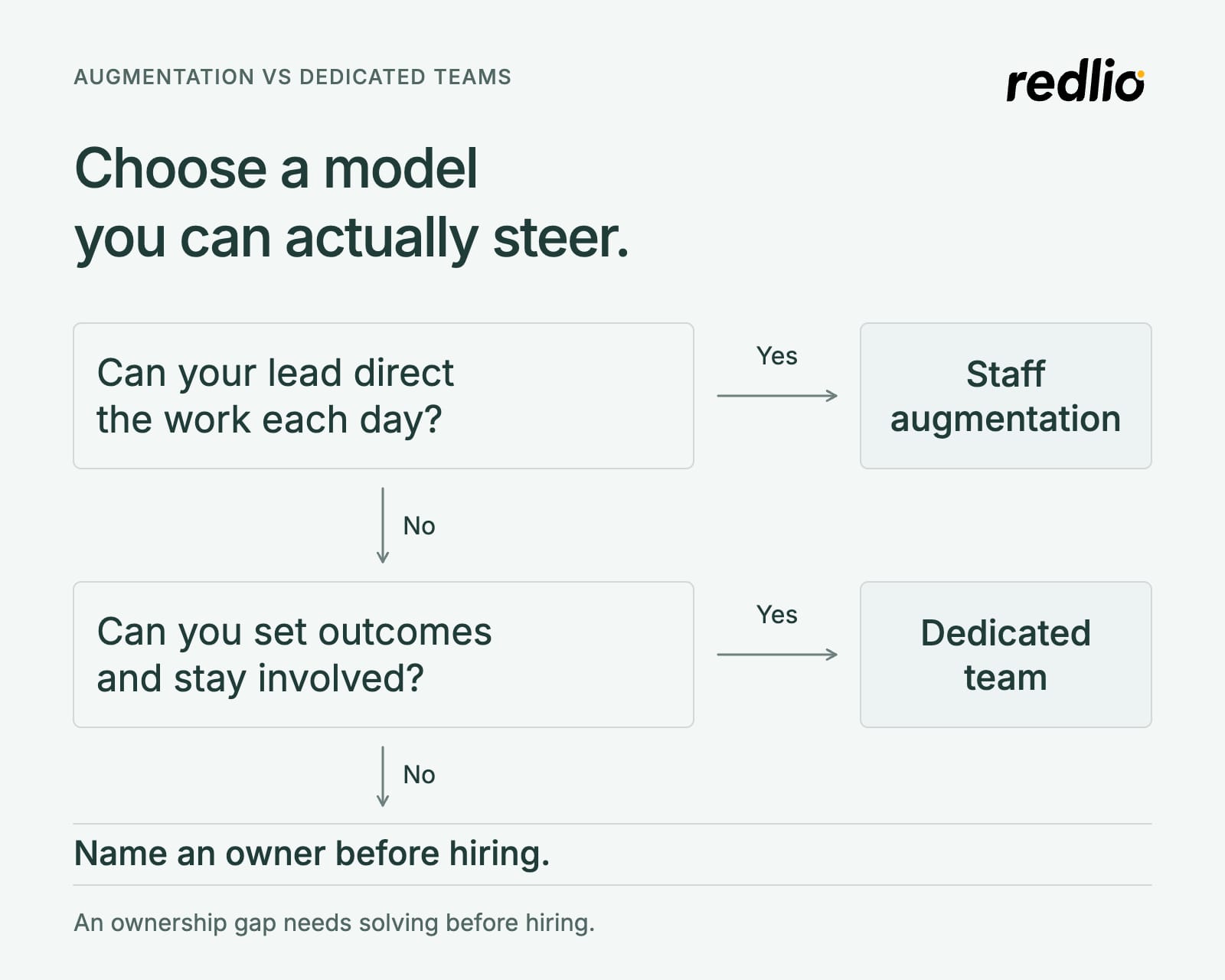
If no one inside can own the work in either shape, neither model fits. An ownership vacuum is the one prerequisite no supplier can provide, and it needs solving before you buy anything.
 (opens full size in a new tab)
Two other cases look like a staffing question and are not. If the outcome is definable and you want one price for it, that is a fixed-scope build. Buying it as capacity means carrying management you did not need. If you need one specialist for two or three weeks, that is a contractor, and wrapping it in a program adds overhead to a problem that had none.
Where one of the two models does fit, the test is usually short. If you have direction to give and the bandwidth to give it, augmentation turns that into output efficiently. If you do not, you are buying a team. Buy it on purpose, before you discover the need eight weeks in.
What the research supports, and two figures it does not
Sorting by who directs and owns the work is our judgment, and it has measured support. Who owns the work predicts its quality better than where the work is done. The same reading turned up two figures this market repeats without a source.
The ownership result is old, so weigh it accordingly, though nothing we have read since contradicts it. Microsoft researchers studied Windows Vista across 3,404 binaries and more than fifty million lines of code. They found that organizational structure predicted which components would fail after release, with 86.2 percent precision and 84 percent recall. That beat code churn, complexity, dependencies, code coverage and pre-release bug counts. The measures that carried the signal included how many separate organizations touched a component, and whether any single one owned most of the edits.
Fragmented ownership and diffuse direction show up later as defects, more reliably than anything about the code itself. Both models can produce clear ownership, and both can destroy it.
A companion Vista study found distributed teams produced about ten percent more post-release failures than co-located ones. The difference became negligible once team size was controlled for.
Vendors quote this as proof that distributed delivery is equivalent. The authors did not claim that. Vista was built entirely inside Microsoft, and they contrast that deliberately with outsourcing, which involves several companies. The study shows geography was not the problem inside one organization. It says nothing about vendor boundaries.
An older study points at the mechanism. At a large telecoms company, Herbsleb and Mockus found work items spread across sites took about two and a half times as long as similar items done in one place. The cause was the number of people involved rather than the distance. The multiplier is dated. The mechanism still applies, because every extra hand-off costs time in either model.
That leaves the two figures. You will meet a claim that a quarter of outsourcing relationships fail within two years and half within five, usually credited to a business information firm. We went looking for the original. Every citation leads to another vendor blog, and no publication with that name, method or sample is reachable. Treat it as folklore.
The same goes for the confident figure that an engineer takes three to nine months to reach full productivity. The research that measured ramp-up at Microsoft anonymized its time unit, so no absolute duration was ever published. The researchers say only that new hires take several weeks or months.
Staff augmentation vs managed services, consulting and time and materials
Buyers often treat these three as alternatives to the two models here. Only one of them is.
Time and materials describes how you pay and leaves open how the work is organized. You pay for the hours or days actually worked rather than a fixed price for a defined result.
Staff augmentation is almost always billed this way, per person, by the hour or the month. A dedicated team is usually billed by the month for the team. A project with a defined scope can be priced as time and materials too. So “T&M or staff augmentation” is the wrong pair to compare. Ask who directs the work, and then how you pay for it.
Managed services is the genuine third model. The provider is accountable for an outcome, usually against a service level with credits if it is missed, and decides how the work gets done. Staff augmentation supplies people you direct.
A dedicated team sits between the two. It is more self-directing than augmentation, but it is engaged on a workstream and its outcomes rather than on a contractual service level. If what you want is a guaranteed operational metric, you are shopping for managed services.
The governance gap between these is measurable. In Deloitte’s 2024 Global Outsourcing Survey, only 34 percent of organizations said they had a strategy for third-party staff augmentation, against 55 percent for managed services. Augmentation is the least governed way most companies buy engineering. Deloitte sells sourcing advice and publishes no sampling frame, so read that directionally.
Consulting buys judgment. Someone tells you what to do, and usually leaves before it is done. Augmentation buys execution under your direction, so someone does what you have already decided.
Confusing them costs you either way. If you buy augmentation when you needed strategy, capable engineers build the wrong thing efficiently. If you buy consultants when you needed hands, you get a recommendation with no capacity behind it.
The questions your legal and security teams will ask
Expect questions on worker classification, intellectual property and access control, and expect them to be harder in augmentation, where your people direct the supplier’s engineers. None of the eight pages we read mentions classification or co-employment. For a large organization these are the questions that stall a contract, so raise them before procurement does.
The line the two models sit either side of is a legal one as well. The first of the common law tests the US Internal Revenue Service applies to worker classification is behavioral control. It asks whether the company controls, or has the right to control, what the worker does and how they do it. Whatever your jurisdiction, that is the same line, which is why the choice has consequences beyond the work.
We are engineers, not lawyers, so the next four are for your own counsel. How is the engagement classified in each jurisdiction involved, and who carries the risk if that classification is challenged? Does the day-to-day direction that defines augmentation create co-employment exposure where you operate, and does that change the model you should pick?
Where does intellectual property assign, and through what chain, when the engineer is employed by a supplier and directed by you? And what non-solicit and conversion terms apply if you later want to hire someone permanently?
The security questions are ours to answer, and any supplier should answer them concretely:
- Do the engineers sit inside your identity provider or the supplier’s, and which directory governs access?
- Whose hardware, under whose device management, with what disk encryption and screen lock policy?
- Who runs background checks, to what standard, and will you see the attestation?
- What can be cloned, and from where? Repository access is the one people forget until offboarding.
- What happens on the first day after an engineer leaves, written as a revocation checklist rather than a promise?
A supplier that answers these readily is showing you how it operates. Be more careful with one that has never been asked them.
What switching between them actually costs
Switching costs you two notice periods running at once, a second ramp, a commercial reset and whatever context was never written down. Organizations do outgrow a model, and switching is often the right call. Four of the eight pages we read say you can switch, and none says what happens next.
Start with the notice periods, which rarely match. Augmentation usually ends per person on short notice. A team engagement ends as a unit on a longer one. You run the outgoing arrangement through its notice while the incoming one starts, so for a while you pay for both. Read both clauses before you decide.
The commercial terms reset too. You renegotiate rates, minimums and the shape of the agreement from a weaker position than the first purchase, because the timeline is now urgent. If a conversion fee applies to hiring an engineer permanently, that is a separate clause, best settled at the start.
The real cost is the context that does not transfer. You keep the code and lose the reasoning behind it: why that exception exists, which customer depends on the odd behavior in that module, what was tried and abandoned. That loss is almost never in the plan.
That loss is why you pay for the ramp twice. The incoming arrangement starts with no context on a codebase that is now larger and less documented than when the first one began. Budget the second ramp as longer than the first.
Direction is thinnest during the changeover itself, when the old arrangement is winding down and the new one has not earned its context. This is where most of the damage happens, and the only defense is a named owner on your side who holds continuity across the boundary.
Two things soften all of this. If particular engineers have been productive, ask early whether they can carry across rather than assuming the switch replaces everyone. Continuity of individuals is often negotiable, and it is worth more than the rate difference that prompted the switch.
The other is what gets written down before anyone moves. That means runbooks, environment access, the deployment path and the history of any decision that is not obvious, plus a handover session while the outgoing engineers are still engaged. If the handover is not in the contract, it will not happen, because no one is paid to do it.
The same thinking applies to a single engineer who is not the right fit. Any serious supplier replaces them, and the terms belong in writing before you start. Those terms are the window in which a replacement costs you nothing, how quickly a candidate is presented, and who absorbs the new person’s ramp. Ask about the handover between the outgoing and incoming engineer too, because a replacement who starts from zero is a cost you carry.
None of this makes switching a mistake. It does cost more than those pages imply. Read both notice clauses, contract the handover and name the owner on your side before you move.
If you have two proposals and cannot tell which side of the line each one sits on, send us both, and tell us who on your side would direct the work. You will hear back inside 12 hours. Because we run both models, the people who would do the work can tell you on a 30 minute call which one your side of the table can support. Sometimes that is neither, and we will say so.
Questions buyers ask
What does staff augmentation mean?
Staff augmentation means adding engineers from a supplier to your own team for a period. They work in your codebase and your process and take direction from your leads, while the supplier employs them. You get capacity quickly, and the management load stays with you.
What does a dedicated team mean?
A dedicated team is a group of engineers, with its own lead, that works only on your product and takes ownership of a workstream. It coordinates itself and reports to you on outcomes you set. It ramps more slowly than augmentation but keeps its context across a long engagement.
What is the difference between T&M and staff augmentation?
Time and materials is a pricing model: you pay for the hours or days worked rather than a fixed price. Staff augmentation is an engagement model: supplier engineers working under your direction. Augmentation is usually billed as time and materials, but a project or a dedicated team can be billed that way too, so the deciding question is who directs the work.
What is the difference between staff augmentation and managed services?
Staff augmentation supplies people you direct. Managed services supplies an outcome the provider is accountable for, usually against a service level with credits attached, and the provider decides how the work is done. A dedicated team sits between them: self-directing, but engaged on a workstream rather than a contractual service level.
Which is more cost-effective, staff augmentation or a dedicated team?
Neither in general, and a comparison of rates alone misses most of the cost. Add the management time each model takes from your leads, the ramp at the start, and the rework when direction arrives slowly. Augmentation tends to win where you have direction to give and a need with a visible end; a dedicated team tends to win over long engagements where context is expensive to rebuild.
Can I switch from staff augmentation to a dedicated team later?
Yes, and it is often the right move, but it is not free. Expect two notice periods that rarely match, a second ramp on a larger codebase, a commercial renegotiation under time pressure, and the loss of whatever the outgoing engineers never wrote down. Contract the handover and keep one named owner on your side across the changeover.
The author