Software development contract clauses for the day things go wrong
A software development contract decides who owns the code, what counts as finished and how you leave. The ownership clause needs the most care. Code from an outside company is not a work made for hire under US law, and when the developer is in India, Indian law fills in what the assignment leaves out.

The advice every contract guide gives first
Every guide to a software development contract opens with the same advice: make sure the contract says you own the code. The advice is right. The sentence written to carry it often does less than the buyer expects.
On November 17, 2026 we read ten pages that a US web search returned for “software development contract” and “custom software development contract”. Template sites, law firms and development companies wrote them. None explains that custom code from an outside company cannot be a work made for hire under US law, and one recommends labelling it that way. None mentions that the developer’s own country has rules for what an assignment must say, or what happens when it says nothing.
The same pages are thin on the day the work ends. One of the ten says the buyer should receive the repositories, documentation and credentials at handover. The same page is the only one to cover the terms a supplier needs when it handles personal data. None discusses deemed acceptance, and none cites research on fixed price against time and materials, though real contracts have been studied.
We sign these contracts from the other side. Redlio Labs is a software development company in Ahmedabad, and our clients are in the US, the UK and Europe. That gives us a stake in what your contract says, and a view of where contracts break. Nothing here is legal advice. The statutes are quoted and linked, ready to check and to take to your own lawyer.
Why a work made for hire clause does not make the code yours
Under US law, software that an outside company builds for you is not a work made for hire, whatever the contract calls it. Ownership moves to you only through a written assignment signed by the company that owns it.
The definition is in 17 U.S.C. §101. A work made for hire is either made by an employee within the scope of the job, or specially commissioned in one of nine categories. They are a contribution to a collective work, part of a film or other audiovisual work, a translation and a supplementary work. The others are a compilation, an instructional text, a test, answer material for a test, and an atlas. Computer programs are not among them.
The US Copyright Office spells out the consequence in Circular 30, revised in August 2024. A commissioned work has to meet four conditions, and the category is one of them. A work that fails any of them is not a work made for hire. Whether someone counts as your employee is decided by the common law of agency, as the Supreme Court held in Community for Creative Non-Violence v. Reid in 1989. A development company’s engineers are its employees, not yours.
So the clause that does the work is the assignment. Under §204(a), a transfer of copyright is not valid unless it is in writing and signed by the owner of the rights or its agent. Well-drafted contracts say both things: the work is made for hire, and to the extent it is not, the developer assigns it to the client. For software, the second half is the one that holds.
UK law reaches the same place by a shorter route. Section 11 of the Copyright, Designs and Patents Act 1988 makes the author the first owner, with an exception for employees and none for commissioned work. Section 90(3) says an assignment is not effective unless it is in writing and signed by or on behalf of the assignor. A supplier that writes your code owns it until it signs it over.
When the developer is in India, Indian law fills the gaps
If your developer is in India, the code is first owned under India’s Copyright Act, and that Act fills in whatever the assignment leaves out. Three of its defaults work against a foreign buyer who signs a short template.
The chain starts inside the supplier. The Copyright Act, 1957 treats a computer programme as a literary work. Under section 17(c), work an employee makes in the course of employment belongs first to the employer, unless they have agreed otherwise. The supplier owns what its engineers write, and only the supplier can assign it to you.
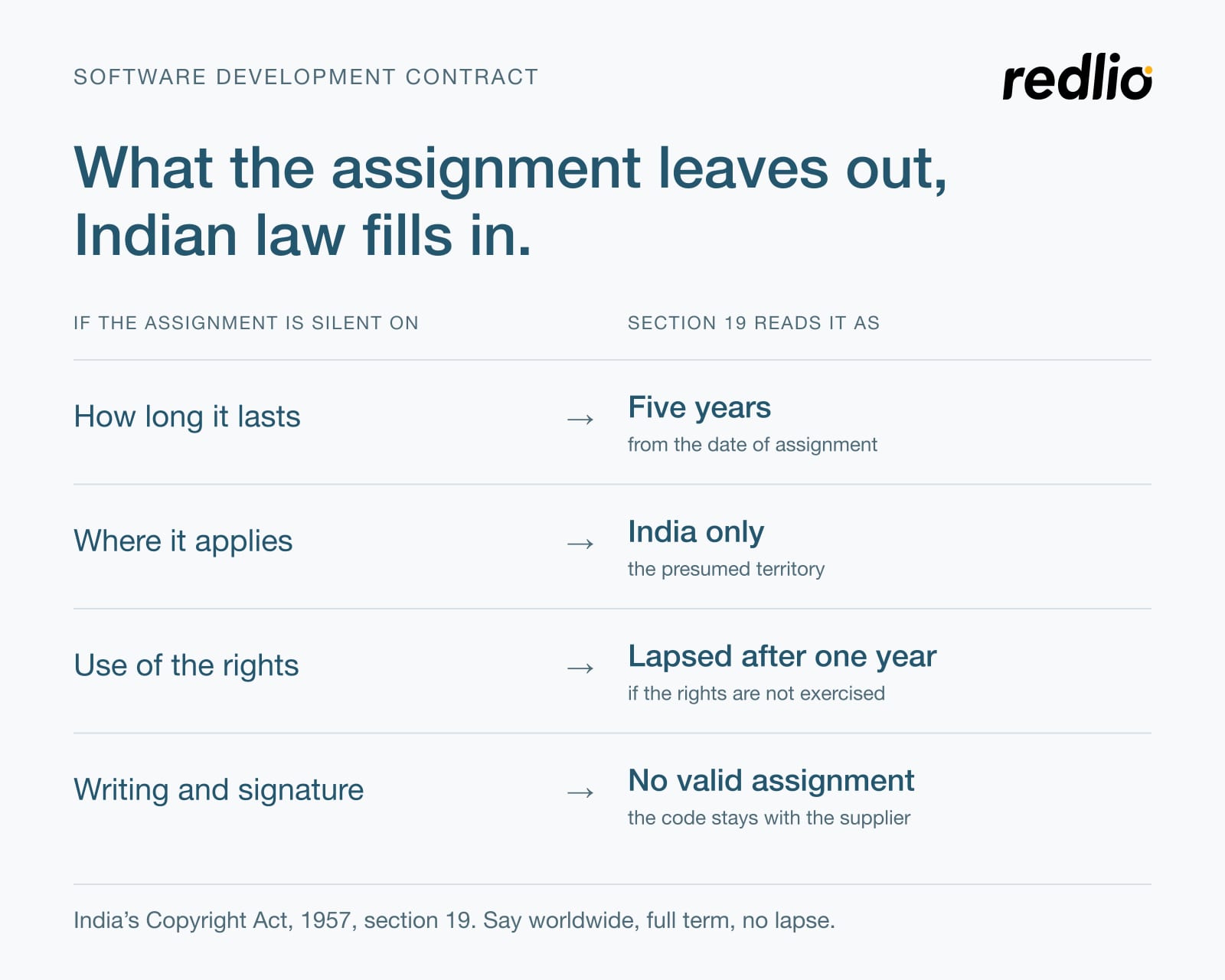
Section 19 sets out what that assignment must contain. It must be in writing and signed by the assignor. It must identify the work and specify the rights assigned, their duration and their territorial extent, and the royalty or other consideration.
Then come the defaults. If the period is not stated, the assignment is deemed to run for five years from its date. If the territory is not stated, it is presumed to extend within India. If the assignee does not exercise the rights within one year, the assignment of those rights is deemed to have lapsed, unless the assignment says otherwise.
 (opens full size in a new tab)
These defaults are why assignment deeds drafted in India say “worldwide”, “for the full term of copyright” and that the assignment does not lapse for non-exercise. A template written for US or UK law may say none of those things.
Section 18 adds one more condition. An assignment does not reach a medium or mode of exploitation that was not in existence or commercial use when it was made. The exception is an assignment that names that medium specifically. Drafters deal with it by assigning the rights in all media, whether now known or developed later.
When the contract chooses another country’s law, which law governs the transfer itself is a question for your lawyer. Drafting the assignment so that it also satisfies section 19 costs nothing.
One ownership clause, written two ways
As an illustration, not a client’s contract, take an ownership clause of the kind the templates offer: “All deliverables are works made for hire and the sole property of the Client.” Signed with a supplier in Bengaluru or Ahmedabad, it rests on a US label that does not fit software, and it states no period, no territory and no consideration.
Rewritten, the clause says the supplier assigns to the client all copyright and other intellectual property in the deliverables. The assignment is worldwide, for the full term of those rights, in all media now known or later developed, in return for the fees in the contract. It adds that the assignment does not lapse if the client does not exercise the rights within any period. And it says when each deliverable is assigned, which is the next question.
When the code becomes yours
Expect a supplier’s draft to tie the assignment to payment. That is reasonable, provided the code is already in your hands before any dispute about payment begins.
The supplier wants to be paid for what it hands over, and you want to hold what you have paid for. The two fit when assignment follows payment milestone by milestone. A contract that assigns everything on final payment leaves you owning nothing during an argument over the last invoice, while the code sits only in the supplier’s systems.
Where the code lives matters as much as the wording. Create the repository in your organization’s account on the first day and add the supplier’s engineers as members. Then the question at the end is never whether the supplier will hand the code over, only whether the assignment covers it.
Who else wrote your code
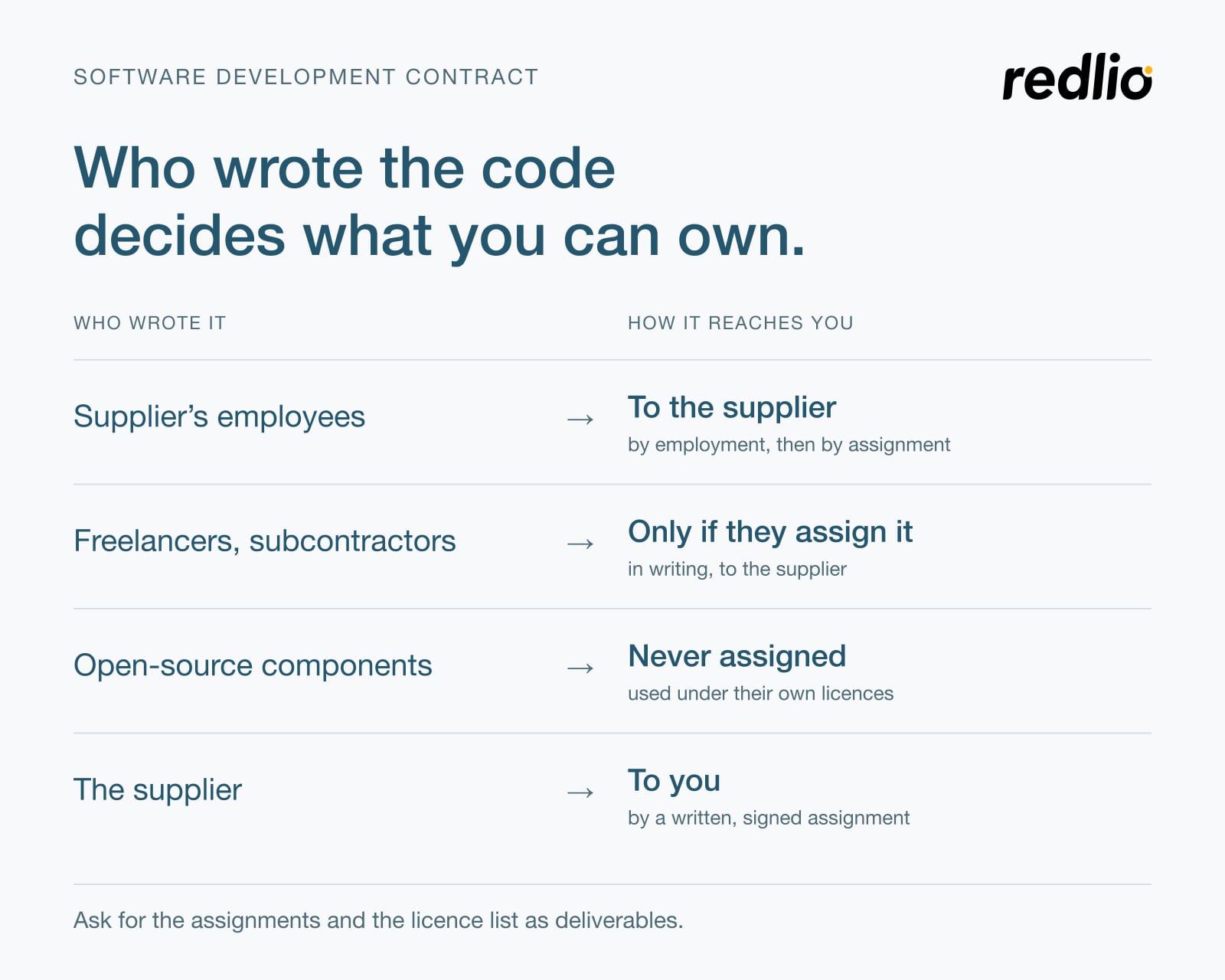
An assignment passes on only what the supplier owns, so the contract has to reach the people and components behind the supplier. That means its employees, anyone it subcontracts to, and the open source your system is built on.
Employees are covered by section 17(c) in India and section 11(2) in the UK, for work done in the course of their employment. Freelancers and subcontractors are not employees. Their code is theirs until they assign it. So the contract should require the supplier to hold written assignments from everyone on your project, and to name any subcontractor before using one.
 (opens full size in a new tab)
Open source is never assigned to you. It is licensed, and each licence has conditions. Black Duck’s 2026 Open Source Security and Risk Analysis audited 947 commercial codebases between November 2024 and October 2025. It found open source in 98% of them and licence conflicts in 68%, up from 56% the year before.
Permissive licences such as MIT and Apache 2.0 ask for little beyond keeping their notices. The one to look for in a web application is the GNU Affero General Public License. Its section 13 says that if you modify the program, users who interact with it over a network must be offered its source code. A modified AGPL component inside your platform can oblige you to publish those changes.
So make a list of every open-source component and its licence a deliverable with each release. Add a clause that no component under a licence you have not approved goes in. The same list is what an acquirer’s due diligence asks for if you ever sell the business.
The supplier’s own tools are the last piece. If it builds on libraries or a platform it keeps, that part is licensed to you, not assigned. Get the licence in writing: perpetual, transferable with your business, and allowing another supplier to change the code.
That is the case where source code escrow helps. An escrow agent holds the source and releases it on events such as the supplier’s insolvency or the end of support, as Escrow London describes on techUK. For code assigned to you and kept in your own repository, escrow adds little, because you already hold it.
Fixed price or time and materials decides who pays for the unknowns
Choosing fixed price or time and materials is choosing who carries the cost of what neither side knew at signing. Each model then needs different clauses to be safe.
The choice has been studied on real contracts. Gopal and colleagues analysed 93 offshore projects at a leading Indian software vendor, in Management Science in 2003. Requirement uncertainty, team size and resource shortage explained which contract was chosen, and the contract type significantly affected the vendor’s profit. A 2008 follow-up by two of the authors summarises the earlier finding: on average, offshore vendors earn more on time and materials than on fixed price.
That is not a reason to insist on a fixed price. Kalnins and Mayer studied 394 IT services contracts. They found time and materials preferred when quality is costly to measure afterwards and costs are hard to estimate in advance. A fixed price on that kind of work does not remove the uncertainty. The supplier prices it in, or it reappears as change requests.
Fink, Lichtenstein and Wyss read 270 contracts at a large international bank. A third of them differed significantly from the plain fixed-price and time-and-materials types. They describe the standard fixed price as carrying an implicit agreement to renegotiate for specification changes at a reasonable mark-up. That implicit agreement is the part worth writing down.
| Model | Who carries the unknowns | The clause it cannot do without |
|---|---|---|
| Fixed price | The supplier, until the scope changes; then you, through change requests | A specification annex, a list of exclusions, and change control with the rate for changes agreed in advance |
| Time and materials | You, month by month | A rate card by role, timesheets you can inspect, notice before spend passes an agreed threshold, and termination at short notice |
| Time and materials with a cap | You up to the cap, the supplier above it | What the cap covers, what happens to unfinished scope when it is reached, and how it moves when the scope does |
When each model suits a project is covered in our custom software cost guide, along with why quotes for one brief spread so far. For the contract, the useful step is narrower. Whatever model you choose, agree the rate at which change will be priced before anyone needs it, because that rate decides most arguments later.
What counts as done
Acceptance decides when you pay and when the warranty starts, so it needs criteria you can test, a window to test in, and a stated result if you say nothing.
Criteria come first. “Works as specified” is testable only if the specification is detailed enough to test against. Tie acceptance to the requirements annex. For anything that is not a function, such as speed, accessibility or the browsers supported, write the number or the standard.
Then the window. Expect a supplier’s draft to include deemed acceptance: if you do not reject a delivery within a set number of days, it counts as accepted. That is fair to a supplier who would otherwise wait months for sign-off. It becomes a problem when the window is shorter than your users need to test, or when it runs across a holiday.
Agree a window your testers can meet. Require a rejection to list defects against the criteria, and set how many rounds of fix and retest the price includes. For goods, US commercial law says acceptance does not occur until the buyer has had a reasonable opportunity to inspect. Whether that rule reaches custom software is contested, and we found no statute on acceptance of software services, so your contract is the rule.
Scope disputes start in the same place. In one Hacker News thread of consulting horror stories, a commenter describes an app delivered without features it needed to work, because the contract never set them out. Criteria written before the build protect both sides from that.
Acceptance also starts the warranty. Agree a period after acceptance in which the supplier fixes defects against the specification at its own cost. Keep it separate from support and new work, which are paid for.
If the developers will touch personal data
When the developers will see personal data from the EU or the UK, the contract needs processor terms, and the GDPR lists what they must say.
Article 28(3) of the GDPR requires a contract setting out the subject, duration, nature and purpose of the processing, the types of data and whose data it is. The processor must act only on your documented instructions and bind its people to confidentiality. It must take the security measures in Article 32 and help you answer people exercising their rights. It must also require the processor to delete or return the data when the work ends, and to allow audits. Under Article 28(2), the processor may not bring in another processor without your written authorisation.
In a development project, personal data reaches the supplier through test databases, logs and production support. Where anonymised or synthetic test data will do, the supplier may not need to process personal data at all. Write down which it is, so nobody assumes.
Sending the data to a supplier in India is also an international transfer, because India has no EU adequacy decision. Our nearshore and offshore guide covers the safeguards that apply and India’s own data protection act. One provision to add from that act: under section 8(2), a data fiduciary may use a processor only under a valid contract. It is in the part of the act set to take effect eighteen months after the November 2025 notification.
Write the exit before anyone needs it
The exit clause is the one you hope not to use. It is also the one written while both sides still want to help each other. It should say how either side can end the contract, what you receive, and what help the supplier gives afterwards, at what rate.
Termination first. Fixed-price work needs a way to stop at a milestone and pay for what was accepted. Time and materials needs notice short enough that you are not paying for a team you have decided to replace. On either, ending the contract must not undo the assignment of what you have paid for.
Then what you receive. The code is the easy part when the repository is already yours. The rest is what a new team needs to run the system without calling the old one, and it is worth listing in the contract by name.
- The source repository with its full history, in your organization’s account.
- The cloud, hosting and database accounts, owned by you, with the supplier as a user.
- Domains, DNS, SSL certificates and app store accounts, registered to your organization.
- Every credential and API key, and the third-party services they belong to.
- The deployment path: how a change goes from a commit to production.
- Documentation of the architecture and of the decisions the code does not explain.
- A handover period, with the outgoing engineers available at agreed rates.
 (opens full size in a new tab)
One of our own projects shows the end state. For a school in India we deployed the site on the school’s own server and handed over the documentation with it. The client told Clutch its team now runs the site independently. The full story is in our build vs buy article.
If the supplier will also run the system after launch, the exit clause matters more. Price transition assistance now: a set number of days of help for the incoming team, at the contract rate, available for a set period after notice.
Before the draft goes to your lawyer
A lawyer will read the draft for enforceability, liability and governing law. The questions in this article are operational, and a lawyer may not know to ask them. They cover where the repository lives, who the subcontractors are, how long your testers need, and what a new team would need when the contract ends. Settle those first, and the legal review has something concrete to check.
If a supplier’s draft is on your desk, ours or another company’s, send it with the scope it covers. An NDA comes first. Then the engineers who would write the code spend half an hour with you on which of these clauses the draft leaves open, and say straight out whether we fit the work. We are not lawyers and will not act as yours.
Questions about software development contracts
Who owns the code in a software development contract?
The supplier, until it assigns the code to you in a signed, written document. In the US, code written by an outside company is not a work made for hire. Software is not one of the nine commissioned categories in 17 U.S.C. §101. UK and Indian law also require an assignment to be in writing and signed.
Is software a work made for hire?
Only when an employee writes it within the scope of the job. Software commissioned from a contractor or a development company fits none of the nine commissioned categories. A clause calling it one does not transfer ownership. A written assignment does.
What should a software development contract include?
The scope and its specification, the pricing model and how changes are priced, acceptance criteria and the testing window, and an assignment of intellectual property with the open-source components listed. Add a warranty period, confidentiality, processor terms if personal data is involved, and termination with a handover. Liability caps, governing law and disputes are for your lawyer.
Which is better, fixed price or time and materials?
Neither in general. Studies of real IT contracts find requirement uncertainty driving the choice. Time and materials is preferred where quality is hard to measure afterwards and costs are hard to estimate in advance. Whichever you choose, agree the rate for changes before you sign.
What is deemed acceptance in a software contract?
A clause that treats a delivery as accepted if you do not reject it within a set number of days. It is fair when the window gives your testers enough time and a rejection only has to list defects against the agreed criteria. Without one, a supplier can wait months for sign-off.
Do I need a data processing agreement with my software developer?
Yes, if the developer processes personal data on your behalf, for example through test databases, logs or support access, and the GDPR or UK GDPR applies. Article 28 lists what it must contain. Anonymised or synthetic test data can keep a development team away from personal data altogether.
Can I use a software development contract template?
As a starting point. Check that the ownership clause is an assignment, not only a work made for hire label. If the developer is in India, it should state worldwide scope and the full term. Acceptance, change pricing and the exit should be spelled out too. Then have a lawyer in your jurisdiction review it.
The author