Website redesign RFP lessons from 21 that were actually sent
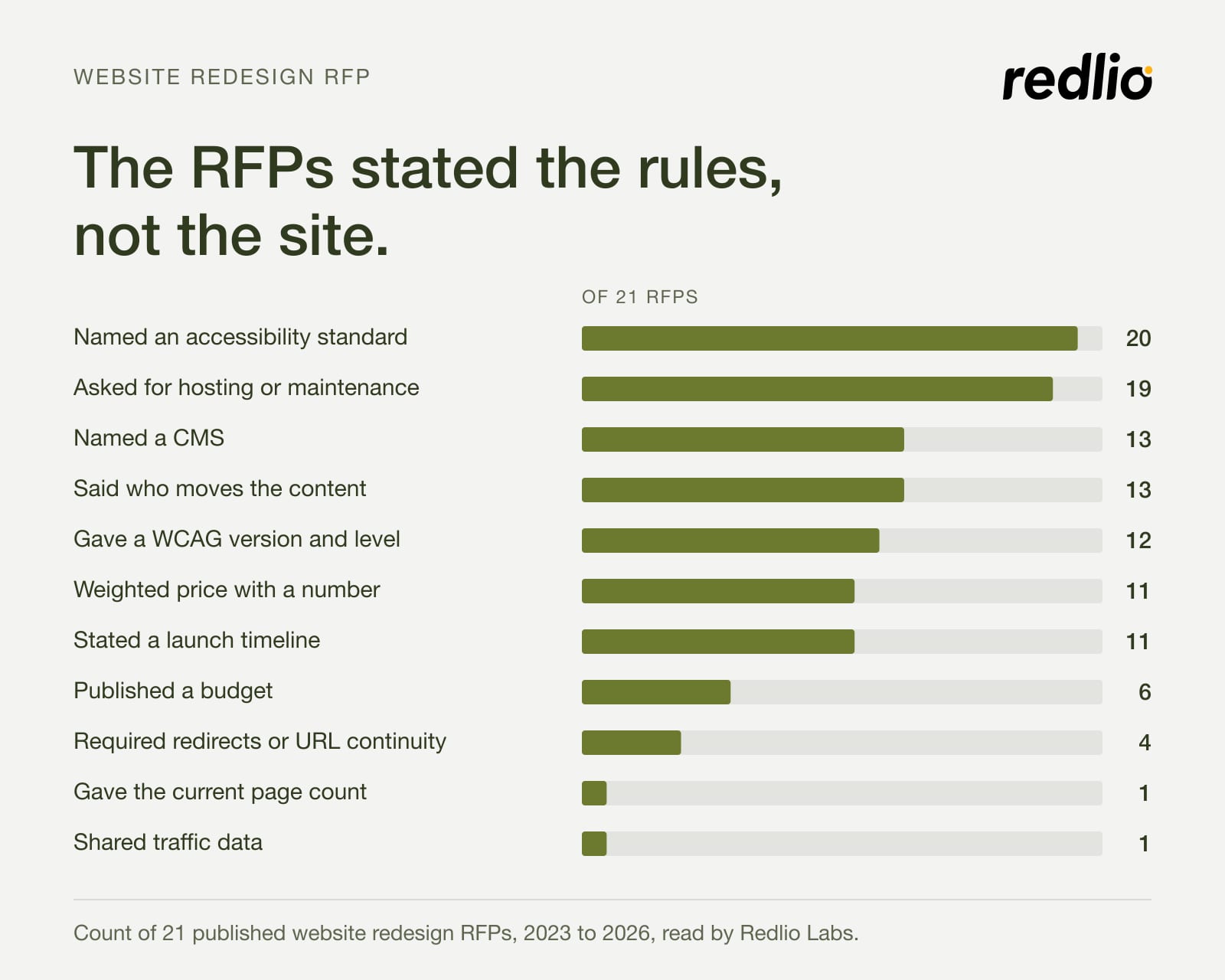
A website redesign RFP gets comparable proposals when it states the facts that set the price: the budget, the size of the site, what must be kept and who moves the content. We read 21 RFPs published from 2023 to 2026. Six stated a budget, four required redirects and one gave the current page count.


Twenty-one website redesign RFPs, read line by line
Advice on writing a website redesign RFP is easy to find and hard to check. The pages a US web search returned for “website redesign rfp” in November 2026 were written by agencies and RFP software companies. Nine of the eleven we could read tell you to include a budget. None looks at what real RFPs contain, so we did.
In November 2026 we read 21 website redesign RFPs published between 2023 and 2026. Seven came from US cities, states and transit districts, and seven from US colleges, universities and school districts. Four came from US nonprofits and associations, and three from UK charities and professional bodies. Public bodies publish their RFPs, which is why the sample leans that way. For every RFP we noted what it told the agencies and what it left them to guess. We read the document text and, where one was published, the question-and-answer addendum.
 (opens full size in a new tab)
The pattern runs one way. Nearly every RFP told agencies which rules to follow and which services to price. Very few described the site to be redesigned: how big it is, who uses it, and what it has earned that must not be lost. Those are the facts an agency needs to price the work, and the published question-and-answer files show agencies asking for them.
We answer RFPs like these. Redlio Labs sells website redesign for B2B organizations. A better RFP is one we would rather receive, so our advice leans the way of the people who respond. The counts below are what the documents say, and every document is linked.
What nearly every RFP got right
Twenty of the 21 named an accessibility standard, and 19 asked for hosting or maintenance after launch. On both, the RFP writers knew what they needed. Accessibility is also where the details most often slipped.
Twelve of the 21 gave both a WCAG version and a level. The rest named the ADA, Section 508 or “WCAG compliance” without saying which. One city asked for WCAG 2.1 Level AA in one section and full compliance with WCAG 2.2 Level AA in another. One chamber of commerce listed WCAG 2.0 and 2.1, Levels A and AA, together.
The version matters because the legal baselines differ. The Justice Department’s 2024 rule under Title II of the ADA requires state and local government websites to meet WCAG 2.1 Level AA. An interim final rule of April 20, 2026 moved the compliance dates. Governments serving 50,000 people or more now have until April 26, 2027, and smaller ones and special districts until April 26, 2028. It left the standard unchanged.
The federal Section 508 standard still points to WCAG 2.0 Level AA, a step below. In the EU, the European Accessibility Act has applied since June 28, 2025 to services such as e-commerce, consumer banking and passenger transport, websites included, with microenterprises exempt. Which of these binds you is a question for your advisers. The RFP only has to name one version and one level, once.
Three of the 21 asked for WCAG 2.2 Level AA, the current version. One city also banned paid accessibility widgets and overlays, which is a useful line to copy if you want the work done in the code. What the standard means for design and content is covered in our website redesign checklist.
The budget, which six of the 21 published
Six of the 21 RFPs stated a budget or a not-to-exceed figure in the document. Three more gave one only when an agency asked in the question period. All three UK RFPs gave a figure; three of the 18 US ones did.
The smallest was a guide of about 25,000 pounds for a UK charity’s brand, research and site together. The largest was 400,000 to 500,000 dollars for a state education department, which said it would reject bids outside that range. The UK Institute of Food Science and Technology gave up to 40,000 pounds for the build, plus a separate annual figure for hosting and maintenance. It called the figure “a maximum, not a target”.
The other side of the argument is in the documents too. One trust answered that it had no budget to share publicly, and one chamber asked agencies to trust that it had budgeted accordingly. The usual worry is that a published figure becomes the price. Agencies say the opposite: without one, many do not bid. One wrote that it will not pursue work where budget parameters are not clearly defined.
A budget also changes what you get back. Given a figure, agencies propose what fits inside it, and you compare approaches. Without one, they guess at your scale, and the spread you see is mostly the spread of their guesses. Why redesign quotes differ, line by line, is in our website redesign cost guide.
How price was actually scored
Eleven RFPs gave price a numeric weight. It ranged from 10% to 50% of the score, and the median was 30%. Seven listed price as a factor without a weight, two published no evaluation criteria at all, and one had no price criterion and asked for no price proposal. One page in the search results tells agencies their response “will be judged primarily on cost”. In the RFPs we read, price was never the majority of the score.
The formula matters as much as the weight. As an illustration, not an evaluation we took part in, take the ratio method in the San Francisco Unified School District’s RFP. Points equal the lowest cost divided by the cost being evaluated, times the maximum. With 10 points for price, a bid of 100,000 dollars against a lowest bid of 80,000 earns 8 points. The higher bid loses two points out of 100, which a stronger technical score can easily outweigh. Publishing the formula tells agencies that, and the good ones price accordingly.
How big the site is, which one RFP said
One RFP in 21 stated how many pages the current site has, and one shared traffic data. Thirteen said who would move the content: the agency in eight, the client in two, and a split in three.
Size is the first thing a redesign estimate needs. Holyoke Community College put the number in the document: more than 5,000 unique pages and over 12,000 URLs. Elsewhere the size came out only under questioning. One college gave “roughly 20000 nodes” in its answers, and one trust gave about 285 pages and over 8,000 files.
The question files show what the silence costs. The City of Exeter’s RFP is short, and its published answers are numbered to 139 questions. The Chesapeake Bay Trust’s are numbered to 215. Both RFPs left out the budget or the size of the site, and both question files spend answers on them.
Reading Is Fundamental was the exception on traffic. Its RFP gave Google Analytics baselines for each property and Lighthouse scores, and offered deeper access after an NDA. An agency reading it knows which pages carry the audience before it writes a word.
Content is the other half. Moving years of pages, files and images can be the largest single task in a redesign. An RFP that does not say who does it gets proposals that each assume a different answer. Say whether the agency migrates everything, migrates a defined set, or builds templates for your team to fill.
 (opens full size in a new tab)
What the redesign must not lose, which four required
Four of the 21 RFPs required redirects or URL continuity, so that pages which earn search traffic keep it after launch. Twelve mentioned SEO in some form, which is not the same thing.
The strongest was the College of Western Idaho’s, which asked for “URL Continuity”, keeping current URL usage through a move from Drupal 7 to Drupal 11. A transit district asked agencies to preserve search ranking by redirecting old URLs to new ones. Holyoke, with over 12,000 URLs, listed SEO features and did not mention redirects.
Put the requirement in the RFP because it changes the price. Mapping every URL with traffic or inbound links to a new destination takes time. An agency that leaves it out will look cheaper than one that includes it. How the map is built and tested is in our checklist. For the RFP, one sentence does it: the agency will deliver a redirect map for every URL with traffic or inbound links, and test it before launch.
How long agencies were given to answer
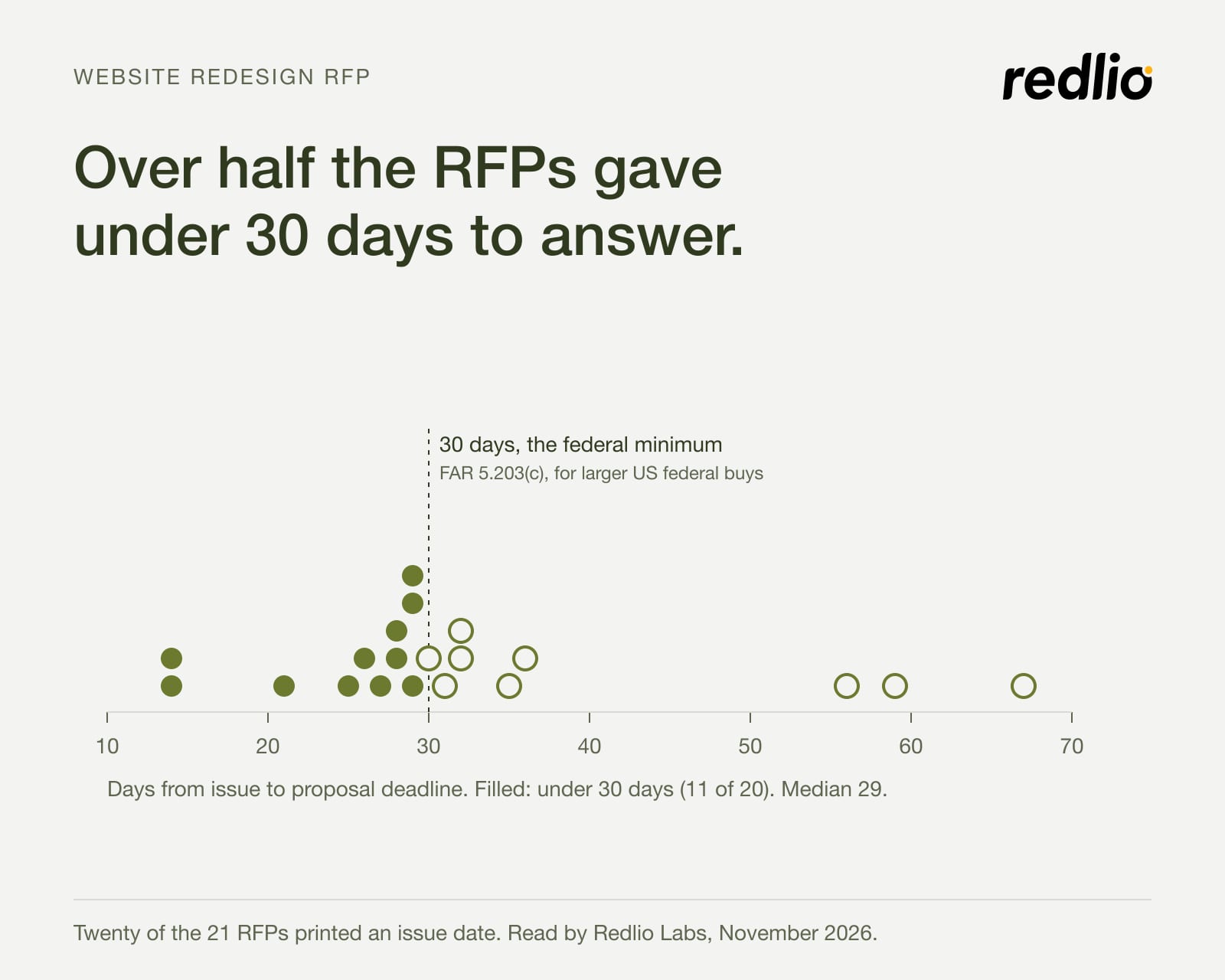
The median RFP gave 29 days from issue to deadline, and 11 of the 20 that printed an issue date gave fewer than 30. Two gave 14 days.
 (opens full size in a new tab)
There is a benchmark. The US Federal Acquisition Regulation, part 5.203(c), requires federal agencies to allow at least 30 days for proposals on larger purchases. It does not bind a city, a college or a charity. It is still a reasonable floor for a document that asks for a plan, a team and a price. Two of the RFPs ran across the December holidays, one issued on December 23 and one on December 30.
Short windows matter because responding is expensive and agencies choose. Loopio’s 2026 benchmark survey of 1,533 companies found teams spend an average of 33 hours on an RFP response and answered 55% of the RFPs they received. That survey covers all industries, not web projects alone. We looked for a study of website RFPs specifically and did not find one with a stated method.
The one response count we found was in a public record: the College of Western Idaho’s opening document lists 17 proposals received. A good RFP does not need more than that. It needs the right few, which is what a budget, a page count and a fair deadline select for.
One document, kept current
Once the RFP is out, every answer and change belongs in it, as a numbered addendum that every bidder receives. Details sent in separate emails get lost, and we have been marked down for exactly that.
A training business for game art students found us on Behance and asked for a landing page explaining its offer. The client told Clutch we responded quickly to feedback and were present every day. Asked what we could improve, the client said that sometimes we missed some details they sent. That project had no RFP. It is a small version of what happens when requirements arrive in pieces across messages instead of in one document both sides work from.
Two of the RFPs in our sample showed signs of being copied from another organization’s document. One asked about a vanpool seat finder and Internet Explorer; another described commencement and academic majors for a chamber of commerce. Templates help, and the search results are full of them. Check every borrowed section against your own site, since agencies price what the document says.
What to attach to a website redesign RFP
The fastest way to improve a website redesign RFP is to attach the facts about the site, not to add more requirements. This list is what the RFPs we read most often left out, in the order an agency uses it.
- The budget, as a figure or a range, with what it covers: build only, or build plus a year of hosting and support.
- The size of the site: the number of pages and files, from a crawl or your CMS, and the main page types.
- Twelve months of traffic, by page, and the pages that bring inquiries or applications.
- The URLs that must keep their traffic, and a requirement for a tested redirect map.
- Who moves the content: the agency, your team, or a named split.
- The current CMS and the systems the site connects to, and whether the CMS can change.
- The accessibility standard, as one WCAG version and level.
- The launch date and the reason for it, so agencies can tell a target from a deadline.
- How proposals will be scored, with the weight and formula for price.
- The question deadline, and how answers will be shared as numbered addenda.
Not every redesign needs an RFP. If your procurement rules do not require one, send a short brief with these attachments to three or four agencies you have already looked at. It gets comparable answers faster. If they do, the same attachments make the formal version work.
If an RFP for your redesign is in draft, send it to us with the current site’s address. You will hear back within 12 hours. The designers and developers who would work on it then spend half an hour with you on the questions agencies are likely to raise, so the answers are in the document before it is published. If we are the wrong fit to bid, you will hear that as well.
Questions about website redesign RFPs
How do you write an RFP for a website redesign?
Describe the site as well as the requirements: its size, its traffic, the pages that must keep their URLs, and who will move the content. Then state the budget, the accessibility standard as one WCAG version and level, the launch date, and how proposals will be scored. Give agencies at least 30 days and publish every answer as an addendum.
Should you include a budget in a website RFP?
Yes. Six of the 21 RFPs we read stated one, and agencies such as Mightybytes say they decline RFPs without one. A range lets agencies propose what fits inside it, so you compare approaches rather than guesses about your scale.
How long should agencies get to respond to a website RFP?
At least 30 days. That is the minimum US federal agencies must allow on larger purchases under FAR 5.203(c). It is a fair floor for anyone asking for a plan, a team and a price. Eleven of the 20 RFPs we could date gave less, and two gave 14 days.
What should a website redesign RFP template include?
Background and goals, the scope of work, the current site’s size and CMS, content migration responsibility, accessibility and redirect requirements, hosting and support, the timeline, the budget, the proposal format, the evaluation criteria with weights, and the question process. Replace anything copied from another organization’s RFP that does not describe yours.
How are website RFP proposals usually scored?
In the 11 RFPs we read that weighted price with a number, it counted for 10% to 50% of the score, with a median of 30%. The rest went to approach, experience, team, references and sometimes accessibility. Publishing the weights and the price formula helps agencies decide whether, and how, to bid.
What is the difference between a website RFP and an RFQ?
An RFP asks agencies how they would do the work and what it would cost, and scores both. A request for quotation asks only for a price against a fully defined specification. A redesign is rarely defined well enough for an RFQ before an agency has looked at the site, so an RFP fits it better.
The author