SEO audit cost depends on which of four audits you are buying
SEO audit cost runs from a few hundred dollars to tens of thousands because four different products are sold under the one name. Decide which one you need first, and judge it the way Google suggests: by whether it ends in an estimate of the work.


One SEO audit pricing page, two prices
One of the first pages Google shows for “seo audit cost” belongs to WebFX, a large US agency. Near the top, the page reports a survey of 250 US businesses: 43% of them pay $101 to $750 for an SEO audit. Further down, the same page lists the agency’s own audit service. Its heading says the service starts at $8,600 a month, and the package table under it lists one audit of 45 days at a cost of $8,600.
Both numbers are on the page. One is what surveyed businesses say they pay, and the other is one agency’s package, so they are different purchases that share a name. The page does not set them side by side. An SEO audit cost tells you little until you know which audit it belongs to.
We wanted to know whether that page is unusual. On October 10, 2026 we took the ten results Google returned in the United States for the search and read nine of them. The tenth, a forum thread, could not be opened.
All nine publish a price or a range. The figures run from that $101 to $750 up to $15,000 to $50,000 for an enterprise site. Five of the nine name no source for their numbers. Seven have something to sell: six are agencies that sell SEO services and one sells audit software. One of the seven labels that interest as a disclosure.
We belong in the same group. We sell SEO services and SEO audit services, so we have the same interest as those seven. We publish no prices of our own. Every figure below is someone else’s data, with its source named.
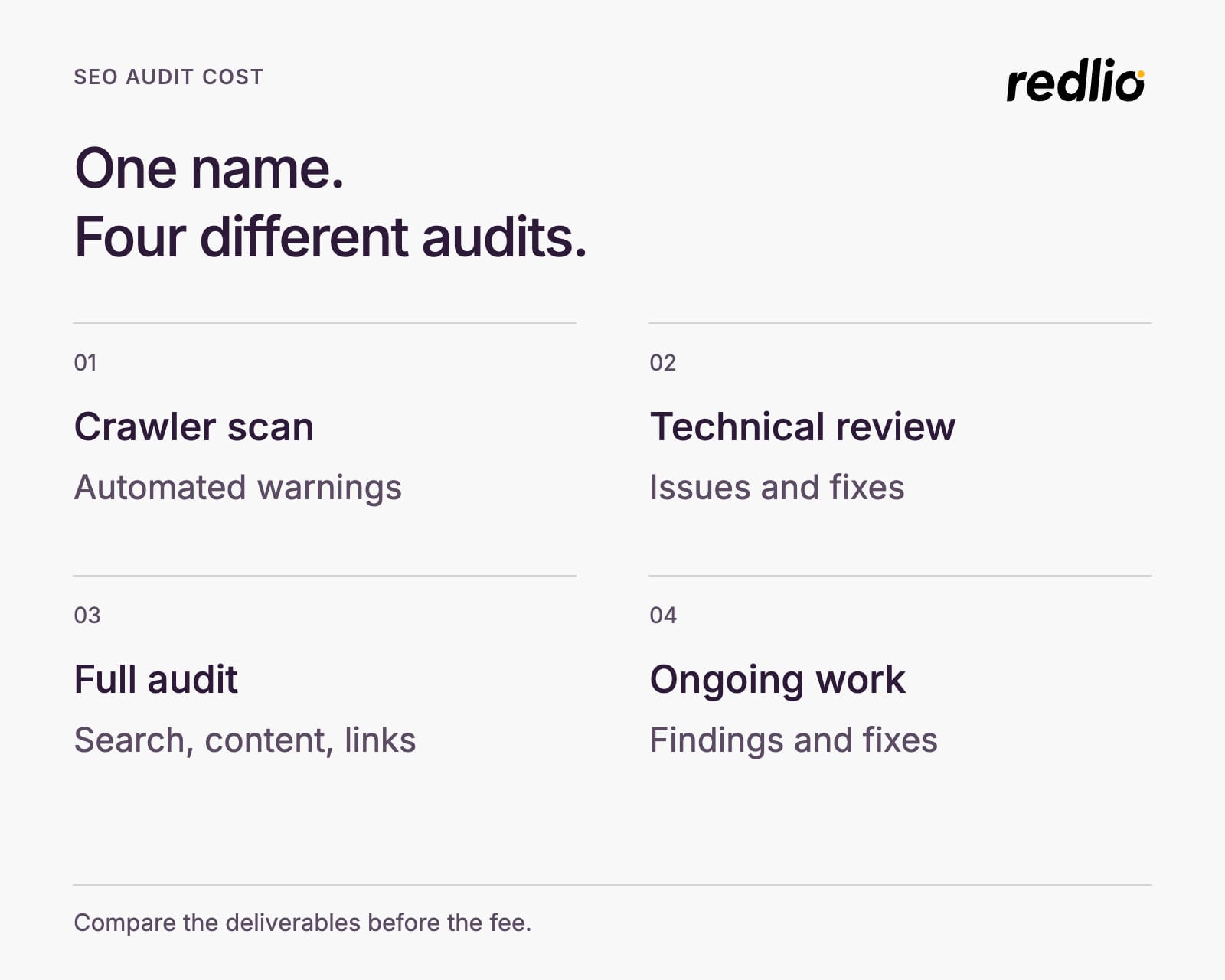
What follows sorts the market into four kinds of audit, cheapest first. The four are our way of sorting it, and no survey measures them separately. For each one it gives the published price and says when that audit is all you need.
The audit that costs nothing
The first audit is done by a machine. A crawler visits your pages and returns a score out of 100 and a list of warnings. It usually takes minutes, and it often arrives as a free PDF with an agency’s logo on the cover.
The best versions belong to Google and are free. Search Console shows which of your pages Google has indexed, which it has not and why. It also shows the searches that bring people to you. PageSpeed Insights reports how fast a page loads, with data from real visitors where Google has it. A paid audit that does not begin from your Search Console data is working from guesses.
Google shows a related question beside this search: can ChatGPT do an SEO audit? It can do this kind. Give an AI assistant a page and it will comment sensibly on the title, the headings and whether the page answers its question. Give it an export from a crawler and it will sort the findings faster than a person.
It has not crawled your whole site, though. It cannot see your Search Console or your inquiry records unless you hand them over.
The machine has the same limit in every form. It reports what is visible. It cannot tell you what matters, because it does not know what you sell, who buys it or which pages earn money. A list of 400 warnings arrives with no way to tell which twelve to fix. Six months later it is still in a folder.
It is enough for a first look, or as a check after a release. It will not tell you why inquiries have stopped.
The audit that costs hundreds
The second audit adds a person, for hours or a few days. A specialist runs the crawl, opens Search Console and writes up the technical SEO problems. Those are pages Google cannot reach or has dropped, broken links and redirect chains, duplicate content, missing or repeated title tags, slow templates and missing structured data. Each finding comes with its fix.
In our judgment, most of the WebFX survey’s $101 to $750 sits here, together with the automated reports sold for a small fee. The survey does not say what its 250 businesses bought, and it gives no date. The sellers’ side shows a similar scale. In Ahrefs’ survey of 439 SEO providers, freelancers most often charged $101 to $250 for a one-off project.
A technical audit is the right purchase around a change. Before a migration or a redesign it tells you what to protect. After one it tells you what broke. Our website redesign checklist covers that case. Google’s guidance on hiring an SEO calls a redesign a great time to bring one in, the earlier the better.
A technical audit stops at the plumbing. A site can pass one and still have no page for the question its buyers ask most.
The audit that costs thousands
The third audit takes an experienced person a week or more. It is what most agency proposals mean by the word.
We found no published price for it with a method you can check. Two sources let you reason about one. Ahrefs’ survey has no line for audits, but an audit is a one-off project. The most common per-project fee was $2,501 to $5,000, charged by 21.2% of respondents. That was also the most common band among agencies.
Clutch’s SEO pricing guide is built from the agencies and client reviews on its platform. It says most SEO agencies it lists charge $100 to $149 an hour, and it gives the same band for agencies in the United States.
Put those together. Say one person spends a working week on your site, 40 hours. At Clutch’s most common rate that is $4,000 to $5,960. The figure is an illustration, not a quote, and not our price.
That range sits beside the band Ahrefs’ agencies most often charge. A “full audit” priced far below it is much less than a week of a person, or no person at all.
In our view the week should cover five things, in this order.
Measurement comes first. Every later finding has to be ranked by what it is worth. If the analytics cannot show which pages lead to an inquiry, the audit can only rank problems by how loudly a tool reports them. Only three of the nine pages we read name analytics as part of an audit.
Crawling and indexing come second. This is the technical audit described above.
The searches and the pages come third. Someone reads the searches your buyers run and checks which page is meant to answer each one. They then say where two pages compete and where no page exists. This is where keyword research and competitive analysis belong: which competitors rank for those searches, and what their pages answer that yours do not. A content audit sits here too, every page sorted into keep, merge, rewrite or remove. A crawler cannot do this part.
Links and mentions are fourth: who links to you and what other sites say about you. That now includes the sources AI assistants read. If an “AI visibility audit” is sold to you as a separate product, put the questions in our guide to choosing a GEO agency to the seller.
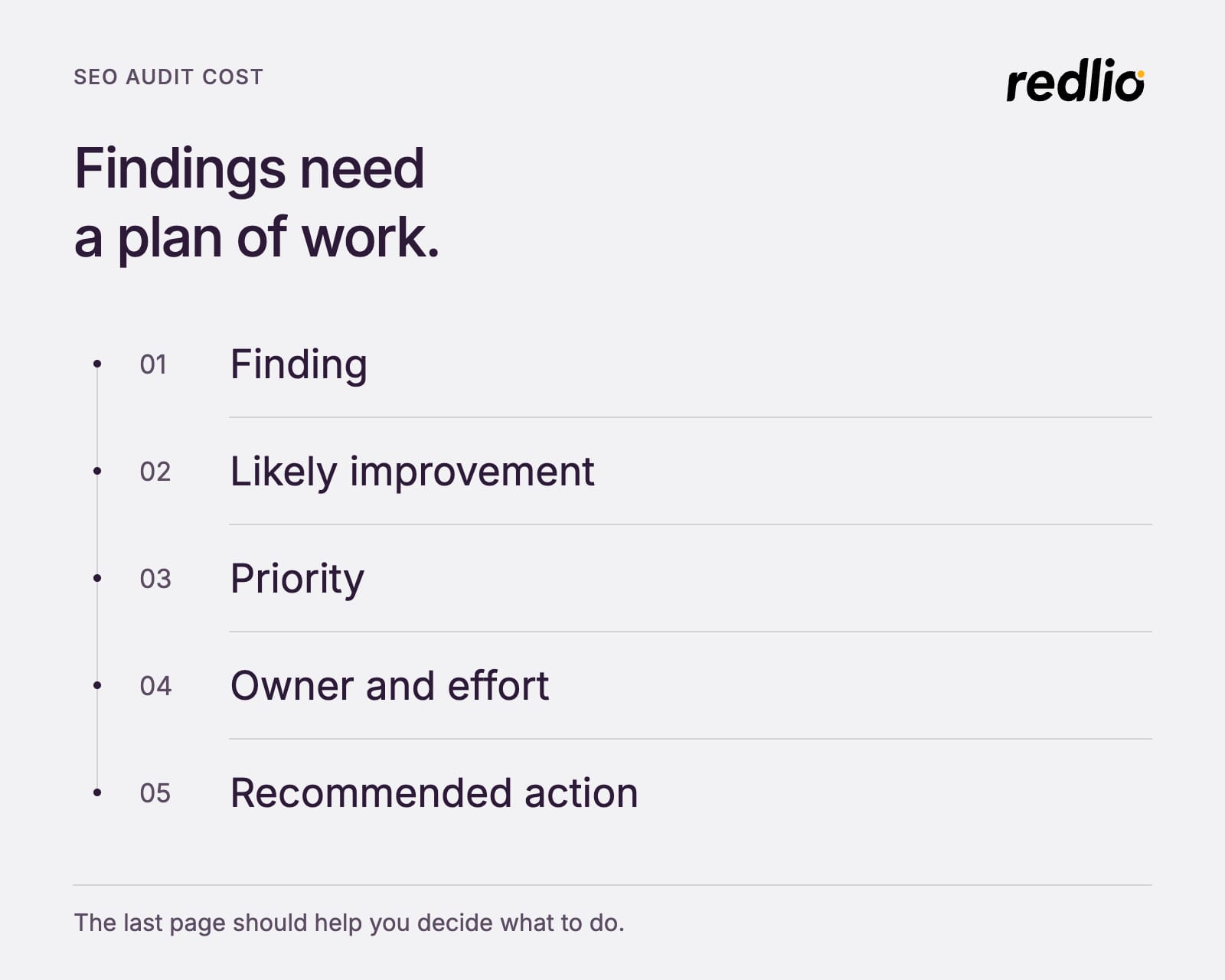
The priorities come last. Each finding carries what it is likely to change, who has to do the work and roughly how long it takes. This page is what you are paying for. The earlier parts are the evidence behind it.
The audit that does not end
The fourth audit is sold as the first month of something longer. The findings arrive with a team attached to fix them, and the price is monthly.
 (opens full size in a new tab)
Clutch puts the typical SEO agency fee at $2,000 to $20,000 a month, with an average of $3,199.19 across the projects reviewed on its platform. In Ahrefs’ survey the most common retainer was far lower, $501 to $1,000 a month. The two measure different sellers. Clutch lists agencies with reviewed projects. Ahrefs’ respondents include freelancers and consultants as well as agencies.
This arrangement suits you when no one on your side can make the changes. The fixes are the larger cost in any case, and they are rarely SEO work. A redirect map and a template fix need a developer. Slow pages need whoever owns the hosting and the front end. Thin or competing pages need a writer who knows the product.
The nine pages we read say little about that cost. None of them gives a separate figure for fixing what an audit finds. Two fold the fixes into a bundled or monthly price.
Settle two things before you agree to it. First, ask whether the audit exists as a document you keep if you stop after month one. If it does not, you cannot take the findings to another supplier.
Second, check that someone can change the site at all. The templates may be locked, the developer may have gone, or every edit may wait months in a queue. In any of those cases the findings will be out of date before the first one is fixed.
What makes the same audit cost more
Within any of the four, the size and complexity of the site set the hours. Crawling 200 pages and crawling 200,000 take the same click and very different amounts of reading.
Page types matter more than the page count. Ten thousand product pages on one template share most of their problems, so they are read as one. Faceted navigation is a different matter, because each filter can create new URLs. Google’s guidance on managing faceted navigation says those addresses can be near limitless, and the audit has to decide which of them Google should crawl at all.
Each language or regional version adds a set of checks, because the versions have to point at one another correctly. A site rendered in the browser by JavaScript needs the rendered page checked as well as the source, since what Google indexes is what it renders.
Local SEO adds a line per location: the Google Business Profile, the location page, and the same name, address and phone number across directories. A company with forty branches is buying forty small audits as well as one large one.
So ask every seller how many URLs, templates, languages and locations its fee assumes. A fixed price that names none of them was set without looking at the site.
Turn to the last page first
Whichever of the four you are offered, Google’s own guidance gives the test. An audit, it says, should be about giving you “realistic estimates of improvement, and an estimate of the work involved”. The line is in Do you need an SEO?, last updated in June 2026.
 (opens full size in a new tab)
Read that as a description of the last page. A list of problems does not meet it. An audit that meets it ends by saying what is likely to improve and how much work that takes. Your developer and your finance lead should both be able to use it.
So before you buy, ask to see the last page of an audit the seller has already delivered, with the client’s name removed. That page shows which of the four products they make.
Ask three more things. First, who does the work, by name, and for how many hours. Five of the nine pages we read give a duration, from a few days to 30 to 45 days, and a 45 day audit can contain one week of a person.
Second, whether the fee is credited against a retainer or is separate from it. Third, what access is needed. Google’s advice is read access to Search Console and no more until you have decided to work together.
One answer should end the conversation. Google states that nobody can guarantee a first-place ranking. If an audit promises one, do not buy it.
If you are not sure you need one
Plenty of sites do not need a paid audit. A small local business can often do much of the work itself, and Google’s guidance says as much. A site rebuilt last year with an SEO involved from the start has, in effect, just had one. A company about to redesign should spend the money inside the redesign.
The case for the third audit is narrower. It fits a site that has grown for years without anyone owning its structure. Organic inquiries have stalled or fallen, and no one inside can say where the problem is. That is the audit our SEO audit services are built for. If paid search is part of the same picture, the account audit there comes before any change too.
If you already hold an audit that left you with a list and no plan, or two quotes with a zero between them, send them to us. A reply comes back inside 12 hours, and we sign an NDA before the first call. On that 30 minute call, the people who would do the work tell you which of the four each one is and what it leaves out. That answer is yours even if you never hire us.
Questions about SEO audit cost
How much does an SEO audit cost?
The cost of an SEO audit runs from a few hundred dollars to tens of thousands, because four different products are sold under the name. In a WebFX survey of 250 US businesses, 43% paid $101 to $750, an SEO audit price that buys an automated scan or a light technical review. Ahrefs’ survey of 439 SEO providers found the most common fee for a one-off project was $2,501 to $5,000, which is closer to a full audit by a person. None of these is our price; we publish none.
What does an SEO audit involve?
An SEO audit is one of four products: an automated scan, a technical audit, a full audit by a person, or an audit sold as the first month of a retainer. The scan lists warnings. The technical audit checks whether Google can crawl and index the site. The full audit adds whether you can measure which pages produce inquiries, whether each buying question has one clear page, who links to and mentions you, and a prioritized list of fixes with the effort each one takes.
Can ChatGPT do an SEO audit?
It can review a single page or summarize an export from a crawler or Search Console. It cannot crawl your whole site, see your Search Console or inquiry data unless you provide them, or know which pages earn money. It is useful as an assistant inside an audit, not as the audit.
Is a technical SEO audit the same as a content audit?
No. A technical SEO audit checks whether Google can crawl, render and index the site: redirects, broken links, duplicate pages, speed and structured data. A content audit reads the pages themselves and decides which to keep, merge, rewrite or remove, and which buying questions have no page at all. The full audit described above includes both, ranked by what each fix is worth.
Is there a free SEO audit tool?
Yes. Google Search Console shows which pages are indexed and which searches bring visitors, and PageSpeed Insights measures page speed, both at no cost. Free scans from other tools list technical warnings. None of them ranks findings by what they are worth to your business.
How long does an SEO audit take?
Five of the nine ranking pages we read give a duration, and their answers run from a few days for a small site to 30 to 45 days for a full agency audit. Ask for the hours as well as the dates: a 45 day audit may contain one week of a person’s work.
How much does SEO usually cost?
Clutch’s 2026 pricing guide says SEO agencies typically charge $2,000 to $20,000 a month, with an average of $3,199.19 across the projects reviewed on its platform. In Ahrefs’ survey of 439 providers the most common retainer was lower, $501 to $1,000 a month. These are market figures, not our prices.
The author