B2B website best practices for buyers who decide before they call
B2B website best practices start from how a buying group decides: mostly before first contact, by several people reading your site separately. In 6sense’s 2025 study of nearly 4,000 buyers, the winning vendor was on the day-one shortlist 95% of the time. The site has to answer price, proof and fit for each of those readers without a salesperson.

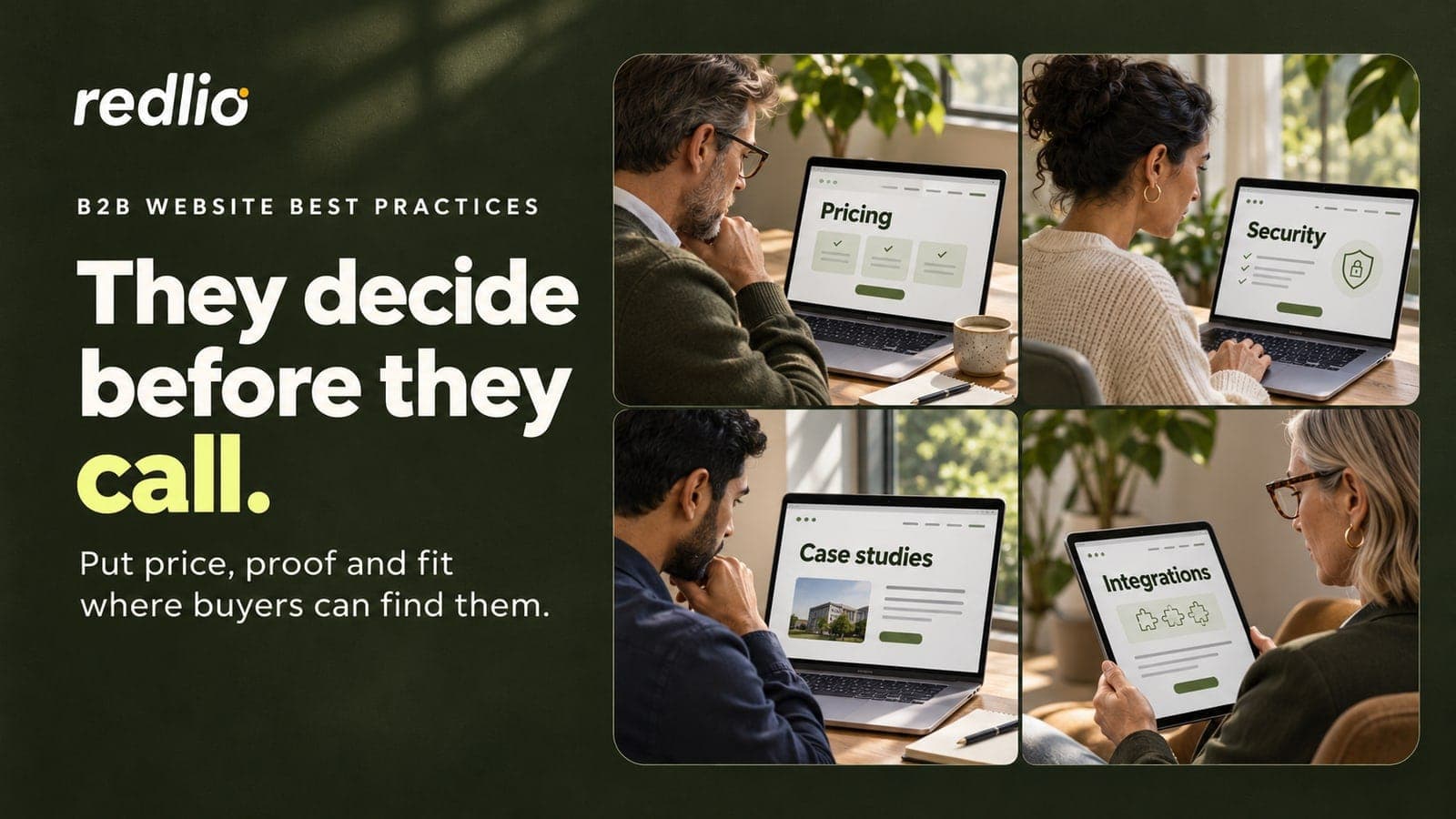
One buying group, four visits
The scene below is invented to illustrate the point. A manufacturer is choosing a supplier for a new order portal. The operations manager finds your site from a search and reads two case studies. A week later the IT lead checks whether you integrate with their ERP and how you handle security.
The finance director looks for a price and finds a form. Procurement wants your contract terms and data processing details. None of them contacts you yet, and between them they have already formed a view.
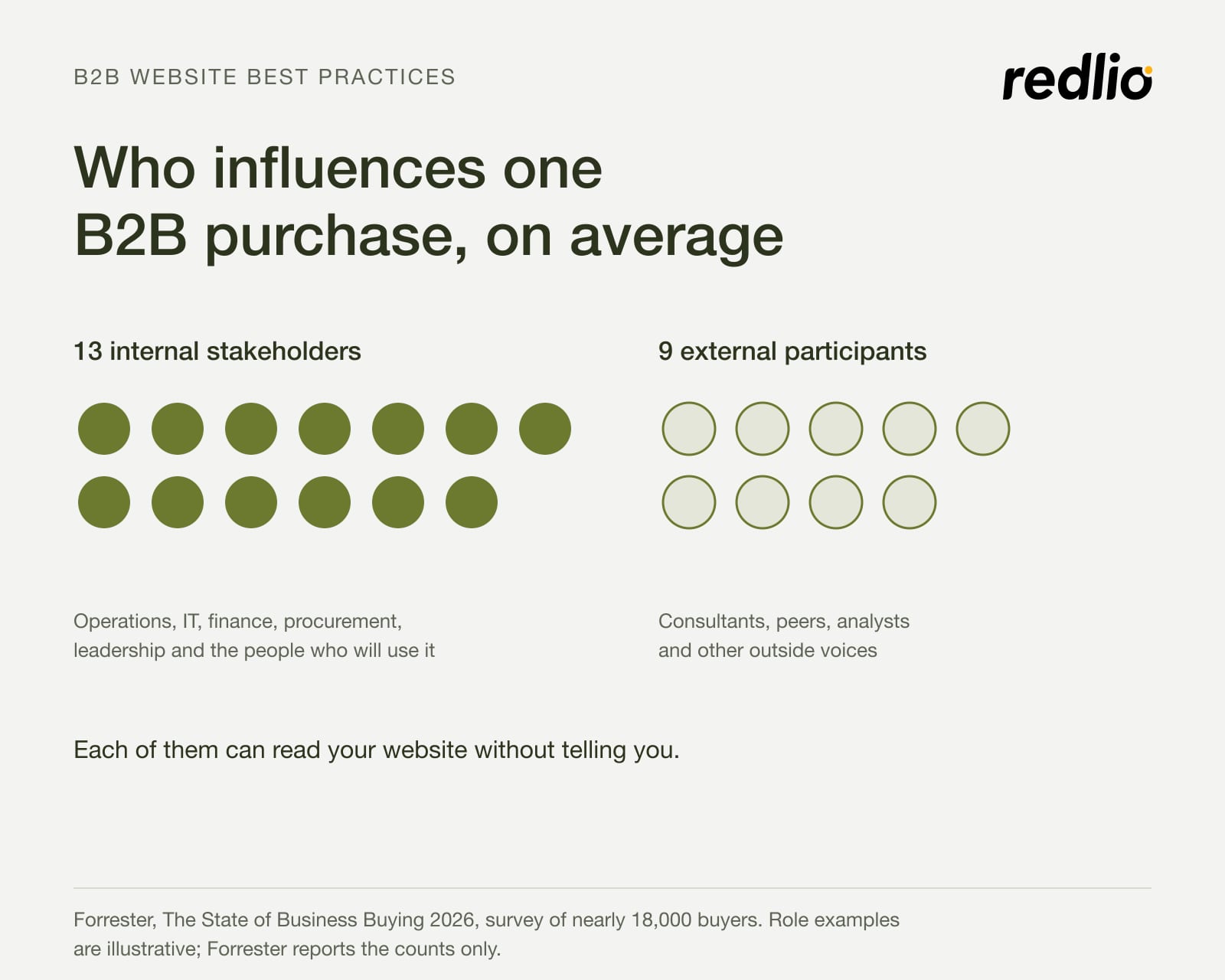
That group is larger than four. In Forrester’s State of Business Buying 2026, from a survey of nearly 18,000 buyers, an average of 13 internal stakeholders and nine external participants influence a purchase. A B2B website is read by all of them, separately, on their own schedule.
Designing B2B websites is our business, which gives us an interest in this advice. Every practice below is one you can check against your own site without hiring anyone.
 (opens full size in a new tab)
What the ranking advice covers
We counted ten pages on November 24, 2026 that rank for “b2b website best practices” and “b2b web design best practices”. All ten come from agencies that sell web design or marketing, as this one does. Six cite a statistic about B2B buyers and six mention the buying committee.
One recommends publishing prices, and one says how many fields a form should have. One gives Core Web Vitals thresholds and two name a WCAG version, neither of them the current 2.2. None shows proof with specific results in the way it tells readers to.
The shortlist forms before anyone calls
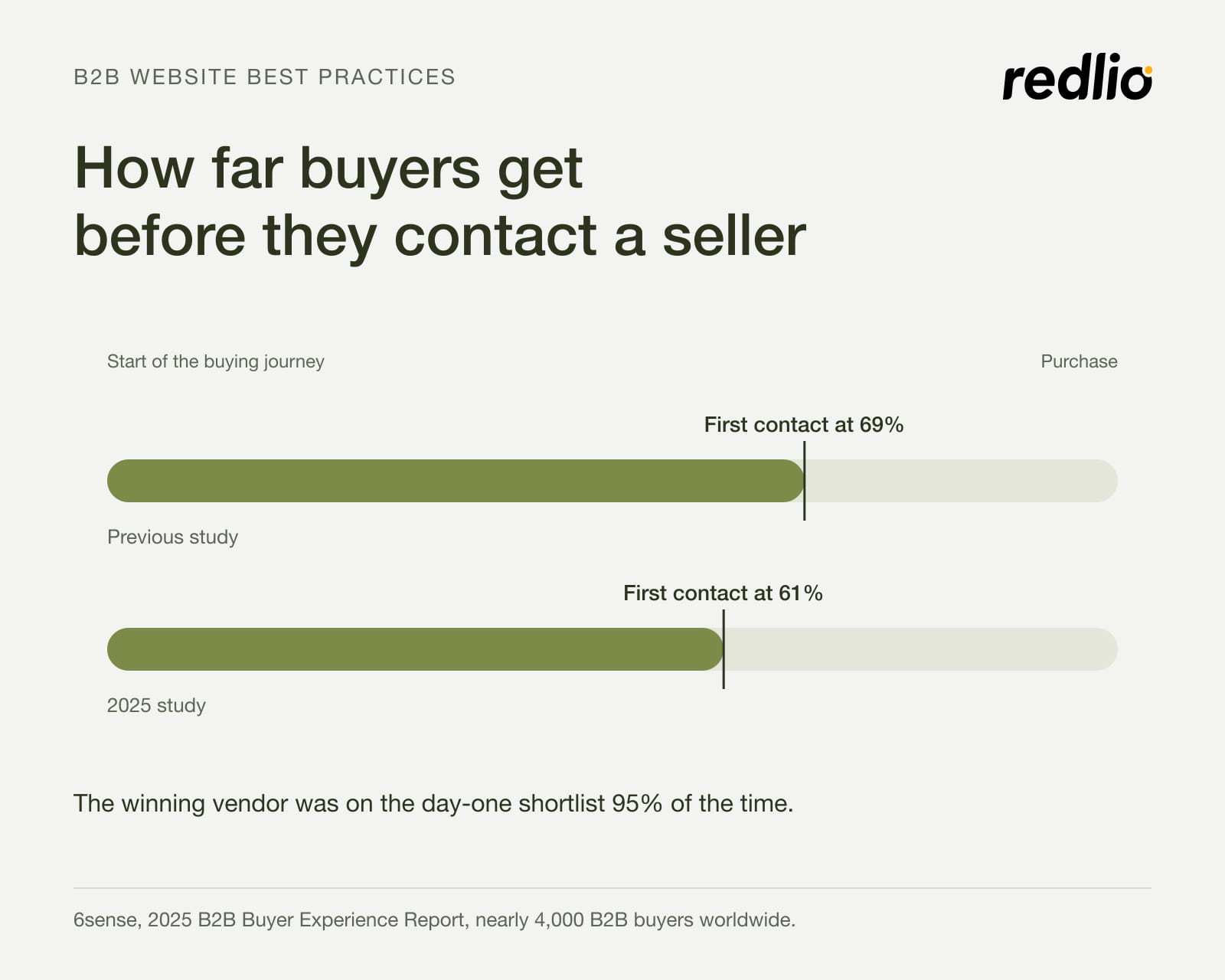
Most of a B2B decision is made on your website and others’ before first contact. 6sense’s 2025 Buyer Experience Report surveyed nearly 4,000 B2B buyers worldwide. First contact with a seller came 61% of the way through the buying journey. In its previous study it came at 69%.
Earlier contact did not mean an open contest. The winning vendor was already on the buyers’ day-one shortlist 95% of the time, and the favourite before first contact won four deals out of five. The report covers B2B buyers in general, not one industry, and 6sense sells software to B2B sellers.
 (opens full size in a new tab)
For the website, this means the job is getting onto the shortlist, not capturing an early lead. A buyer who cannot tell what you do, for whom and at what scale will leave you off it without telling you.
Publish what you can about price
Price is the information B2B buyers want most and get least. In Nielsen Norman Group’s study of 179 B2B websites (2006), prices scored highest by far among 28 types of site information. The study called a complete lack of pricing the most user-hostile element of most B2B sites.
Twenty years on, buyers say the same. In TrustRadius’s 2026 B2B Buying Disconnect survey of 1,862 technology buyers, transparent pricing was the top answer when buyers were asked what they would change about buying. Its sample is software buyers, which is where the pricing debate is loudest.
Not every business can publish a rate card. Custom work is priced from scope, and we do not publish rates ourselves. What you can publish is the pricing model, a starting point or typical range, the minimum engagement, and the factors that move the price. A buyer who sees those can place you on the shortlist or rule you out on facts.
Proof each reader can check
Buyers discount what a vendor says about itself. Analysing the same TrustRadius survey, its parent company HG Insights reported that vendor marketing collateral ranked last among the resources buyers consult. Proof works when the reader can check it.
That means case studies that name the sector, the problem, what you built and a result the client agreed to publish. It also means reviews on third-party sites the buyer already trusts, linked from your pages, and named people the buyer can see.
A page for each person in the group
Each member of the buying group arrives with a different question, and most B2B sites answer only the first one. The operations lead asks whether you understand the problem. IT asks how you connect and how you keep data safe. Finance asks what it costs and how it is billed, and procurement asks for terms.
Give each a page that answers in their own terms. The problem goes on a service or product page, IT gets an integrations and security page, and finance a pricing page. Procurement needs a page with contract, data processing and compliance details. Link them from each other, because the people reading them will forward the links.
Write each page so that it still makes sense when an AI assistant summarises it. In the same TrustRadius survey, 63% of buyers used AI during their purchase. Plain answers to the questions above, with figures and dates, are what those tools pick up.
Forms that ask only what routes the enquiry
A B2B contact form should ask for what you need to route and answer the enquiry, and nothing you could find out on the first call. We looked for published research on B2B lead form length whose method is stated, and found none that settles a number.
Our own form asks for a name, a work email, a phone number, the service and a line about the project. The company, the budget band and how you found us are optional, so a buyer who is not ready to share them can still write. Whatever you ask, say what happens next and how fast, because the buyer is deciding whether to wait.
Speed and accessibility as part of the brief
Speed and accessibility belong in the website brief, with targets, not in a launch checklist. The thresholds and how to write them into a brief are in our redesign checklist. The accessibility standard to name is WCAG 2.2 at level AA.
B2B buyers often work on corporate laptops behind slow networks, use assistive technology, or read on a phone between meetings. A page that lets any of them down loses that reader, and you will not see it in your enquiries.
B2B website best practices to check your site against
Read your own site as each member of the buying group would, and check it against these.
- The first screen says what you do, for whom, and at what scale.
- A pricing page shows the model, a starting point or range, the minimum, and what moves the price.
- Case studies name the sector, the problem, the work and a result the client approved.
- Third-party reviews are linked from the pages where buyers decide.
- IT can find integrations, security practices and hosting without asking.
- Procurement can find contract terms, data processing and compliance details.
- Every page answers its question in words an AI summary can repeat without losing the facts.
- The contact form asks only what routes the enquiry and says what happens next.
- The brief sets speed targets and the WCAG 2.2 AA level, and both are checked before launch.
With a new B2B site or a redesign on next year’s plan, send us the current site and who buys from you. Expect an answer within 12 hours. A 30 minute call follows, in which the team who would design and code it reads your site as each member of a buying group would. They will also say directly whether we are the right fit.
Questions about B2B websites
What are the best practices for a B2B website?
Make the first screen say what you do and for whom, and publish what you can about price. Show proof buyers can check, and give each member of the buying group a page that answers their question. Keep forms short, and set speed and accessibility targets, at WCAG 2.2 AA, in the brief.
Should a B2B website show pricing?
Show as much as your business allows. Nielsen Norman Group found prices were the information B2B users wanted most, and TrustRadius’s 2026 survey found transparent pricing was buyers’ top requested change. If you cannot publish a rate card, publish the model, a range and what moves the price.
How is a B2B website different from a B2C website?
A B2B site is read by a group of people with different questions, over weeks or months, before anyone contacts you. It has to brief technical, financial and procurement readers as well as the person with the problem, and it sells a conversation more often than a checkout.
What pages should a B2B website have?
Service or product pages for the problem, case studies and a pricing page. Add an integrations and security page and a page with contract and data processing details. Finish with an about page with named people and a contact page that says what happens next.
How many fields should a B2B contact form have?
As few as you need to route and answer the enquiry. No published study we could find settles a number for B2B lead forms. Ask for contact details and the one or two answers that decide who replies, and leave the rest for the first call.
The author