Google Ads vs Facebook Ads: why I put our own budget into Search first
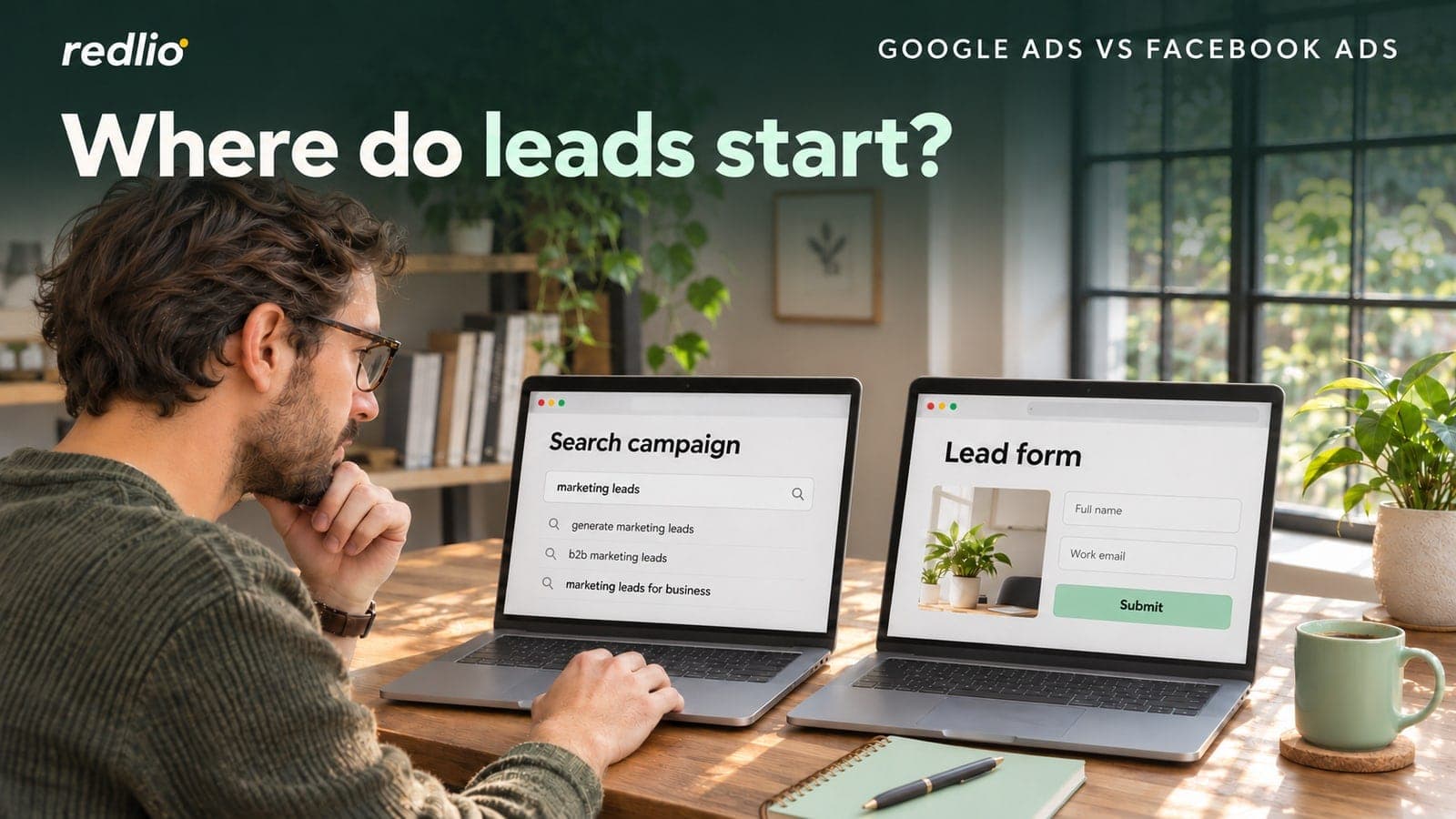
Google Ads vs Facebook Ads comes down to where the lead starts. Search reaches someone who already has the need; Meta predicts who might. For a B2B company with buyers who search, fund Search first, and judge both platforms by qualified leads in your CRM, not by cost per lead.

I chose Search for our own budget
Google Ads vs Facebook Ads stops being a debate once the money is your own. When we rebuilt Redlio Labs’ ad account for our new site in November 2026, I put the whole budget into Google Search and nothing into Meta.
There are two campaigns, both aimed at Mumbai, Navi Mumbai and Thane. One sells custom software and runs at ₹500 a day. The other sells custom ERP at ₹300 a day.
Each uses 17 or 18 keywords on exact and phrase match, never broad. A shared list of about 75 negative keywords keeps out job seekers, students and people after packaged products. The only conversion the account is told to chase is a submitted inquiry form.
We manage Google Ads and Meta ads for clients, so I don’t gain anything by favoring one. What I do have is a test of my own advice: this is what I’d tell a B2B client, and I followed it with our money.
The campaigns are new, so this post is about the decision, not the results. I’ll write those up once there are enough leads to read.
Search sells to a need that already exists
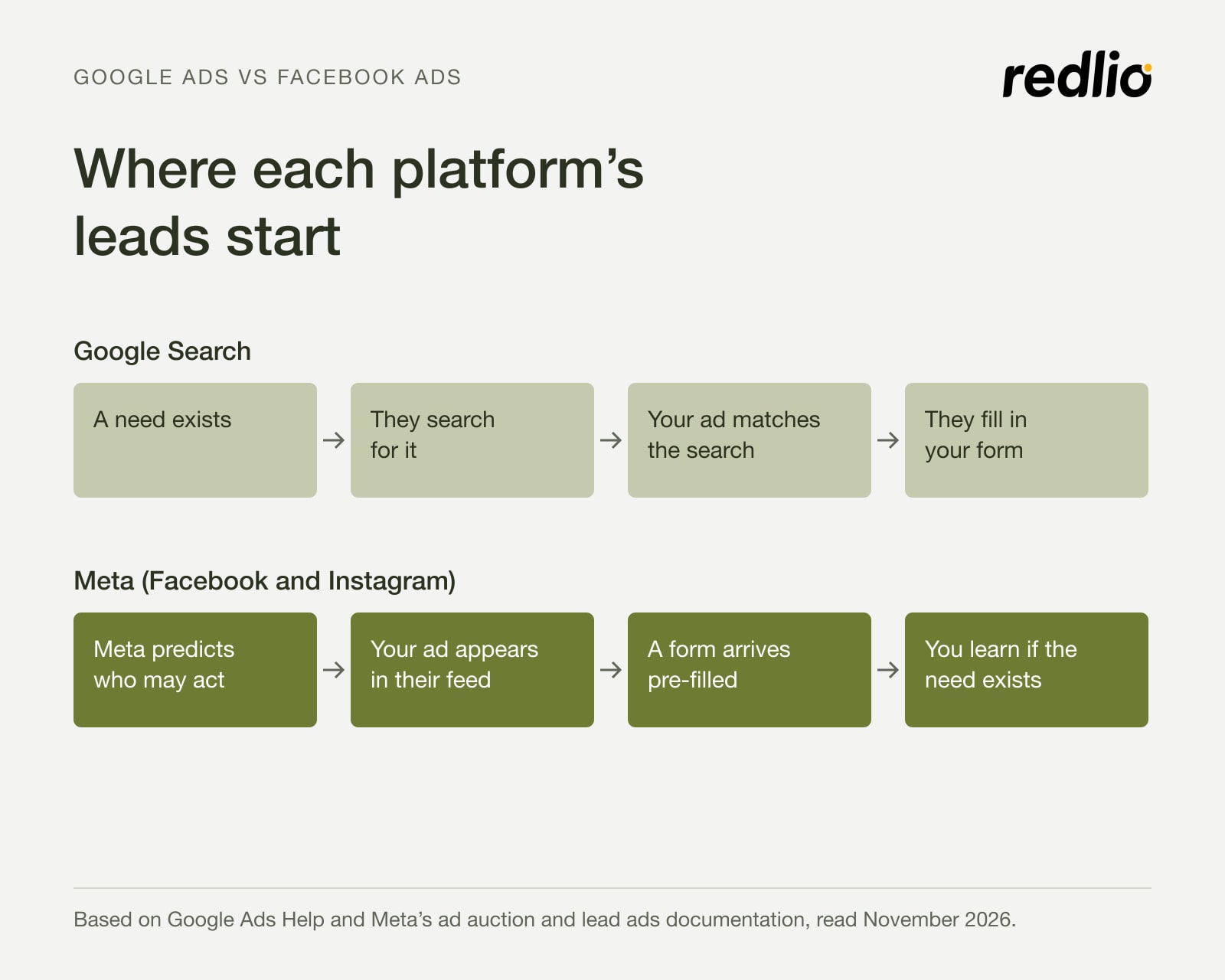
Google Search shows your ad because of what someone typed, so the need comes before the ad. Google says the auction process is repeated for every search, and it describes Search campaigns as a way to reach people actively searching for what you sell.
For a B2B seller that one fact carries most of the argument. A person searching for custom ERP development in Mumbai has a project, a problem or at least a budget conversation behind the search. I can’t buy that signal anywhere else.
The catch is volume. Google’s Keyword Planner showed most of our buyer terms at 10 to 100 searches a month in Mumbai, with top-of-page bids from about ₹33 to ₹330. Small numbers like these are normal in B2B, and they’re why every wasted click matters.
Match types don’t protect you as much as their names suggest. Broad match is the default, and Google’s keyword matching rules let even exact match show on searches with the same meaning or intent. So the negative list and a weekly read of the search terms report do the real filtering, which is how we run PPC management for clients too.
Meta decides who sees the ad
On Facebook and Instagram no one has asked for anything, so Meta predicts who is likely to act. Its ad auction page says the winner isn’t simply the highest bid; Meta weighs the bid against estimated action rates and ad quality, which together measure relevance.
That prediction is good at finding people who click and fill in forms. It doesn’t know whether they have a project. And the controls an advertiser has over the audience have narrowed.
In January 2025 Meta announced it was removing detailed targeting exclusions, saying its test showed a 22.6% lower median cost per conversion without them. Cost per conversion is the number Meta can see. Whether those conversions became customers is a number only the advertiser has.
The pool is enormous. Pew Research Center’s 2026 survey found 70% of US adults use Facebook and 51% use Instagram. A B2B audience is a sliver of that, and the auction will happily spend outside it if those people convert more cheaply.
Then there is the form itself. Meta’s lead ads fill in fields from information people already shared with Facebook, so sending one takes seconds. That is good for volume and bad for intent: with a search lead the need came first, and with a lead ad you find out afterward.
 (opens full size in a new tab)
Some sellers have less room still. Credit and other financial products, housing and jobs fall under Meta’s Special Ad Categories. Those ads lose gender and ZIP code targeting, get a fixed age range of 18 to 65 and over, and can’t use lookalike audiences.
Facebook leads cost less, which tells you little
Facebook leads are cheaper on the published medians, by more than half. The figures are LocaliQ and WordStream’s 2026 search benchmarks, from 13,474 US campaigns run April 2025 to March 2026. The Facebook side is their 2026 Facebook benchmarks, from 1,892 US campaigns run April 2025 to June 2026.
| Median, US campaigns | Google Search | Facebook lead campaigns |
|---|---|---|
| Cost per click, all industries | $5.42 | $1.80 |
| Cost per lead, all industries | $66.69 | $27.39 |
| Cost per lead, Industrial and Commercial | $75.19 | $35.87 |
| Cost per lead, Business Services | $93.69 | Not published for lead campaigns |
Read them as reference points, not targets. Both datasets come from campaigns LocaliQ’s customers ran, both count a lead the moment a form arrives, and neither says what share of those leads bought anything.
The comparison articles rarely say so. On November 26, 2026 I opened the eight pages a web search in the US turned up for “google ads vs facebook ads”. Five relied on data from before 2024, one presented 2016 and 2021 figures as current averages, and only three named a source for their numbers. None had a section for B2B buyers.
Here is how the cheaper lead can still cost more. The example is made up and isn’t from a client’s account. Take the Industrial and Commercial medians, the one B2B row both reports publish for lead campaigns. A $3,000 month buys about 40 leads on Google and about 84 on Meta.
Now suppose one Google lead in four turns into a real sales conversation and one Meta lead in fifteen does. Google gives you ten conversations and Meta between five and six. Those two ratios are invented for the example; your CRM has the real ones, and they are the only numbers that settle this.
Judge both in your CRM, not in the ad account
Both platforms can learn from what happens after the form, if you send it back. Until you do, each one optimizes for whatever it counts as a conversion, which is usually the form.
Google’s enhanced conversions for leads is the successor to importing offline conversions: you keep the lead in your CRM and report the stages that matter. Its import guidelines set a 63-day window for that method and 90 days for older click-ID uploads, so slow sales cycles need a plan.
Meta’s equivalent is the Conversions API, which accepts events from your server, app or CRM. PPC for SaaS follows one lead through those stages in detail. The short version for this decision is that a platform comparison made without this data compares form fills, and form fills are the easy part.
When I’d fund Meta first
I’d put Meta first when your buyers don’t search yet. A new category, a product people don’t know exists, or a problem nobody names in a search box all leave Search with nothing to match.
Meta also wins when the audience is defined by who people are rather than what they type, and the decision is small enough to start from a feed. A webinar, a free tool or an event sign-up fits that shape far better than a six-month software build does.
And it earns second place for almost any B2B company already running Search. Showing ads again to people who visited the service page costs little and reminds a buyer who is still comparing. Our Meta ads management page sets out where each Meta format fits.
For us, none of the first cases applied. People who need custom ERP know what to call it and go looking, so we paid to be there when they do.
Where LinkedIn fits in the comparison
LinkedIn is the third option most B2B buyers ask about, and it targets by job title, seniority, company and industry. LinkedIn requires an audience of at least 300 members and suggests 50,000 or more, with a minimum daily budget of $10.
Its reach is narrower by design. Pew puts LinkedIn use at 31% of US adults, rising to 51% of college graduates. I’d use it when the job title matters more than the search, and fund it from what Search has already proved about the offer.
If you’re weighing these channels for your own company, send me what you sell, the usual deal size and where your inquiries come from today. In a half-hour call, the engineers and marketers who’d actually manage your campaigns will say which channel they’d fund first. If the answer is neither, you’ll hear that too.
Questions about Google Ads vs Facebook Ads
Which is better for B2B, Google Ads or Facebook Ads?
Google Ads, for most B2B companies whose buyers search for what they sell, because the search shows the need before the click. Meta suits offers people don’t search for yet and remarketing to past visitors. Decide on qualified leads in your CRM, not on cost per lead.
Is Facebook advertising cheaper than Google Ads?
Per click and per lead, usually yes. LocaliQ and WordStream’s 2026 medians put a Facebook lead at $27.39 and a Google Search lead at $66.69. The samples differ, and neither figure shows how many leads became customers.
Is $20 a day good for Google Ads?
At the 2026 median cost per click of $5.42 it buys three or four clicks a day. In a narrow B2B market with tight keywords, that can be enough. Google may spend up to twice the daily budget on a given day, but no more than 30.4 times it over a month.
Is $10 a day enough for Facebook ads?
It buys about five clicks a day at the 2026 lead-campaign median of $1.80. At the median cost per lead, that is roughly one lead every three days. That is enough to test an offer slowly, not to judge it in a week.
Should I run Google Ads and Facebook Ads together?
Often, but in order. Start with the channel that matches how your buyers behave and connect the CRM so it learns from qualified leads. Then add the second, usually Meta remarketing to people who already visited.
The author