How to choose a web design agency when the contract decides who owns the site
Choosing a web design agency starts with ownership. Without a signed assignment, the agency that built your site usually owns its copyright, and the domain may sit in its name. After that, judge the people who will do the work, read reviews knowing some are fake, and make the scope name accessibility, speed and redirects.

Who owns the site if the contract says nothing
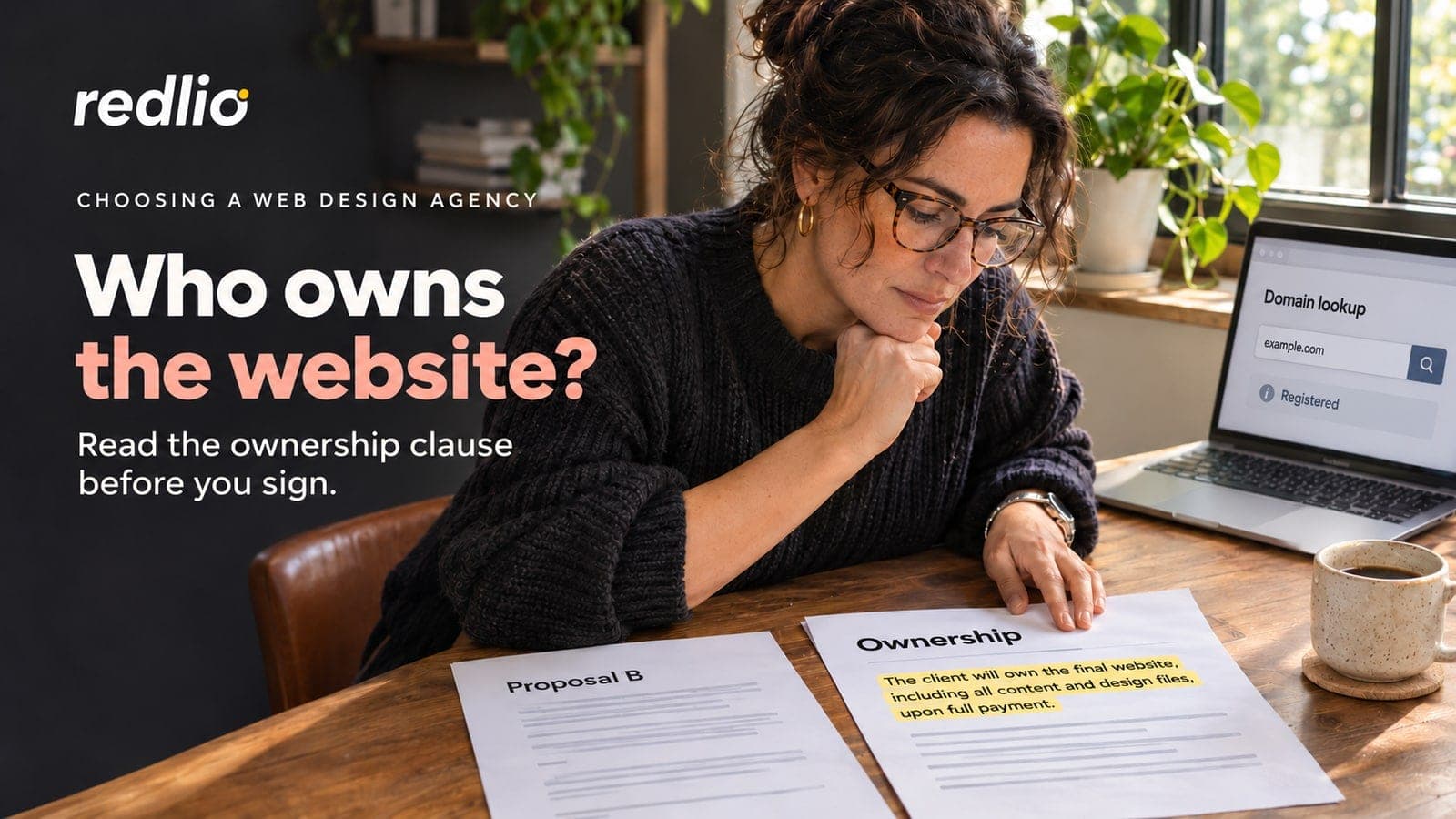
Most buyers assume they own a website because they paid for it. Under US copyright law that is not the default. The US Copyright Office’s Circular 30 says the author of a work is ordinarily the person who created it.
A commissioned work becomes the client’s as a work made for hire only in nine listed categories, and only with a written agreement both sides sign. Websites are not among the nine. Without an employee relationship or a signed assignment, the agency that wrote the code and made the designs is likely to hold the copyright.
The fix is a clause, not a lawsuit: a written assignment of copyright in the code, designs and content the agency creates, taking effect on payment. I’m not a lawyer, and a short review by yours is cheap compared with rebuilding a site you thought you owned.
I run an agency that designs and builds websites, so I’m one of the people this article tells you how to judge. Use these tests on us as hard as on anyone.
The domain, the hosting and the logins
The domain name is the asset that hurts most to lose. ICANN’s own explanation of registrant rights uses the example of a website designer registering a domain for a client. Whoever is listed as the registrant controls it, and can even be held accountable for how someone else uses it.
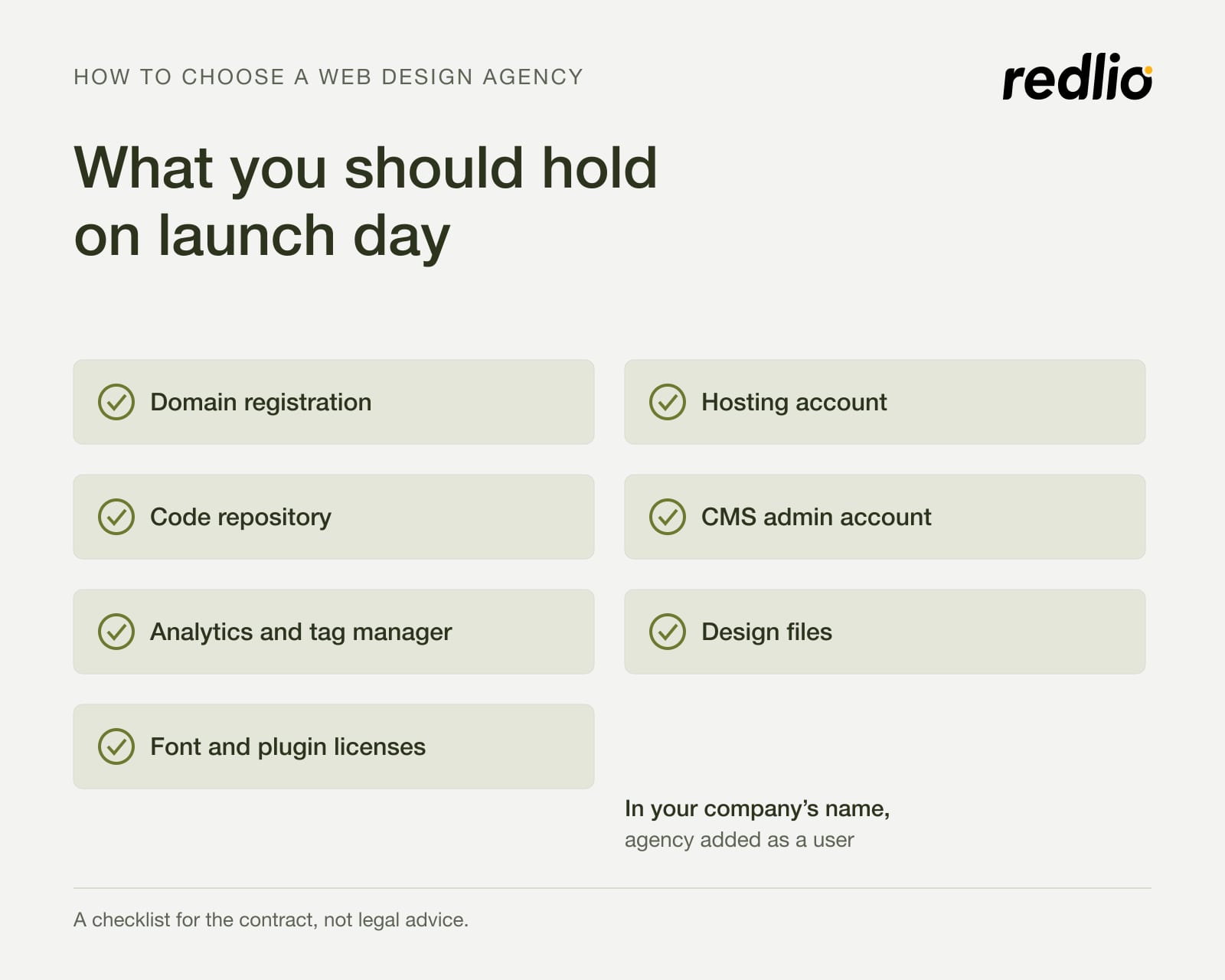
So the domain should be registered in your company’s name, on a registrar account your company controls, with the agency added as a user if it needs access. The same goes for hosting, analytics, the CMS admin account and any paid plugins or fonts.
Checking a domain you already have
Take a made-up firm that has used the same agency for six years. A lookup at ICANN’s registration data service shows the registrant organization as the agency, not the firm. Nothing is wrong today. But if the relationship ends badly, the firm needs the agency’s cooperation to move its own address.
The fix takes an afternoon while relations are good. Ask the agency to change the registrant through the registrar, then move the registrar account into the firm’s name. Do it before you need it.
 (opens full size in a new tab)
Reading reviews when some of them are fake
Reviews still matter; just know what you are reading. The US Federal Trade Commission’s rule on fake reviews has applied since October 21, 2024. It bans fake and AI-written reviews, undisclosed insider reviews, and paying for reviews on condition they are positive. The FTC can now seek civil penalties against knowing violators.
Platforms differ in how hard they check. Clutch says reviewers sign in through LinkedIn, Google or a company email, and a human editor checks every review. It rejected 10% of submissions in 2025 for signs of falsified information. Google’s contribution policy forbids paying for reviews and asking only happy customers for them.
Read the criticism first. Praise sounds alike from one agency to the next, and the complaints show you what working with them felt like. One of our own clients told Clutch we could have paid closer attention to minute details, and that line tells you more about us than any five-star summary.
Then ask for two references from projects like yours, and call them. Ask about the worst week and how the agency dealt with it. Every project has a bad week; you want to know what happened in it.
Meet the people who will build it
The person who sells you the project is often not the person who designs or codes it. Ask for the designer and the developer by name, how senior they are, and how many other projects they are carrying.
Then talk to them. Ten minutes with the developer will tell you more about redirects, speed and how your forms will reach your CRM than any portfolio. If an agency can’t put its makers on a call before you sign, assume you won’t see much of them after.
What the scope has to name
A website proposal is easy to compare on design and hard to compare on everything else. Make the scope name the parts that are expensive to add later.
Accessibility comes first, against a named standard, which today means WCAG 2.2 AA. In WebAIM’s 2026 Million report, 95.9% of a million home pages failed automated WCAG checks. “We build accessible sites” means little without a level and a test. None of the nine ranking guides I read named a WCAG version.
Then speed targets, written as Core Web Vitals, which our redesign checklist explains. Then redirects from every old URL, if you have an existing site, covered in our migration guide. Then who moves the content, and how forms and analytics will be tested before launch.
Try a small paid piece of work first
The cheapest way to test an agency is to buy something small from it. A paid discovery, a content inventory, or a homepage concept shows how it thinks, what it asks and how it writes things down. None of the ranking guides suggested this.
It also gives you something to keep if you walk away. A sitemap and a content plan you paid for are yours to hand to the next agency.
What a website costs, and why the guides disagree
Four of the guides I read give price ranges, from a few thousand dollars to over a hundred thousand, and none says where its figures come from. Price follows scope: the number of templates, how much content moves, integrations, and the standards above.
What moves the number is broken down in our redesign cost guide. Proximity sometimes matters as much as price: one client told Clutch it chose us partly because we were close by.
Questions to ask a web design agency
Send these in writing before the first call, so every agency answers the same questions.
- Will you assign copyright in the code, designs and content to us on payment, in writing?
- Will the domain, hosting, analytics and CMS accounts be in our company’s name from day one?
- Who will design and build our site, named, and when can we speak to them?
- Which WCAG level do you build to, and how do you test it?
- What speed targets will you commit to, measured how?
- Who writes the redirect map from our old URLs, and who tests it?
- Who moves our content, and what happens to pages nobody wants?
- Can we buy a small paid first piece of work before the full project?
- What does support after launch cover, for how long, and at what price?
- Can we call two clients whose projects were like ours?
If you are choosing an agency now, send me your current site and the shortlist’s proposals. I’ll reply within 12 hours. On a call, our designer and developer will mark what each proposal leaves out, ours included if we are on your list.
Questions about choosing a web design agency
How do I choose a web design agency?
Settle ownership first: a written copyright assignment and the domain and accounts in your name. Then meet the designer and developer, and read reviews critically. Make the scope name accessibility, speed and redirects, and test the agency with a small paid piece of work.
Who owns my website, me or the web designer?
Under US law, the creator usually owns the copyright unless you have a signed assignment. Websites are not among the nine categories a commissioned work needs to count as made for hire, so put a written assignment in the contract.
What are red flags when hiring a web design agency?
Watch for an agency that registers your domain in its own name or refuses to assign copyright. Be wary if it keeps its designers and developers away from you before signing. No named accessibility standard and no plan for redirects are red flags too.
What questions should I ask a web design agency?
Ask who owns the code and accounts, and who will do the work. Ask for the WCAG level, the speed targets, and who handles redirects and content. Then ask about a small paid first piece, what support covers, and for two references from similar projects.
Are web design agency reviews reliable?
Partly. The FTC banned fake and paid-for reviews in 2024, and platforms such as Clutch verify reviewers, but no system is perfect. Read the criticism, look for detail, and call references yourself.
The author