Software development RFP: what a supplier needs before it can price the work
A software development RFP gets prices you can compare when it describes the problem and leaves the solution open. It should state who uses the software, which systems it must connect to and what data it inherits. At that stage an estimate can still be four times too high or too low, so ask for a range and what would narrow it.

What an inquiry found in one payroll tender
In 2013 a commission of inquiry in Queensland reported on the payroll system built for the state’s health department. IBM’s tender price had been A$98 million. The commission’s report estimated that the system would cost about A$1.2 billion over the next eight years, and that paying staff each fortnight took about 1,000 employees.
The commission did not put the failure down to code. It found that the scope “was never properly defined” from the state’s side, and that the department had been passive in identifying and communicating its business requirements. Changes to that scope, it said, were a major contributor to the sharp rise in the price.
A software development RFP is where scope is first written down for people outside the organisation. Suppliers price what it says and assume the rest. Those assumptions are where prices move later, and where three proposals for the same RFP stop being comparable.
We build custom software and price briefs that buyers send us, so the way these documents are written affects us directly. What follows is about making any supplier’s price comparable, ours included.
Where the advice on writing one disagrees
On November 21, 2026 we opened the pages Google ranked for “software development rfp” and “how to write an rfp for software development”. Nine opened in full. Eight are published by firms that sell software development or RFP software. Six tell you to describe the problem rather than list features, and we agree with them.
They disagree on length. The four that give a page count say three pages, three to four, two to six, and ten to twenty, and none gives evidence for its figure. One mentions acceptance criteria. None suggests asking suppliers for working code, which is what the US government’s own digital teams told agencies to do, as the section on code shows.
Why a price from an RFP is still an estimate
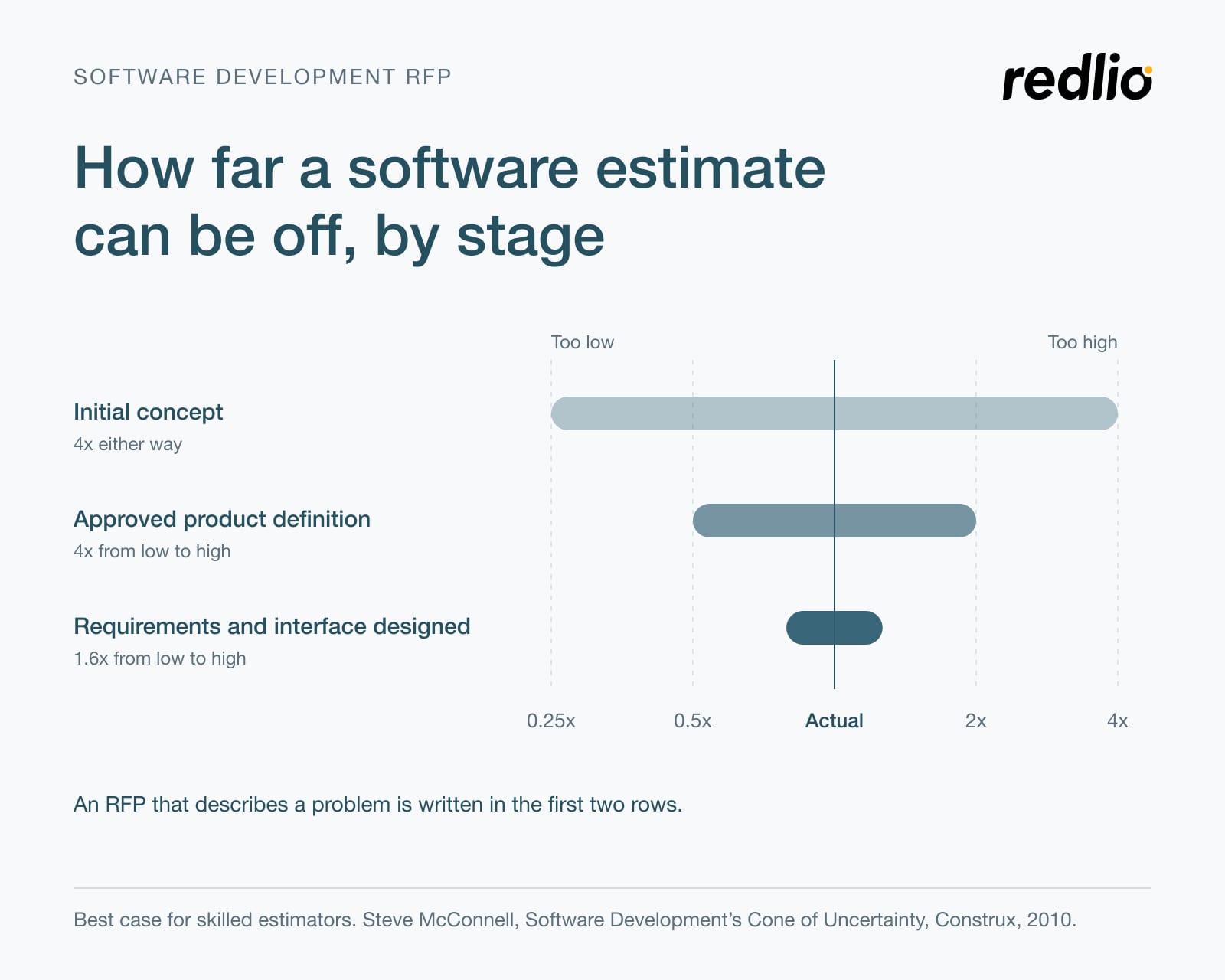
Software project estimation narrows as decisions get made, and an RFP is written before most of them are. Steve McConnell’s paper on the cone of uncertainty (Construx, 2010) puts estimates made at the initial concept up to four times too high or four times too low.
Once the requirements are complete and the user interface is designed, the spread between a high and a low estimate falls to 1.6 times. McConnell calls this the best case for skilled estimators: doing worse is easy, and doing better is luck. He also writes that meaningful commitments are not possible in the early, wide part of the cone.
 (opens full size in a new tab)
So a fixed price in reply to an RFP is a range with the risk priced in. Faced with an open question, a supplier can pad for it, assume the cheap answer and list it as an exclusion, or decline to bid. Three proposals can make three different choices on the same line.
Ask for the estimate as a range, with the assumptions behind it and what would narrow it. If you need one fixed number, buy a short discovery phase first and fix the build price on what it produces. How each pricing model shares the cost of what is still unknown is covered in our contract article.
Describe the problem and the facts a price depends on
The UK government’s guidance for buyers on its Digital Outcomes framework says requirements tell suppliers about your situation or problem. The suppliers then propose the solution. The US Digital Service’s TechFAR Hub draws the same line between a specification that says how and a product vision that describes the outcome wanted.
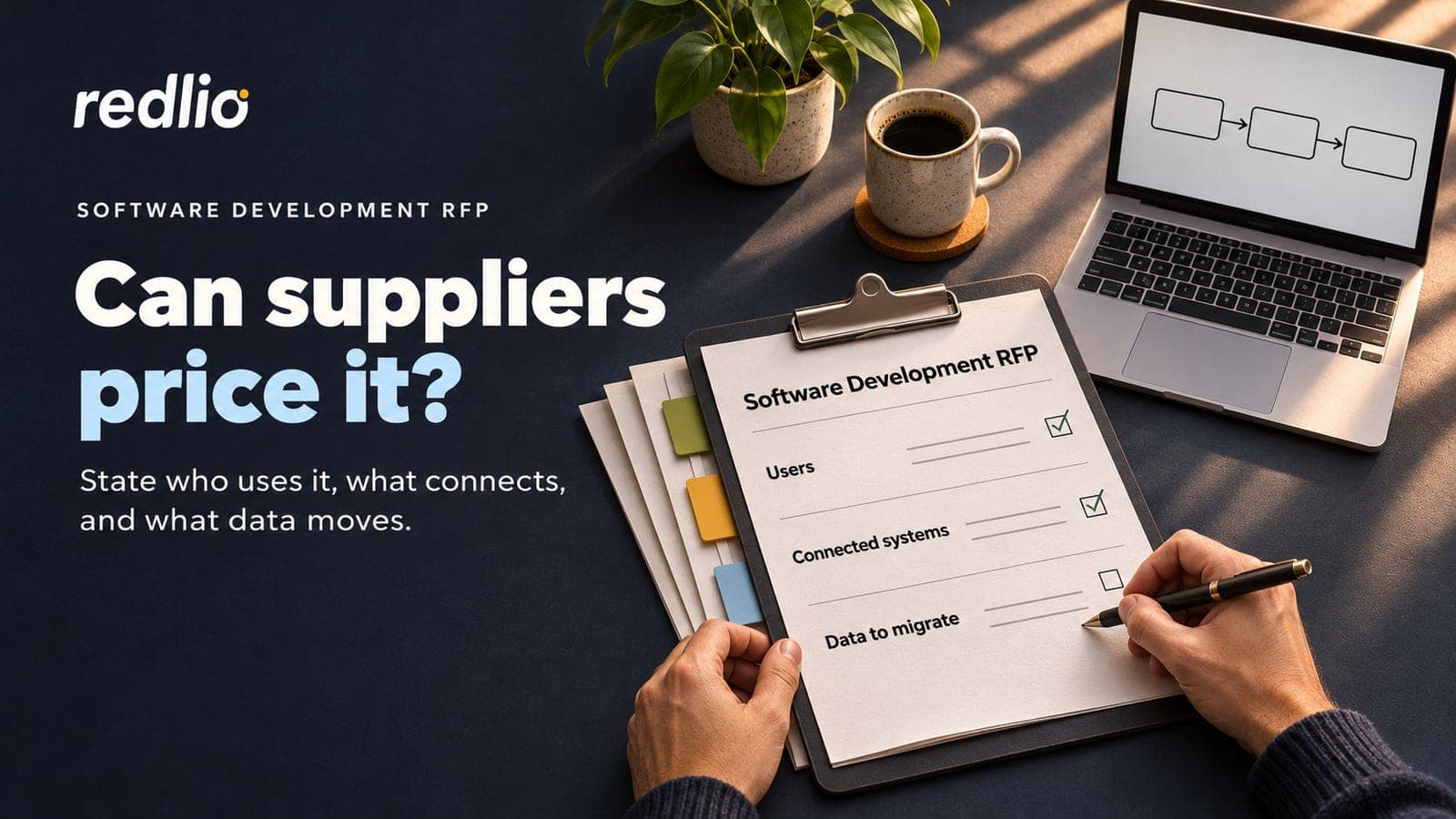
Leaving the solution open does not mean leaving the facts out. The facts a supplier prices from are ones only you hold. They include who will use the software and in what numbers, the systems it must exchange data with, and the data it inherits. Add the rules it must meet on security, accessibility and where data is stored.
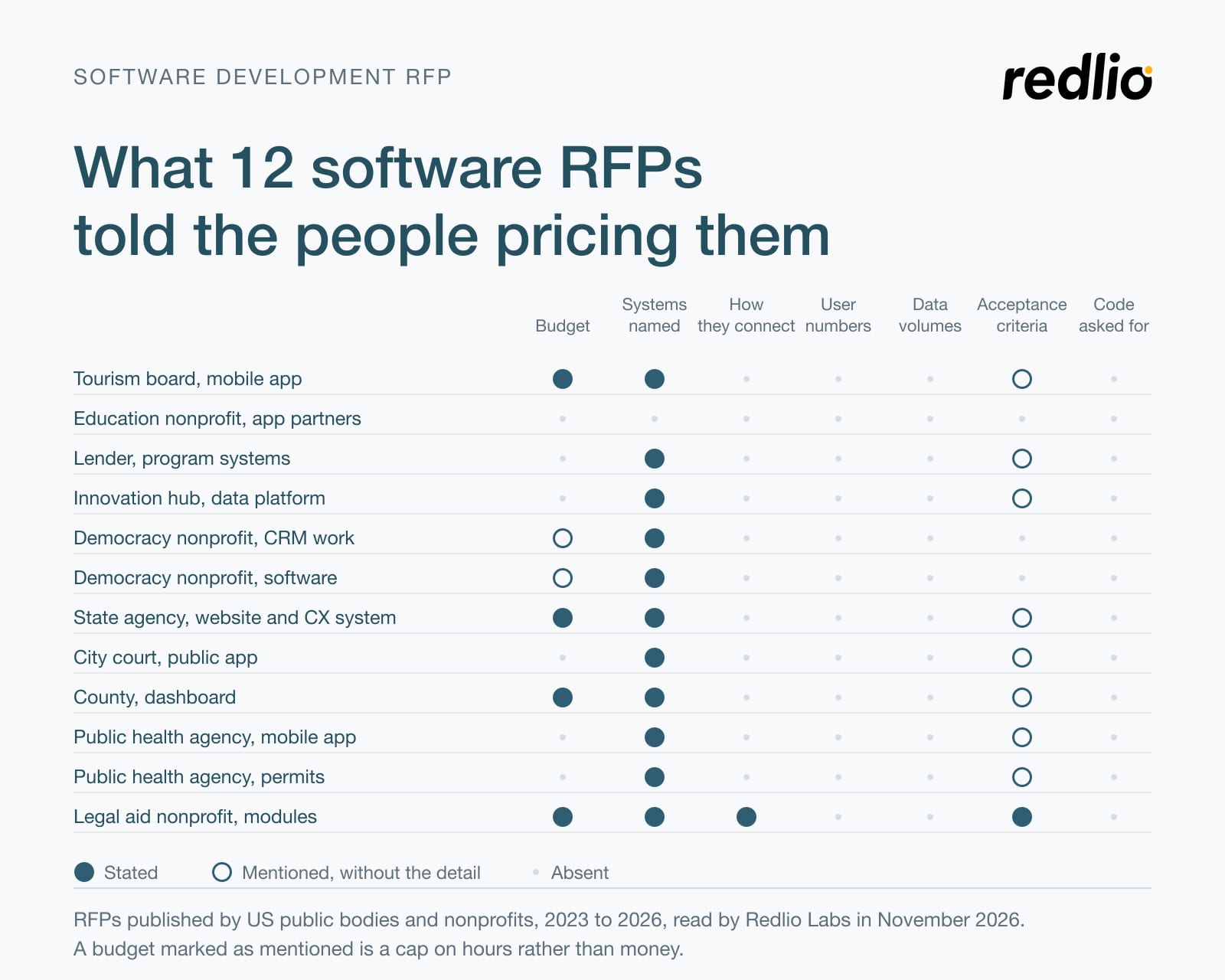
Published RFPs are thin on exactly these. We read 12 software development RFPs issued by US public bodies and nonprofits from 2023 to 2026, from a tourism board’s mobile app to a court’s public app. Eleven named the systems the software had to connect to. One said how they would connect: which interface, with what level of detail.
None said how many people would use the software. Three involved moving data from an old system, and none of the three said how much. A supplier pricing any of the twelve had to guess at both, and so did every competing bidder, each in its own way.
 (opens full size in a new tab)
Integrations deserve the most words. “Integrates with our ERP” can mean a nightly file export or a two-way sync with error handling on both sides. A supplier cannot tell which from the sentence. Our own work points the same way. For the step counter app we built for a consumer company in Egypt, discovery meetings settled the features, deadlines and cost before any build began.
The whole project is described in our mobile app cost article.
One requirement, written twice
Here is an illustration rather than a client’s project. A distributor wants its customers to see the status of their orders online. The first version of the requirement reads: “The portal shall integrate with the ERP to show real-time order status.”
A supplier pricing that sentence has to assume which ERP, which version, and whether it has an interface the supplier may use. It also has to guess what real time means, how many customers and orders there are, and who fixes the ERP side when a sync fails. Each assumption becomes an exclusion or a margin in the price.
The second version reads: “Customers see the status of orders placed in the last 24 months. Orders are held in our ERP, which has a documented REST API our IT team will open to the supplier. About 400 customers place around 3,000 orders a month. Status may lag by up to 15 minutes. Our ERP partner makes any change on the ERP side.”
The second version is five sentences long and still says nothing about how to build the portal. It turns the guesses into facts, so three suppliers price the same work. The differences left between their proposals are differences in approach, team and price for the same scope.
A software requirements document does a different job
A software requirements document specifies a system in enough detail to build and test it. ISO/IEC/IEEE 29148, the international standard for requirements engineering, lists what such a specification covers. That includes product functions, user characteristics, external interfaces, performance, usability, database requirements, design constraints and how each requirement will be verified.
Projects fail at both ends of this. The FBI’s Virtual Case File shows what happens when requirements are missing. In 2005 the US Justice Department’s inspector general reported on the system after more than three years and about $170 million. Its first delivery had not been accepted because it did not meet the FBI’s requirements.
The report put poorly defined and slowly evolving design requirements first among the causes. It also noted that the FBI had chosen cost-plus contracts because it lacked clearly defined requirements, a contract type that leaves the buyer carrying the cost of change.
The opposite mistake is to write every requirement before any supplier is chosen. 18F was the US government’s in-house digital consultancy. Its de-risking guide warned that requirements gathered that way no longer match the agency’s needs by the time the contract is awarded. 18F was shut down on March 1, 2025, its former staff record, and an archived copy of the guide is still online.
Our view is that the RFP should settle the problem, the boundaries and the facts a price depends on. The detailed specification is the first thing you build with the supplier you choose, during discovery. Changes to it after that point are governed by the contract, and acceptance is where they get checked.
Requirements changed across several review cycles on the school website we cover in our article on building or buying software. On Clutch, the school’s only criticism was that it wanted the work checked more formally at key milestones. That step belongs in the contract as acceptance, and the RFP should say it will be there.
Ask to see code, not more prose
The best evidence of how a supplier builds is code it has written. 18F’s guide told agencies to keep proposals under ten pages, recommending a hard limit of five. In place of narrative, it asked bidders for links to two or three source code repositories.
Its reasoning was that real code shows how a team will perform better than staged exercises such as bake-offs or hackathons. It also recommended spoken interviews with the named team. The TechFAR Hub records a case study in which the Department of Veterans Affairs gave bidders for its appeals system 72 hours to submit code.
None of the 12 published RFPs we read asked for code or a technical exercise. Three asked for a demonstration of the proposed solution, and four asked for portfolios or work samples. For a private buyer the test is cheap to run. Ask each shortlisted supplier for a repository it can show, or set a small paid exercise, and have someone technical read the result.
Applied to us, that is a test we would expect to sit. Our first call already puts you in front of the developers who would build the software.
Budget, pricing model and time to answer
State a budget range. Four of the 12 RFPs gave a money figure and two capped the hours instead. Our count of website RFPs makes the same case for redesigns. For software the cone above makes it matter more, because without a range each supplier picks its own point in a very wide spread.
Say which pricing model you will accept, or ask each supplier to propose one and explain it. Three of the 12 asked for a fixed price paid by milestone, two asked for hourly rates, two let the bidder choose and three never said. Discovery at a fixed price, followed by a range for the build, fits what an RFP can actually tell a supplier.
Give suppliers time to read and ask questions. Above the simplified acquisition threshold, FAR 5.203(c) gives bidders on US federal contracts a minimum of 30 days. The 11 dated RFPs we read gave between 21 and 65 days, with a median of 32.
Answer every question to every bidder in writing. If an answer changes the scope, amend the RFP, which FAR 15.206 requires of federal buyers. Four of the 12 contained errors a bidder would have had to ask about. One cited an interface table that was not there and one gave two due dates. One had scoring weights adding up to 140, and one still had bracketed placeholders.
What a software development RFP should contain
Written to the list below, the main document can stay short, with the detail in attachments. Each line is something a supplier would otherwise have to guess.
- The problem: who has it, what it costs today, and what will be different when it is solved.
- The users: each role, roughly how many people in it, and where they work.
- The systems to connect: name and version, who controls each, and the documentation or API access you can give.
- The data the software inherits: where it lives, how much there is, how far back it goes, and how clean it is.
- The rules: security, privacy, accessibility, hosting and where data must be stored.
- Anything this phase leaves out.
- The budget range, the date that matters, and why it matters.
- How you will choose: the criteria and their weights, the code you will ask to see, and who will interview whom.
- What you want back: an estimate as a range with its assumptions, a price for discovery, the named team, and how acceptance and code ownership will work.
If you are drafting an RFP for custom software, share the draft with whatever documentation exists for the systems it has to talk to. Expect a reply inside 12 hours, and an NDA before any call. Then the developers who would build it go through the draft with you for half an hour, marking each line a supplier would be left guessing at. You get a straight answer on whether we suit the project too, invited to bid or not.
Questions about software development RFPs
What should a software development RFP include?
It should include the problem and what success looks like, the users and their numbers, and the systems the software must connect to and how. Add the data it inherits, the rules it must meet, what this phase leaves out, a budget range, the deadline and the evaluation criteria. Ask for an estimate as a range with its assumptions, and for a price for discovery.
How long should a software development RFP be?
There is no evidence for any length. Ranking guides recommend anything from two to twenty pages, none with a source. Length matters less than whether the document states the facts a supplier prices from. Keep the main document short and put system documentation and data samples in attachments.
Should you include a budget in a software RFP?
Yes, as a range. An estimate made from an RFP can be several times too high or too low. Without a range, each supplier picks its own point in that spread and the proposals stop being comparable. Four of the 12 published software RFPs we read stated a money figure.
What is the difference between an RFP and a software requirements document?
An RFP describes the problem, the facts and the terms so suppliers can propose and price a solution. A software requirements document specifies the chosen solution in enough detail to build and test it, and ISO/IEC/IEEE 29148 sets out what it covers. In our view the requirements document comes out of discovery with the supplier you choose.
How do vendors estimate a software project from an RFP?
They break the described work into parts, estimate each, and add allowances for whatever the RFP leaves open. Steve McConnell’s cone of uncertainty puts estimates at the concept stage up to four times too high or too low, narrowing as requirements and design are settled. That is why a responsible reply to an RFP is a range with stated assumptions.
How long should vendors get to respond to a software RFP?
On US federal contracts above the simplified acquisition threshold, the minimum is 30 days. The 11 dated software RFPs we read gave between 21 and 65 days, with a median of 32. Allow time for questions, and publish every answer to every bidder.
The author