Staff augmentation vs outsourcing, decided by what the work needs to know
Staff augmentation vs outsourcing is a choice about where the knowledge sits. Outsource work that someone outside can be judged on without knowing your business. Augment your team for work that depends on what only your people know, because that is where outsourcing’s hidden costs rise.


One piece of work, bought two ways
As an illustration, not a client’s project, take a mid-size distributor that wants a customer portal on top of its existing order system. Customers should see their orders, invoices and delivery dates, and reorder without calling sales.
Bought as staff augmentation, two engineers from a supplier join the distributor’s own team. Its tech lead decides what they build each week. They learn the order system the way an employee would, by reading the code and asking the people who wrote it. When they leave, what they learned stays in the distributor’s codebase and in its team’s heads.
Bought as outsourcing, a supplier quotes the portal as a project. Before it can, someone at the distributor has to write down how the order system works. That means its data, its exceptions, and the pricing rules a few long-standing customers get. The supplier builds against that document, and the distributor accepts the result against criteria. Much of what the supplier learns along the way stays with the supplier.
Both can work. The difference is how much of the distributor’s own knowledge the portal needs. If the order system is clean and documented, the outsourcing route is cheaper to run. If the useful rules live in three people’s heads, the document the supplier needs is the hard part, and augmentation brings the engineers to the knowledge instead.
That is the test this article argues for. It is different from the one in our staff augmentation vs dedicated team article, which turns on who gives the engineers their instructions. This article asks where the knowledge has to be for the work to go well, and where you want it when the work is over.
We sell both models: IT staff augmentation and custom software development as a fixed-scope project. We read nine of the ten pages a US web search returned for “staff augmentation vs outsourcing” on November 19, 2026. All nine were published by companies with a stake in the answer, eight ended in a pitch for their own service, and none said so as a caveat. Four cited any source, none mentioned worker classification or IR35, and one put a figure on the buyer’s management time, without a source.
Where the definitions agree
Staff augmentation adds people you direct; outsourcing hands an outside company a result to deliver. All nine pages we read define them that way, and so do the tax authorities.
The US Internal Revenue Service draws the line in one sentence. A person is an independent contractor when the business may direct only the result of the work, and not what will be done and how. Outsourcing buys a result. Augmentation buys the right to direct what is done and how.
Is staff augmentation considered outsourcing? Commercially, yes: you buy people from another company, and Deloitte’s outsourcing survey, for one, counts it as an outsourcing model. Operationally and legally it sits on the other side of the line, because you direct the work. That is why the two need different contracts, different management and different checks.
The line UK tax law draws between them
In the UK, the difference between augmentation and outsourcing decides who has to assess the workers’ employment status for tax. HMRC’s manual draws the line in the same place as the definitions, and it looks past the label on the contract.
Since April 2021, a medium or large client that engages contractors working through their own companies must decide their status and issue a status determination statement. HMRC’s manual on contracted-out services says a client that receives a fully contracted-out service does not need to apply those rules. It also says that calling a contract a contracted-out service or a statement of work does not help when, in reality, the contract provides labour.
One of the manual’s examples is IT contractors building an app under the client’s own project service manager. HMRC’s answer is that this is not a contracted-out service, and the client must determine the workers’ status. In the terms of this article, that is augmentation, and the paperwork does not change it.
The rules turn on contractors who work through their own intermediary companies. HMRC’s guidance does not directly address a non-UK supplier’s salaried employees serving a UK client, so take advice on that case. What is clear is that the shape of the work, not the title of the contract, decides which side you are on.
The EU uses the same words. The temporary agency work directive covers workers assigned to a company to work under its supervision and direction. It entitles them to at least the basic conditions they would have if hired directly. In the US, the Labor Department proposed a new joint employer rule in April 2026, and no final rule had been published by November 19, 2026. The questions your legal team will ask about augmentation are listed in our dedicated team comparison.
What outsourcing costs the client after signing
Outsourcing’s hidden costs land on the client, and they grow with how much client-specific knowledge the work needs. That is the clearest finding we know of on this choice.
Dibbern, Winkler and Heinzl followed six projects that a German financial services firm offshored to Indian suppliers, in a study published in MIS Quarterly in 2008. The client’s extra costs after the contract fell into four areas: specifying requirements and design, transferring knowledge, controlling the work, and coordinating it. They rose with the amount of client-specific knowledge each project needed. They arose largely whether or not the supplier behaved opportunistically, and distance and staff turnover made them larger.
 (opens full size in a new tab)
The finding is about one firm and six projects, and it is older than most of the tools teams use today. It matches what practitioners say in public. One engineer wrote on Hacker News that most outsourced teams need specifications and do not work well without them. A specification is client-specific knowledge written down, and writing it is a cost the quote does not show.
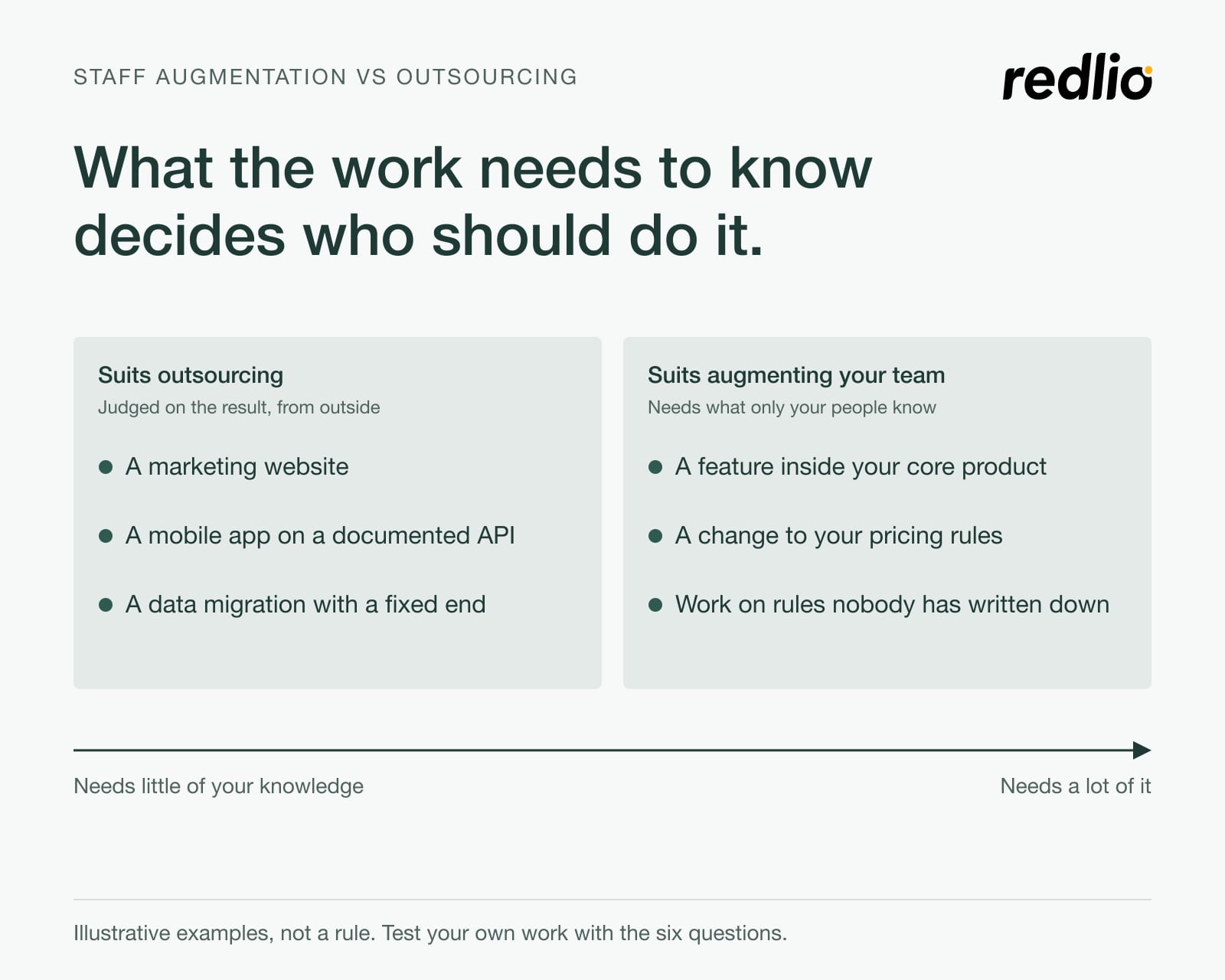
So outsource work that someone outside can be judged on without knowing your business. A marketing website, an app built against an API that is already documented, or a migration with a defined start and end all fit. Augment your team for work tangled up with your own systems, rules and decisions, such as a feature inside your core product or a change to how you price.
The worked test is simple. Ask whether you could write acceptance criteria for the work that a stranger could be held to. If you can, outsourcing turns that into a delivery you can accept or reject. If writing them would take longer than doing the work with your own team, augment.
What augmented engineers are allowed to do
Augmentation brings engineers to your knowledge, but only pays off if you let them use it. Research on contract professionals found that the way their jobs are designed, not their ability, explained why they were rated lower.
Ang and Slaughter compared contract and permanent IT professionals working on the same software teams, in MIS Quarterly in 2001. Supervisors rated the contractors as lower performing and less loyal. The contractors were given narrower jobs, and permanent staff took on the wider scope that was left. The rating followed the job design.
The lesson for a buyer is to decide the scope before the engineers arrive. Augmented engineers kept to the edge of the work, without access to the people and decisions behind it, will look like the weaker hires and will be. If the work is too sensitive to share that context, it is not work to augment, and it may not be work to outsource either.
Which way the market is moving
Large buyers have been moving from buying hours to buying outcomes, and many have also brought outsourced work back in house. Both trends say more about reversibility than about which model is better.
Deloitte’s 2024 Global Outsourcing Survey, of more than 500 business and technology leaders, found 67% had adopted managed or operate services and 29% the staff augmentation model. Cost savings as the main reason to outsource fell from 70% four years earlier to 34%. Deloitte sells sourcing advice, so read its framing with that in mind.
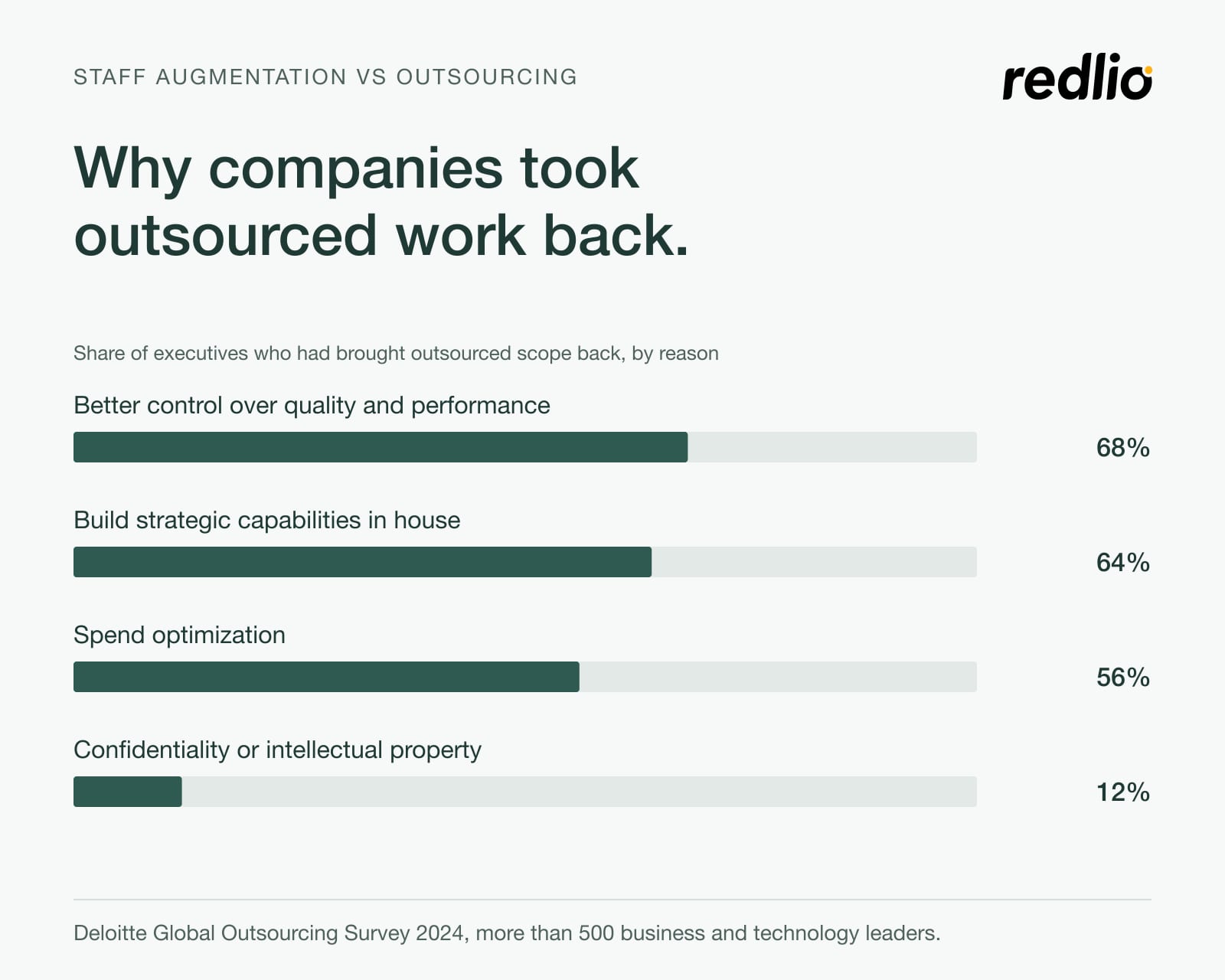
The same survey found that 70% of executives had brought some outsourced scope back in house over the previous five years, most of them very selectively. Their most common reasons were better control over quality and performance (68%) and building strategic capabilities in house (64%), ahead of spend optimization (56%). Confidentiality or intellectual property was a reason for 12%. Poor supplier performance during transitions was a challenge for 46% of all respondents.
 (opens full size in a new tab)
In the US, Staffing Industry Analysts estimates IT staffing revenue fell 6% in 2024 and about 3% in 2025. Its September 2026 forecast expects growth of 2% to 38.1 billion dollars in 2026. Those figures leave out work bought under statements of work, so they measure the augmentation side only.
None of this should decide your case. The trend toward outcomes fits work that can be specified, and the insourcing figures are a reminder that work is often taken back later. Choose the model for the work, and plan how you would get the work back either way.
Getting the work back
Leaving augmentation is an offboarding; leaving outsourcing is a handover project. Each model keeps its knowledge in a different place, so each is reversed differently.
With augmentation, the code and the process are already yours, and the risk is the context in individual engineers’ heads. Ask for decisions to be written down as they are made, and overlap any replacement with the person leaving.
With outsourcing, the knowledge sits with the supplier until it is handed over. The repository, the accounts, the deployment path and the documentation all have to move, and the time to agree that is before you sign. Our software development contract guide lists what to name in the exit clause.
Two of our projects, one each way
Our own work shows both sides of the test, and neither story is more than its client said.
A matrimonial service for verified professionals bought a website from us as a project, with ongoing maintenance after it. The client wrote on Clutch that the designs were finalized first and the functionality tested after. It said the work arrived on time and met all the requirements. The client chose us partly for being close by. The requirements could be written down and the result checked against them, which is the work outsourcing suits.
The other side is a digital marketing agency that hired us for overflow design work. It had already decided what its client’s site should be, and we worked to its specification. That story is told in full in our dedicated team comparison. The knowledge stayed with the agency, and our engineers added capacity to it.
Six questions that settle staff augmentation vs outsourcing
These are the questions we would put to any piece of work before choosing. Answer them about the work, not about your organization in general.
- Could you write acceptance criteria for this work that a stranger could be held to?
- How much of the work depends on knowledge that only your people hold, and is any of it written down?
- Who on your side has time each week either to direct engineers or to review and accept deliverables?
- Where should the knowledge live when the work is finished: in your team or with a supplier you keep?
- How would you take the work back, and what would that cost in time?
- Where will the people work, and has your adviser checked how the engagement is classified there?
If the first two answers point to outsourcing and the third has a name next to it, buy a project. If they point the other way, augment. If they disagree, split the work: outsource the parts with a clear edge and augment your team for the part tangled up with your business.
Unsure which side a job falls on? Describe it to us and name the person who would direct or sign it off. We reply within 12 hours. We sell both models, so the engineers who would build it will say on a short call which one fits, or that neither does.
Questions about staff augmentation and outsourcing
What is the difference between staff augmentation and outsourcing?
Staff augmentation adds a supplier’s engineers to your team, working under your direction in your process. Outsourcing hands a supplier a defined result to deliver, and the supplier decides how. With augmentation the knowledge stays in your team; with outsourcing much of it stays with the supplier until it is handed over.
Is staff augmentation considered outsourcing?
Commercially it often is, because you buy people from another company, and Deloitte’s outsourcing survey counts it as an outsourcing model. In how the work runs, and in UK tax law, it does not. You direct the people, so it counts as a provision of labour rather than a contracted-out service.
Which is cheaper, staff augmentation or outsourcing?
Neither in general. Outsourcing can cost less to manage when the work can be specified. Research on offshored projects found the client’s extra costs rise with how much client-specific knowledge the work needs. Augmentation costs your leads’ time to direct the engineers. Compare the full cost of each for the specific piece of work, not the rates.
When should you choose staff augmentation over outsourcing?
When the work depends on knowledge only your people hold, when you have someone with time to direct the engineers, and when you want what is learned to stay in your team. Features inside a core product and changes to business rules are typical cases.
Does IR35 apply to staff augmentation?
It can. HMRC says a fully contracted-out service is outside the off-payroll working rules, but a contract that in reality provides labour is not, whatever it is called. Its own example of IT contractors building an app under the client’s project manager falls inside. Whether the rules reach a non-UK supplier’s salaried employees needs your own advisers.
Can you combine staff augmentation and outsourcing?
Yes. Split the work by how much of your own knowledge each part needs. Outsource the parts with a clear edge and acceptance criteria, and augment your team for the parts tangled up with your systems. Give each part one owner on your side.
The author