Website redesign timeline, and why “three to six months” has no source
A website redesign usually takes longer than the three to six months agencies quote, and that figure traces back to one agency manager’s estimate from 2020. Public projects with published dates ran six to twelve months. Most of the difference is client-side work: content, approvals and decisions, which is where to plan the schedule.


Where “three to six months” comes from
Search for how long a website redesign takes and the most repeated answer is three to six months. HubSpot’s web redesign statistics page states it as an average. Follow its source and it leads to a 2020 IMPACT article, where it is given as the estimate of IMPACT’s head of web services.
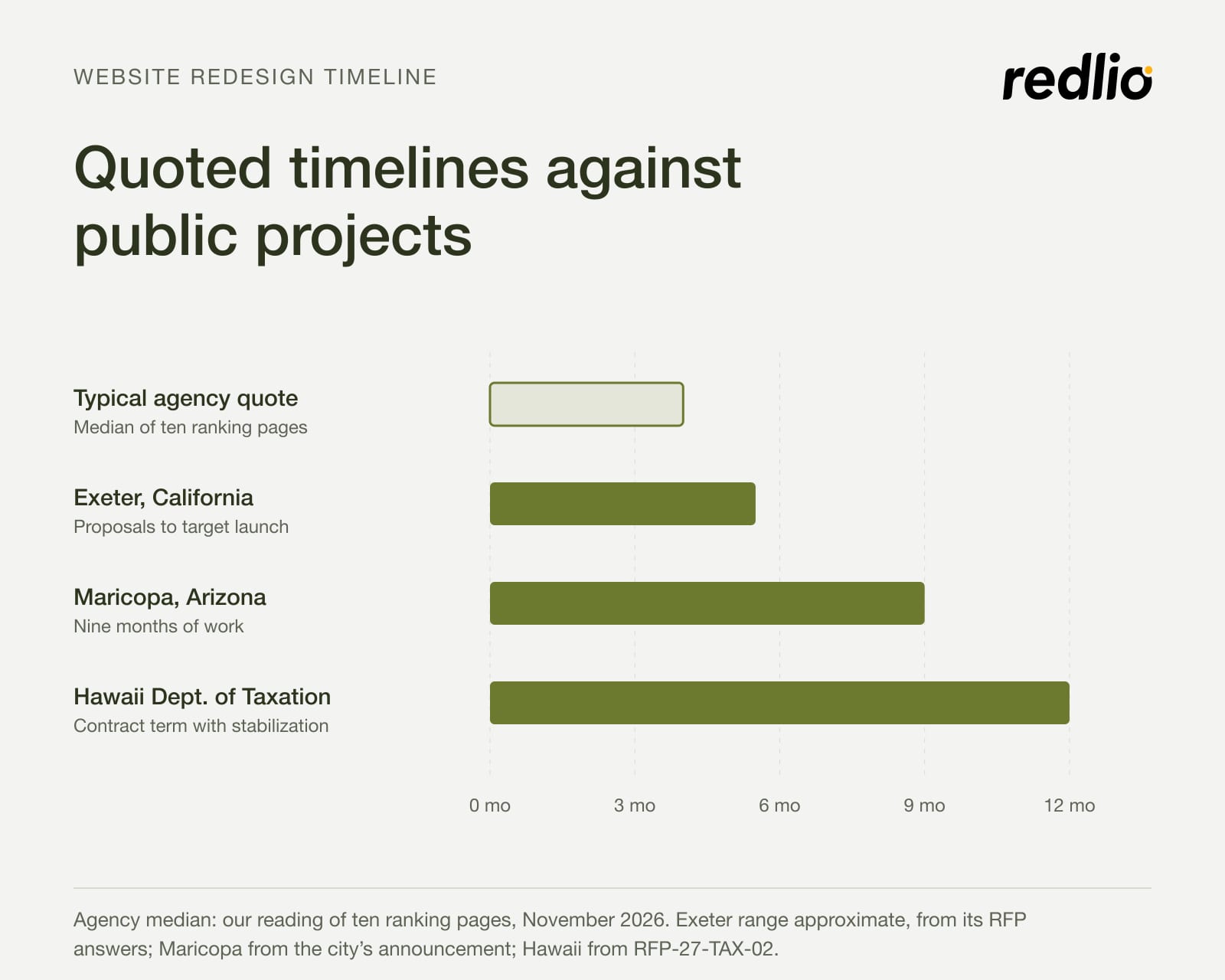
That is a reasonable thing for an agency to say, and it is not a measurement. In November 2026 I went through ten pages ranking for this question. Nine were written by agencies, none tied its timeline to a dataset, and the middle of their quoted ranges was about four months.
I run an agency too, and I don’t give a launch date until the scope is on paper. Instead, here is what public projects took when their dates were published, and where the time goes.
What public redesigns actually took
Public bodies publish their schedules, which makes them a useful check. The City of Maricopa, Arizona, launched its new site in April 2026 after what it described as nine months of work, underway since fall 2024.
Hawaii’s Department of Taxation released a website RFP in July 2026 with a twelve-month contract, November 2026 to October 2027, including a stabilization period after launch. The City of Exeter, California, took proposals in September 2026 and, in its published answers to bidders, gave a target launch of January to March 2027.
 (opens full size in a new tab)
Public projects carry procurement and approval steps a private company may skip, so read them as an upper reference, not a forecast. In our own count of 21 published website RFPs, eleven stated a launch timeline at all.
Most of the slip is on the client side
Eight of those ten pages blamed late redesigns on the client side. They named content that isn’t ready, approvals that wait for a meeting, and requirements that change. None measured it. Projects I have run point the same way, and it is worth planning around because it is the part you control.
Content is the long pole. Only three of the ten pages gave content its own phase, and none separated writing new copy from moving old pages. Writing, approving and legal-checking twenty service pages can take longer than designing them.
Approvals are the second. Each review round needs the right people in the room on a fixed date. If your sign-off chain is three people deep, add the time it takes to get all three, not one.
A schedule built from your own scope
The only reliable answer to how long your redesign will take is a schedule built from its scope, not a borrowed number. Start from the launch date that matters to the business, then count back.
One site, counted back from launch
Imagine a B2B firm, invented for this example, with forty pages, a platform change and a trade-show launch date. Counting back: a week of launch checks, two weeks of testing including accessibility, the build, design rounds with two reviewers, and the URL map before any of it.
The content runs alongside, and it decides the date. If the firm’s team can approve four pages a week, forty pages take ten weeks of their time, whatever the agency does. The schedule only works if those ten weeks start on day one.
Accessibility and redirects belong in the schedule as their own lines. No ranking page gave accessibility its own time; I would. Redirects get their own treatment in our migration guide and redesign checklist.
What sets the length
A redesign timeline grows with pages and templates, and with how much content is rewritten rather than moved. A platform change, CRM and form integrations, the accessibility standard and the number of approvers all add weeks.
Small projects do move fast. A UK boutique we worked with told Clutch its online store went live in five weeks, with the remaining features added later. That was a store, built from a clear brief with quick decisions, which is exactly what made it fast.
If a redesign is on your plan, tell me which date matters and where the site lives today. You get an answer inside 12 hours. Once the scope is in writing, we will build the schedule back from that date with you, content weeks included.
Questions about website redesign timelines
How long does a website redesign take?
Agency pages commonly say three to six months, but that figure traces back to one agency manager’s estimate. Public projects with published dates ran about six to twelve months. Build your own schedule from the scope and the launch date that matters.
What causes website redesigns to run late?
Usually content that is not ready, approvals that wait, and requirements that change. These are client-side tasks, so schedule content writing and review rounds from the first week.
What should a website redesign project plan include?
Start with the launch date and what drives it, then the URL map and the design and build phases. Give content writing and approval weekly targets. Add accessibility and redirect testing as their own lines, and a week of launch checks.
Can a website redesign be done in a month?
A small site with ready content and fast decisions can be very quick. A B2B site with dozens of pages, new content and several approvers takes far longer. The content and sign-off load sets the floor.
The author