Custom software development process, seen from the client’s chair
A custom software development process runs through discovery, design, build in short releases, acceptance, launch and support. Whether it works depends on the decisions you make at each stage. In one dataset of 1,509 business IT projects, the best put about three times as much effort into analysis and design as the worst.


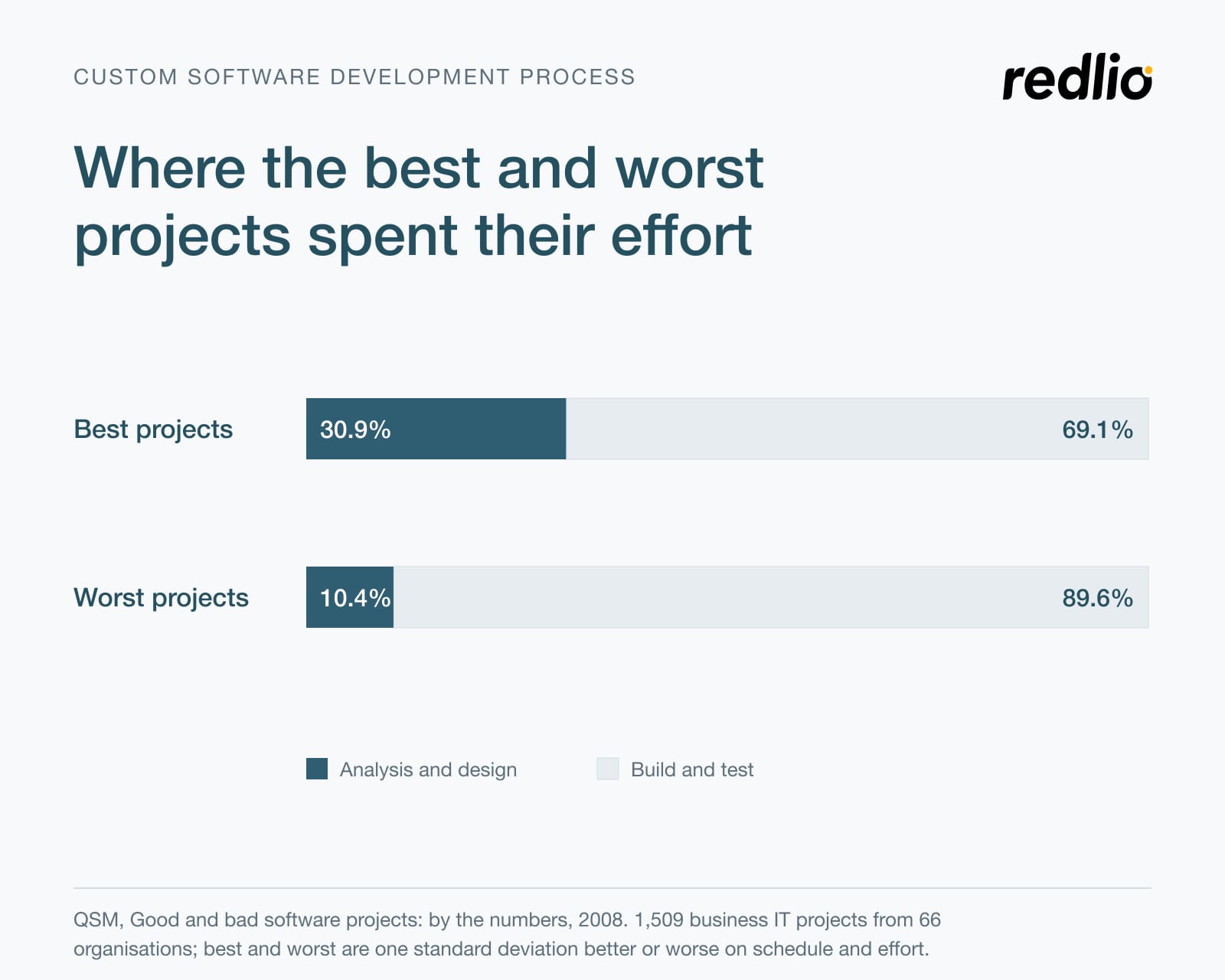
Where the best projects spent their effort
In 2008 QSM, a firm that collects software project data, compared the best and worst of 1,509 business IT projects from 66 organisations. It defined best and worst as at least one standard deviation better or worse than average on both schedule and effort. The findings deck shows how differently the two groups spent their time.
The best projects put 30.9% of their effort into analysis and design, and the worst put in 10.4%. For a system of the same size, the worst projects took on average 30.6 times as much effort as the best. The data is old and covers business IT in general, so treat it as a signal, not a forecast.
Analysis and design are the stages where the client does most of the work: explaining the process, deciding what matters, saying yes or no to a prototype. This article walks through the custom software development process from that side. I have built software for clients since 2013, and I write this as the supplier who sits across that table. Our own version, with its timings, is on our service page.
 (opens full size in a new tab)
Discovery, bought on its own
Discovery turns a business problem into a scope someone can build and price. It covers the workflow as it really runs, the systems it has to exchange data with, the data it inherits and the rules it must follow. The output is a written scope, a list of integrations and risks, and an estimate with its assumptions.
Buy it as its own small contract when the scope is not yet clear. None of the ten process guides that rank for this search treats it that way. A price for the whole build before discovery is a guess with a margin added, for the reasons set out in our RFP article. A short paid discovery lets you take the scope to another supplier if you choose.
Your side needs one person who can decide, plus the staff who run the process now. The decision maker settles priorities and trade-offs. Those staff explain the exceptions, which are where custom software earns its cost and where estimates go wrong.
Design you can click before anyone codes
Design shows the software before it exists, as screens and a clickable prototype of the main tasks. It is the cheapest point to find out that a screen asks for information nobody has, or that two departments expect different things from the same button.
Put the prototype in front of the people who will use it, not only the sponsor. For a Munich conference venue, our design moved from three mockups to a clickable prototype. Brief sessions with the client added ideas before the build began. Our custom software cost article tells that project in full.
Building in short releases
The build should produce working software you can try at regular intervals, not a single delivery at the end. The Scrum Guide sets sprints at one month or less and ends each with a review to inspect the outcome and decide what comes next. The Agile Manifesto’s principles put it as working software being the primary measure of progress.
Google’s DORA research programme finds that working in small batches predicts both software delivery performance and organisational performance. For a buyer, small batches mean that a misunderstanding costs one sprint instead of the whole budget.
Your side needs a product owner: one named person who can say yes or no without a committee. The Scrum Guide makes that role accountable for the value of what gets built. If that call takes your side a week, the team will either wait or guess.
One change request, handled inside a sprint
This example is invented for illustration. Halfway through the build of an ordering system, the finance lead asks for a second approval step on orders above a set value. At the sprint review the team estimates it at three days of work.
The product owner has two choices. Move a lower priority feature, such as a reporting export, to the next release, or add the work and accept a later date or a higher cost. Either is fine if it is decided in that meeting and written down. The project goes wrong when the change is accepted with no decision about what gives way.
Testing, and the acceptance only you can do
The supplier tests that the software works as built. You test that it works for your business, with real cases and realistic data. That second step, user acceptance testing, cannot be delegated to the people who wrote the code.
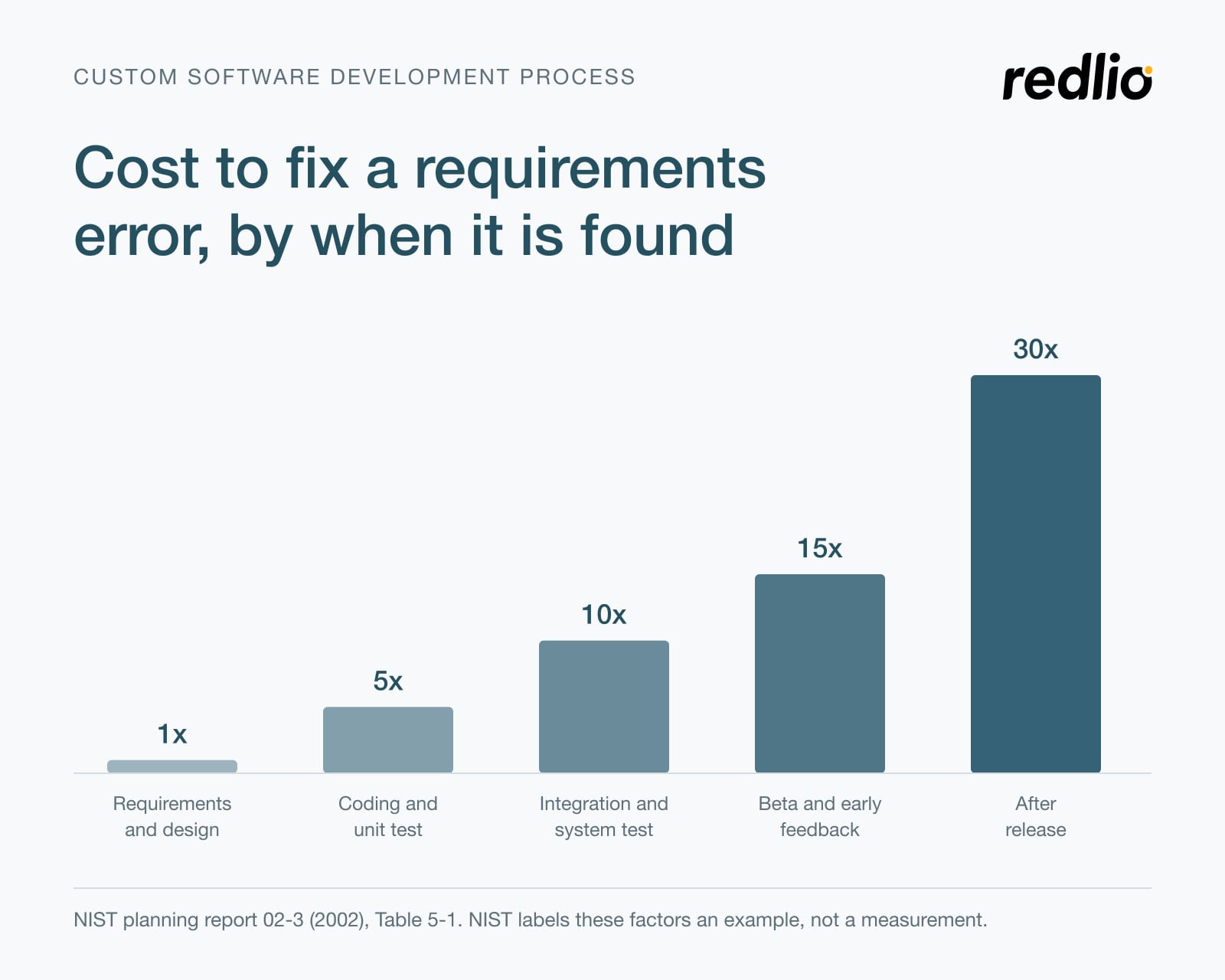
Late defects are expensive. A 2002 NIST planning report estimated that inadequate software testing cost the US economy $59.5 billion a year. Its illustrative table shows a requirements error costing 1 unit to fix when found early, 10 at system test and 30 after release. NIST labels those factors an example, not a measurement.
 (opens full size in a new tab)
Write each release’s acceptance criteria before work on it starts, and give your testers the time to run them. How acceptance should be worded in the contract, including what happens when you do not respond, is set out in our contract article.
Launch, and what you should hold afterwards
Launch moves the software into use, often with data moved across from a legacy system and staff trained on the new one. Plan it for a period when the business can absorb a slow week, and agree beforehand the point at which you would return to the old system.
After launch you should hold everything needed to run the software without the supplier. That means the source code in a repository your company owns, the credentials for every service, the deployment setup and the documentation. Ask for it as a deliverable of the first release, not at the end of the relationship. Our contract article lists what to write into the exit clause.
Running it after launch
Running costs continue after launch: hosting, security patches, the libraries it depends on, fixes and the next round of changes. Two of the guides we read put annual maintenance at 15 to 20% of the build cost. Both trace the figure to other vendors’ blog posts, and our search turned up no study behind it.
Budget instead from what will change. List the systems the software connects to and how often they change, the security patching you need, and the improvements already waiting. Then agree whether the supplier, your own team or a mix will carry each.
What each stage needs from your side
| Stage | Who from your side | What you decide | What you should receive |
|---|---|---|---|
| Discovery | A decision maker and the staff who run the process now | Scope, priorities and what is out | A written scope, integration and risk list, and an estimate with assumptions |
| Design | The future users of each main task | Whether the prototype matches the real workflow | Clickable prototype and approved screens |
| Build | A product owner who can say yes or no quickly | What goes in each release and what gives way for a change | Working software at every review |
| Acceptance | Testers from the business, with real cases | Whether each release meets the criteria | A fixed list of defects and their status |
| Launch | Operations, support and training leads | The date, the migration plan and the rollback point | Code, credentials, deployment setup and documentation |
| After launch | An owner for the system | Who carries updates, fixes and new work | A support agreement with response times |
If a custom build is on your list for next year, tell us what it has to do and which systems it must work with. An NDA comes before the call, and the engineers who would take on the build walk you through which of these stages your project needs most. We will also say if a product you can buy already does the job.
Questions about the custom software development process
What are the stages of custom software development?
Discovery, design, build in short releases, testing and user acceptance, launch, and support after launch. The ten guides we read list between five and eight stages under different names. What matters more is what the client decides and receives at each one.
How long does custom software development take?
It depends on scope, integrations and how quickly decisions are made on the client’s side. We found no current published dataset of custom build durations with a stated method. Ask each supplier for a timeline built from the scope after discovery, with the assumptions written down.
Do I need to pay for a discovery phase?
If the scope is not yet clear, a paid discovery phase is usually cheaper than a fixed build price, which has to cover what is still unknown. It produces a written scope and estimate you own and can take to any supplier.
What is the client’s role in custom software development?
To provide a decision maker, the people who know the current process, a product owner who can approve or reject work quickly, and testers for user acceptance. The Scrum Guide makes the product owner accountable for the value of what is built.
What is user acceptance testing?
In user acceptance testing, people from the business check each release against their real tasks and realistic data. They test against criteria agreed before the release was built. The supplier’s own testing checks that the software works as built, not that it fits the business.
How much does custom software cost to maintain?
A figure of 15 to 20% of the build cost a year circulates on vendor sites, with no study behind it that we could find. Estimate maintenance from what will change: connected systems, security updates, dependencies and planned improvements.
The author