Software development outsourcing, and the judgement you cannot hand over
Software development outsourcing works best when you outsource part of the work and keep the judgement about it in-house. In one study of 14 total outsourcing deals, two were reported successes. Before you sign, decide who on your side will direct, review and accept the supplier’s work, and budget for the costs that never appear on a quote.

The deal that made outsourcing respectable
In July 1989 Eastman Kodak agreed that IBM would build and run a new data centre for it in Rochester, New York, replacing four of Kodak’s own. According to UPI’s report at the time, about 275 Kodak staff would be offered jobs at IBM. Kodak’s spokesman said analysts put the savings at up to 40 or 50 percent. IBM said it expected the deal to become a showcase for the whole industry.
Researchers later asked whether other companies outsourced because Kodak had. Loh and Venkatraman’s 1992 study found that after the deal, outsourcing spread mainly through imitation between companies. A 1997 re-examination by Hu, Saunders and Gebelt found mixed influences and no evidence of a Kodak effect. Case studies from the time describe at least one telecoms company whose executives decided to outsource after reading about Kodak’s success.
Either way, the decision to outsource should rest on your own work, not on what peers are doing. This guide is about that decision. I have been on the supplier side of it since 2013, first as a freelance engineer for clients in the US and Germany, then running Redlio Labs. Weigh my view accordingly, and check it against the sources.
Outsource part of the work, not all of it
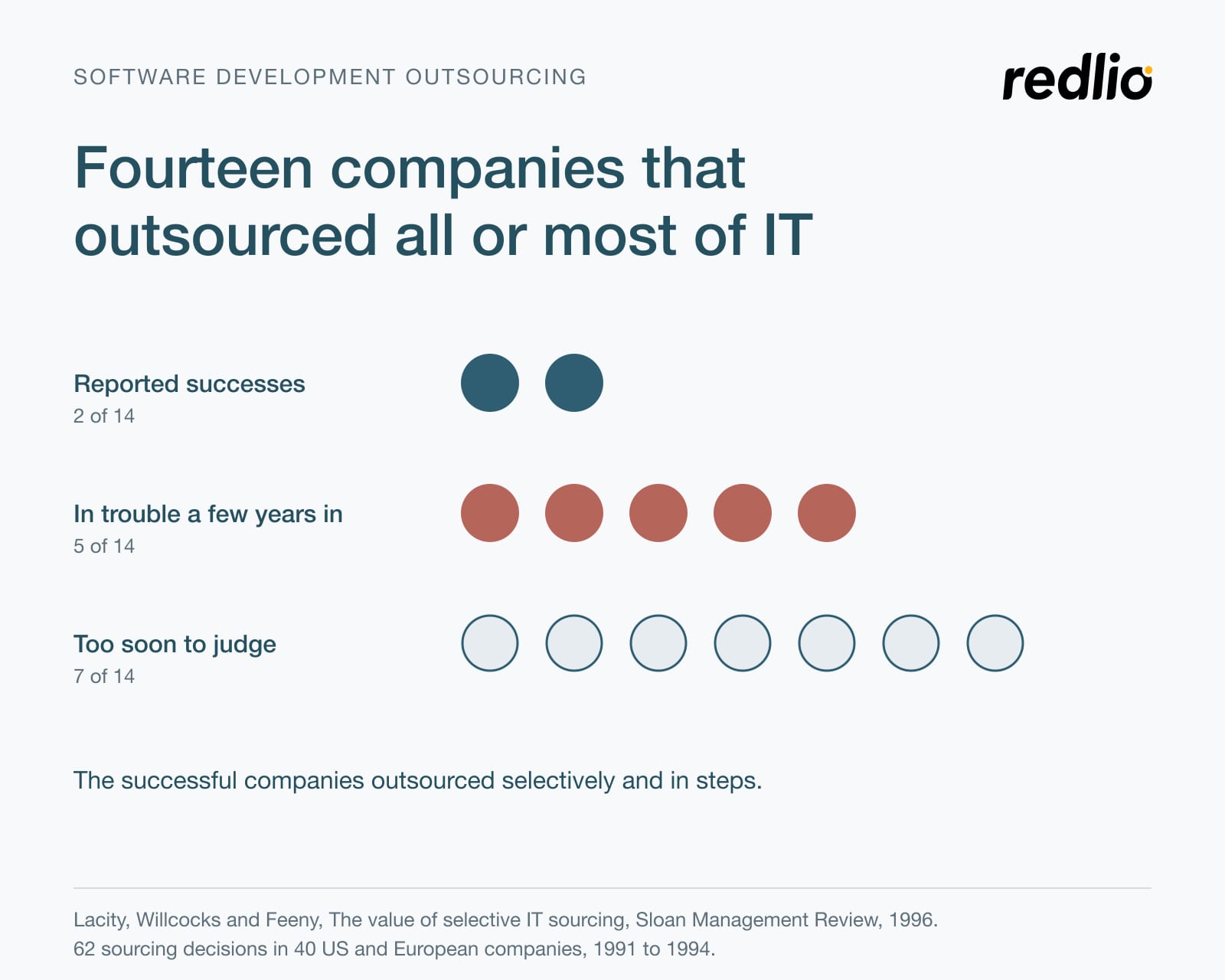
The research on IT outsourcing favours selective deals over total ones. Mary Lacity, Leslie Willcocks and David Feeny studied 62 sourcing decisions in 40 US and European companies between 1991 and 1994. Of the 14 that outsourced all or most of their IT, two were reported successes and five ran into trouble a few years in. For the other seven it was too soon to judge, though participants already reported unexpected fees and hidden costs.
 (opens full size in a new tab)
The companies that did well, the authors wrote, took a reasoned, incremental and selective approach. A related study by Lacity and Willcocks in MIS Quarterly in 1998 covered 61 decisions in 40 organisations. Selective outsourcing reached its expected savings more often than either total outsourcing or keeping everything in-house.
The studies are about IT functions in the 1990s, not software builds today. Their lesson still applies to a build: outsource well-defined pieces, keep the decisions that shape the product, and add more only once the first piece works. The way companies bring work back later is covered in our staff augmentation vs outsourcing comparison.
The judgement you cannot outsource
Someone on your side has to direct the supplier, review what it delivers and accept or reject it. That person decides which trade-offs are acceptable and reads the code or the architecture well enough to spot shortcuts. They also hold the keys: the repository, the hosting accounts and the credentials.
If you have a CTO or senior engineer, give them the hours for it and the right to refuse a delivery. If you do not, decide before you sign how you will cover it. Six of the ten ranking guides we read say you need this person, and none says what to do without one. There are three routes, and none involves trusting the supplier to review itself.
You can hire a senior engineer first, who then owns the supplier relationship. You can retain a part-time technical adviser who attends reviews and reads the code at each milestone. Or you can commission an independent review of the architecture and code at set points, paid by you and reporting to you.
Whichever you choose, write it into the contract: the reviewer’s access to the code, the right to see test results, and acceptance tied to their sign-off. Our contract article covers how acceptance clauses work.
Software development outsourcing models
The four models differ in who directs the daily work and who bears delivery risk. Just one of the ten ranking guides named all four.
| Model | Who directs the daily work | Who carries delivery risk | Fits when |
|---|---|---|---|
| Project-based | The supplier, against an agreed scope | Mostly the supplier, within the scope | The scope can be written down and judged from outside |
| Dedicated team | The supplier’s lead, with your product owner setting priorities | Shared | Work is ongoing and the roadmap changes |
| Staff augmentation | Your own managers | You | You have the management and need more hands or a skill |
| Managed services | The supplier, against service levels | The supplier, for the service levels agreed | The system is built and needs running and improving |
Our posts on staff augmentation vs dedicated teams and hiring a dedicated team go deeper on the middle two.
How to outsource software development
In order, the steps that settle most of the outcome before any code is written.
- Decide which work to outsource and which decisions stay with you.
- Name the technical owner on your side, or choose how you will cover the role.
- Write a brief that states the problem, the users, the systems and the data.
- Shortlist suppliers and test them on code they have written, not on slides.
- Buy a short paid discovery or pilot before committing to the full build.
- Sign a contract that makes the code yours and ties acceptance to your reviewer.
- Set the rhythm: a working demo every sprint, a monthly review, and a quarterly check that you could take the work elsewhere.
The brief is covered in our software development RFP guide, the shortlist in how to choose a software development company, and discovery in our process article.
When not to outsource
Keep the work in-house when it is the product your customers pay for and it changes every week, because the knowledge behind it is the asset. Keep it in-house, or delay it, when nobody can own it on your side and you are not willing to hire or retain someone who can.
Delay it as well when the scope is still a guess. Buy a short discovery first, so that whoever builds it, inside or out, starts from the same written scope.
Managing the supplier after signing
Most of an outsourcing deal’s value is won or lost after the contract is signed. The NAO drew three lessons from the HMRC contract. Prepare early for the contract’s end, keep the option of competition alive, and run the move between suppliers as a planned piece of work.
For a software build that means three habits, and one clause. The clause I ask every client to sign covers the exit. The repository, the credentials and the documentation sit in their hands from the first release, not the last. See working software at every sprint, not status reports. Review cost, quality and risks monthly with someone senior from the supplier. Every quarter, check that the code, documentation and access you hold would let another team take over.
If you are weighing up outsourcing a build, tell us what you want to hand over and what you want to keep. An NDA comes first and a reply within 12 hours. On the call, the developers you would work with say which parts are worth outsourcing to anyone, us included, and which you should keep.
Questions about software development outsourcing
What is software development outsourcing?
It is contracting another company to design, build, test or run software for you. The main models are project-based work, a dedicated team, augmented staff and a managed service. They differ in who directs the daily work and who carries the delivery risk.
What are the benefits of outsourcing software development?
Access to skills you do not have, capacity without permanent hiring, and sometimes lower cost. The research on IT outsourcing found the benefits most reliable when companies outsourced selectively and kept the decisions that shape the product in-house.
How do I manage an outsourced team without a CTO?
Cover the technical owner role before you sign. Hire a senior engineer, retain a part-time technical adviser, or commission independent reviews of the code and architecture at set milestones. Do not rely on the supplier to review its own work.
How much does it cost to outsource software development?
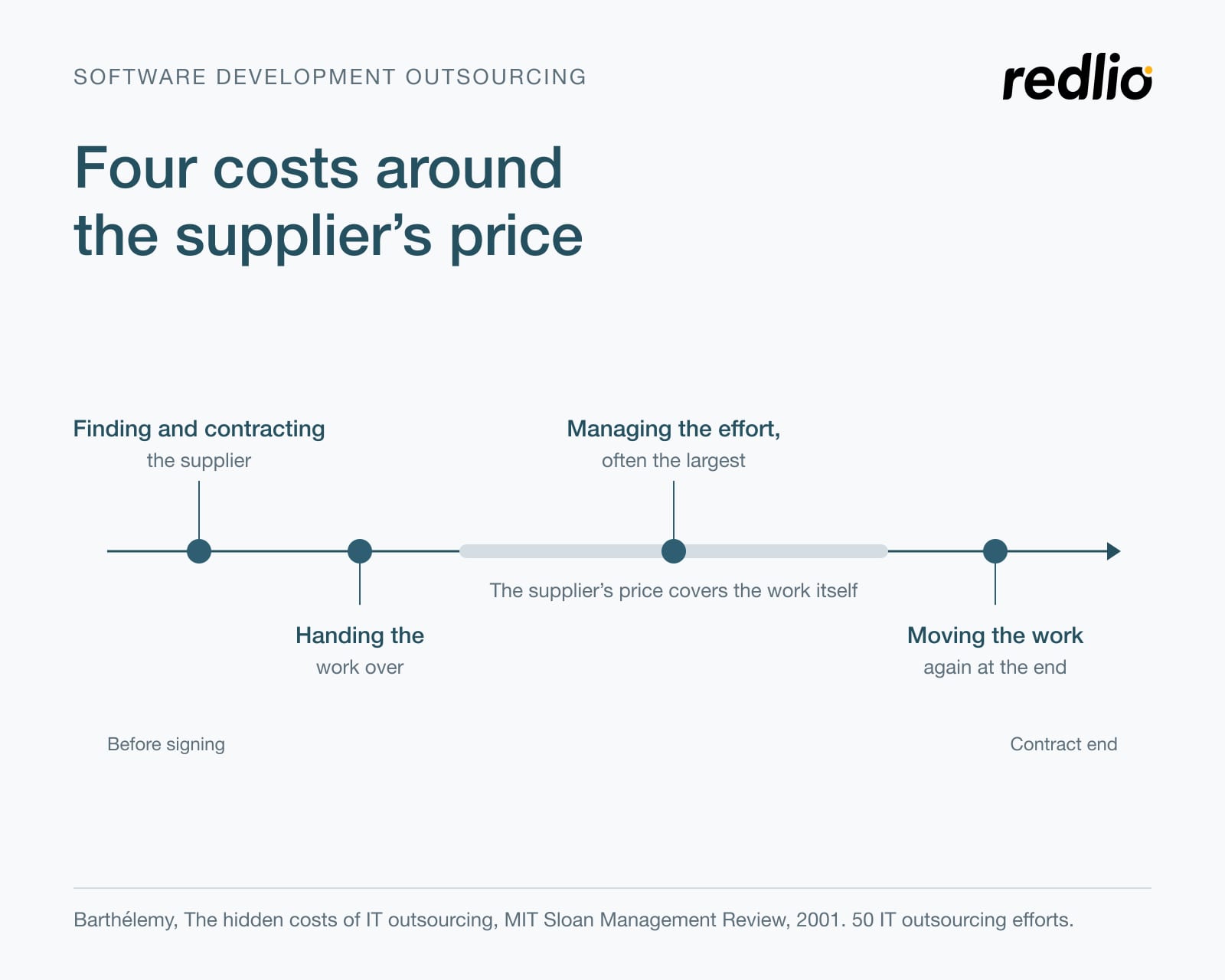
The supplier’s price depends on scope, team and location; published rates are in our cost guide. Add the costs that are not on the quote: choosing the supplier, handing over, your own team’s time managing the work, and moving it at the end.
When should you outsource software development?
Outsource when the work can be described and judged from outside and someone on your side can direct and review it. It helps most when you need skills or capacity faster than you can hire. Keep work in-house when it is the product itself and changes weekly.
What are the hidden costs of outsourcing?
Barthélemy’s study of 50 IT outsourcing efforts named four. They are finding and contracting the supplier, handing the work over, managing the effort, and moving the work again at the end. Managing the effort was often the largest.
The author