ERP implementation plan, built backwards from the day you go live
An ERP implementation plan should start from go-live and work back. It covers the cutover approach, rehearsed data migration, acceptance by the business and the people you must free up. Public failures from Revlon to Birmingham City Council trace back to those lines, not to the software.

What a council’s commissioners found
Birmingham City Council started using its new Oracle system in April 2022. In June 2023 the council announced that it expected the final cost of implementing Oracle to be around £100 million. It said the platform had been customised to fit its existing business processes instead of the council adopting the system’s.
In January 2025 the commissioners sent in by the UK government reported that data quality was “very poor”, after years of weak data management. They named cultural resistance, data quality and an under-resourced programme team as the challenges that remained. The council planned to implement the system again from April 2026.
None of those causes is a feature of the software. They are lines in a plan: who does the work, how the data is prepared, and whether the organisation changes its process or the system’s. This article builds an ERP implementation plan around them, starting from go-live and working back.
At Redlio Labs we build custom ERP systems and do not resell packaged ones, so my interest is in the cases where building fits. The plan below applies to both, and our ERP cost article covers what each line costs.
The phases, as the vendors’ own methods name them
The two largest vendors publish their methods, and they agree more than their names suggest. SAP’s Activate runs Discover, Prepare, Explore, Realize, Deploy and Run. Microsoft’s Success by Design runs Discover, Initiate, Implement, Prepare and Operate.
| Step | SAP Activate | Microsoft Success by Design | What you should hold at the end |
|---|---|---|---|
| Decide what you are buying | Discover | Discover | Goals, scope and a high level solution approach |
| Set up the project | Prepare | Initiate | Governance, team, plan and test environments |
| Fit the process to the system | Explore (fit to standard) | Initiate | A list of gaps, each decided: change the process or extend the system |
| Build and test | Realize, ending in integration and acceptance tests | Implement | A configured system accepted by business users |
| Rehearse and cut over | Deploy | Prepare, with mock go-lives and go/no-go criteria | A cutover plan run at least once in rehearsal |
| Stabilise and run | Deploy (hypercare), then Run | Operate | Agreed exit criteria for hypercare and a support model |
A custom ERP follows the same shape. The fit to standard step becomes a decision about which processes to build around and which to simplify first, the subject of our build vs buy guide.
Who from your side, and for how long
The ERP implementation team that decides the outcome is yours, not the vendor’s. Oracle’s own project plan guide tells customers to assign key people full time and to hire temporary staff to cover the work they leave.
Revlon’s 2018 annual report shows what happens when that is underdone. After its US launch in February 2018, the company could not ship about $64 million of net sales and incurred $53.6 million in extra charges. It reported a material weakness, including that it lacked enough knowledgeable, trained personnel in the affected operations.
At minimum you need an executive sponsor with authority over every affected department and a full-time project lead. Add a process owner for each area, such as finance, inventory or sales. Each process owner needs a deputy who can make decisions when they are in their day job. Plan the backfill before the project starts, not when the first deadline slips.
Adopt the system’s process or adapt the system
Every gap between your process and the system needs a decision. Customising a packaged ERP to match how things are done today is the expensive answer, and the public record shows how expensive.
The US Air Force cancelled its Expeditionary Combat Support System after spending over $1 billion from 2004. Introducing a Senate report in 2014, Senator John McCain told the Senate that customising the commercial software was a major root cause. He also named requirements that were never stabilised and a culture of resistance to change.
So record each gap with its owner, the options and the decision, and review the list monthly. Where the process is truly yours and gives you an edge, extending or building is justified. Where it is habit, change the process.
Data migration, rehearsed until it is boring
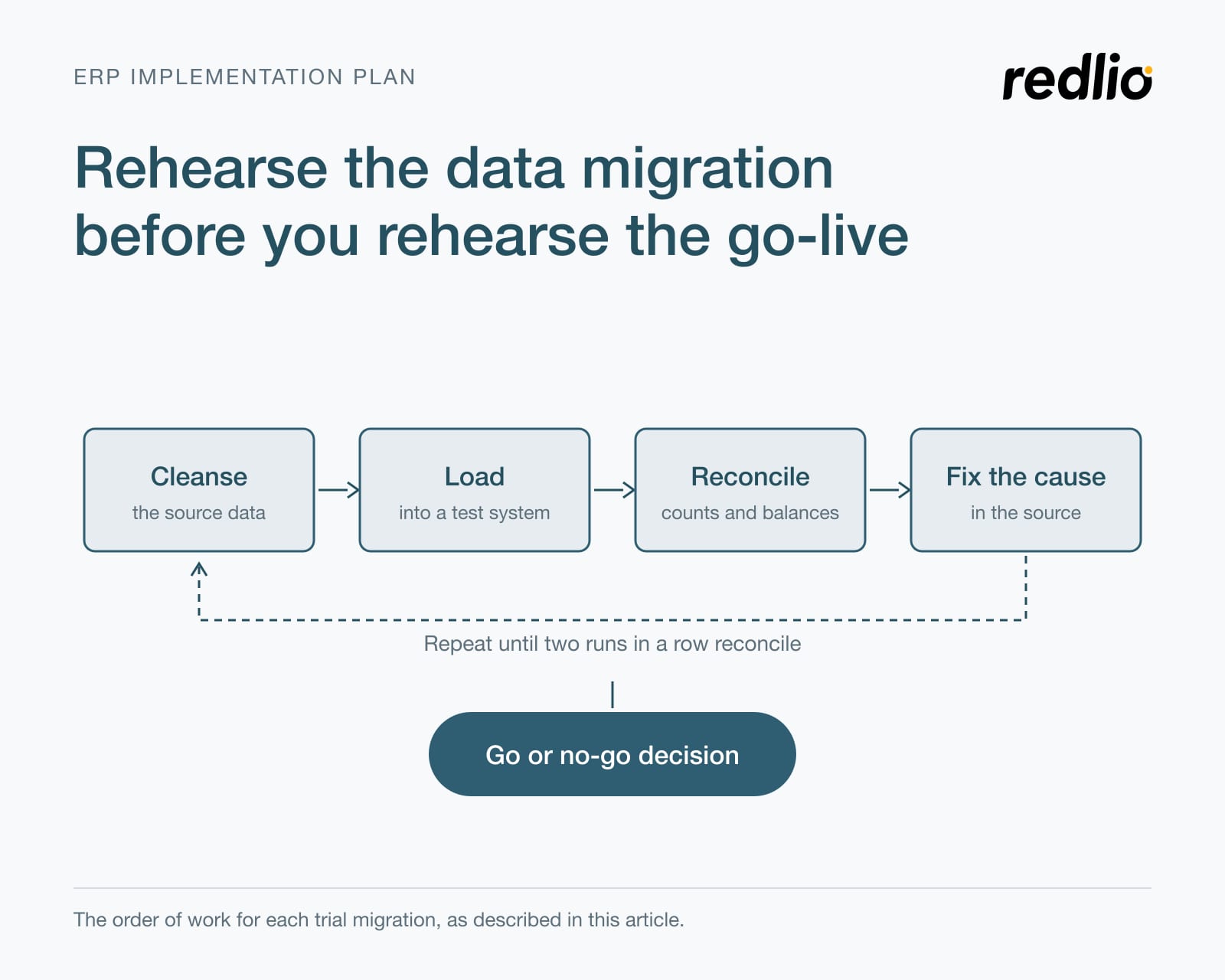
ERP data migration should be run several times before go-live, each run reconciled against the old system. Birmingham’s commissioners traced their data problem to many years of weak data management, which no migration script fixes on the night.
Start cleansing in the first month: duplicate customers and suppliers, obsolete items, open documents that will never close. Then run trial loads into a test environment. Microsoft’s method schedules mock go-lives in its Prepare phase for this reason.
One trial load, reconciled
For illustration only, with invented figures, a distributor loads its customers and open invoices into the new system. The old system shows 4,812 active customers and open receivables of 2,340,500. The trial load shows 4,797 customers and 2,338,120.
The 15 missing customers turn out to be accounts with no country code, which the new system rejects. Their invoices account for the 2,380 difference. The fix is a cleansing rule in the old system, not a manual edit after the load. The next trial is reconciled the same way, and the migration is ready when two runs in a row match to the unit.
 (opens full size in a new tab)
Choosing big bang, phased or parallel
The cutover approach decides how much can go wrong on one day. Big bang moves everything at once, phased moves one module or site at a time, and parallel runs old and new side by side. None of the ten guides gives a way to choose.
Our view is that big bang suits a single site whose modules depend tightly on each other and whose data can be moved over a weekend. Phased suits sites or business units that can run separately for a while, accepting temporary interfaces between old and new. Parallel suits a finance team that must prove the new system’s numbers, provided you can staff double entry for the weeks it lasts.
Whatever you choose, write go/no-go criteria in advance and decide what would make you roll back. I want that rollback condition on paper weeks before go-live, agreed while everyone is still calm, not argued about at two in the morning on cutover night. Microsoft’s method puts both in the cutover plan. Typical criteria are the last migration rehearsal reconciled, no open critical defects, acceptance signed by each process owner, and trained users in every affected role.
ERP implementation timeline
There is no reliable single figure for how long an ERP implementation takes. The four ranking guides that give one say four to eight months, six months to a year, and a few months to several years, all without a source. Panorama Consulting’s 2026 ERP Report found that more than a quarter of organisations went over budget, and publishes its full figures only behind a form.
Build the timeline from your plan instead. Count back from the go-live date: hypercare after it, then the go/no-go meeting, the final rehearsal, acceptance testing, the build, and the fit decisions. If the dates do not fit, move go-live, not the rehearsals.
Hypercare, and how it ends
Hypercare is the period after go-live when the project team stays on to fix problems fast. None of the ten ERP guides that rank for this search mentions it. SAP’s method places it at the end of its Deploy phase, and Microsoft’s Operate phase has stabilisation as its goal.
Agree in advance what ends it. Typical exits are the first month end closed in the new system, support tickets back to an agreed daily level, and no workarounds left outside the system. Until then, keep the process owners and the people who built the system within reach.
ERP implementation checklist
The lines that decided the public failures above, in the order a plan needs them.
- An executive sponsor with authority over every affected department.
- A full-time project lead, a process owner per area, and backfill for their day jobs.
- Scope in writing, with what is out of this phase.
- A gap list: each difference between process and system, with its owner and decision.
- Data cleansing started in the first month, with owners for each data set.
- At least two trial migrations reconciled on counts and balances.
- Acceptance testing by business users against criteria agreed in advance.
- A cutover approach chosen for stated reasons, with go/no-go and rollback criteria.
- Training for every affected role before go-live.
- Hypercare with agreed exit criteria, and a support model after it.
When an ERP project is on your plan and a package is up against a build, send us the processes that matter most. Name the systems the ERP must live with too. Our reply comes within half a day, with an NDA signed before any call. On that call, our engineers for the build tell you which parts a package already does well and which, if any, are worth building.
Questions about ERP implementation plans
What are the steps of an ERP implementation?
Discovery, project setup, fitting the process to the system, build and test, rehearsal and cutover, then hypercare and support. SAP Activate and Microsoft Success by Design both follow this shape under different phase names.
How long does an ERP implementation take?
It depends on scope, data quality, the number of sites and how much the system is changed. The figures on ranking guides carry no source. Build the timeline back from go-live, leaving room for at least two reconciled data rehearsals and acceptance testing by the business.
What should an ERP implementation checklist include?
Start with a sponsor, a full-time project lead and process owners with backfill. Then written scope, a gap list with decisions and early data cleansing. Finish with reconciled trial migrations, business acceptance testing, a cutover with go/no-go criteria, training, and hypercare with exit criteria.
Which is better, big bang or phased ERP implementation?
Big bang suits a single site with tightly linked modules and data that can move in one weekend. Phased suits sites or units that can run separately for a while. Parallel running suits finance teams that must prove the numbers, if double entry can be staffed.
What is hypercare in an ERP implementation?
Hypercare is the period after go-live when the project team stays on to fix problems quickly. It should end on agreed criteria, such as the first month end closed in the new system and support tickets back to a normal level.
Why do ERP implementations fail?
The public cases point to people, data and process rather than software. Revlon reported too few trained staff in its affected operations. The US Air Force’s project was blamed on customisation. Birmingham’s commissioners named data quality, resistance to change and an under-resourced team.
The author