Fintech app development cost is mostly decided before the first screen
Fintech app development cost is driven by decisions made before design. How much card data do your systems touch, whose license does the money move under, how are customers verified, and what do the app stores allow? Get those right and the build shrinks. None of the ten ranking pages I read tied a single cost figure to a source.

The cost is in the rules, not the screens
Two payment apps with the same screens can differ by months of work because one stores card numbers and the other never sees them. Ten pages ranking for this search quote fintech builds from about $20,000 to over $700,000. None names a source, and none explains how to make the regulated part of the system smaller.
That is where I would start. Before anyone designs a screen, decide how much card data you will touch, whose license the money moves under, and how customers get verified. Each decision can remove a large block of work, or add one.
Redlio Labs builds financial software, and I don’t price a fintech build before those three answers are on paper. What follows is the reasoning, with the rules quoted where they are written. It is not legal advice; your counsel and your bank partner have the final word.
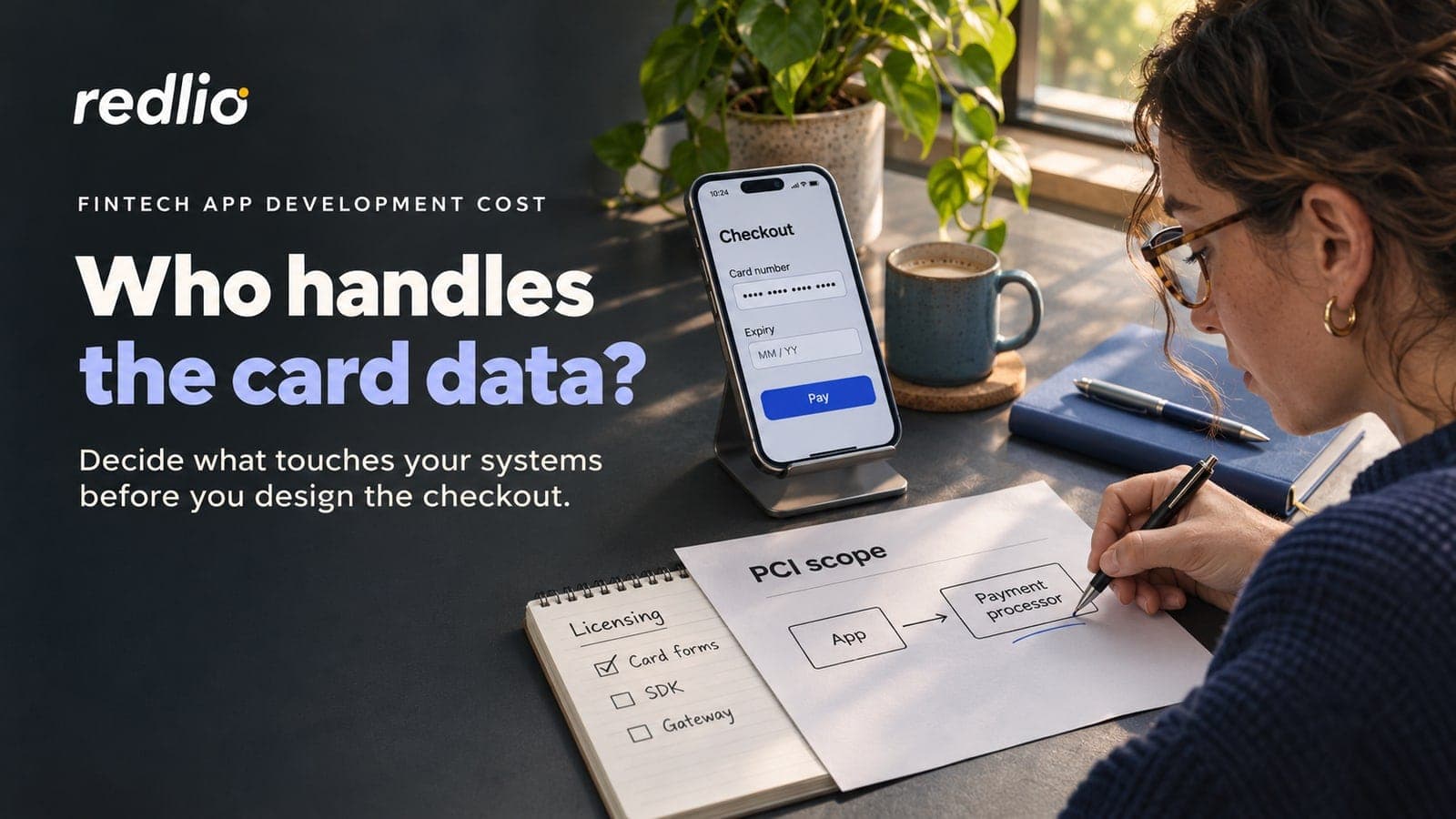
Shrink your PCI scope before you build
PCI DSS applies to anything that stores, processes or transmits card data, and how much of your system counts decides how much you must secure, document and audit. The current version, 4.0.1, made no new requirements, and its future-dated requirements took effect on March 31, 2025.
The smallest self-assessment, SAQ A, is for merchants whose card processing is entirely outsourced, where every element of the payment page comes directly from a PCI-compliant provider. In January 2025 the PCI Council added a condition: the merchant must confirm its site is not open to script attacks that could affect the payment page.
One checkout, built two ways
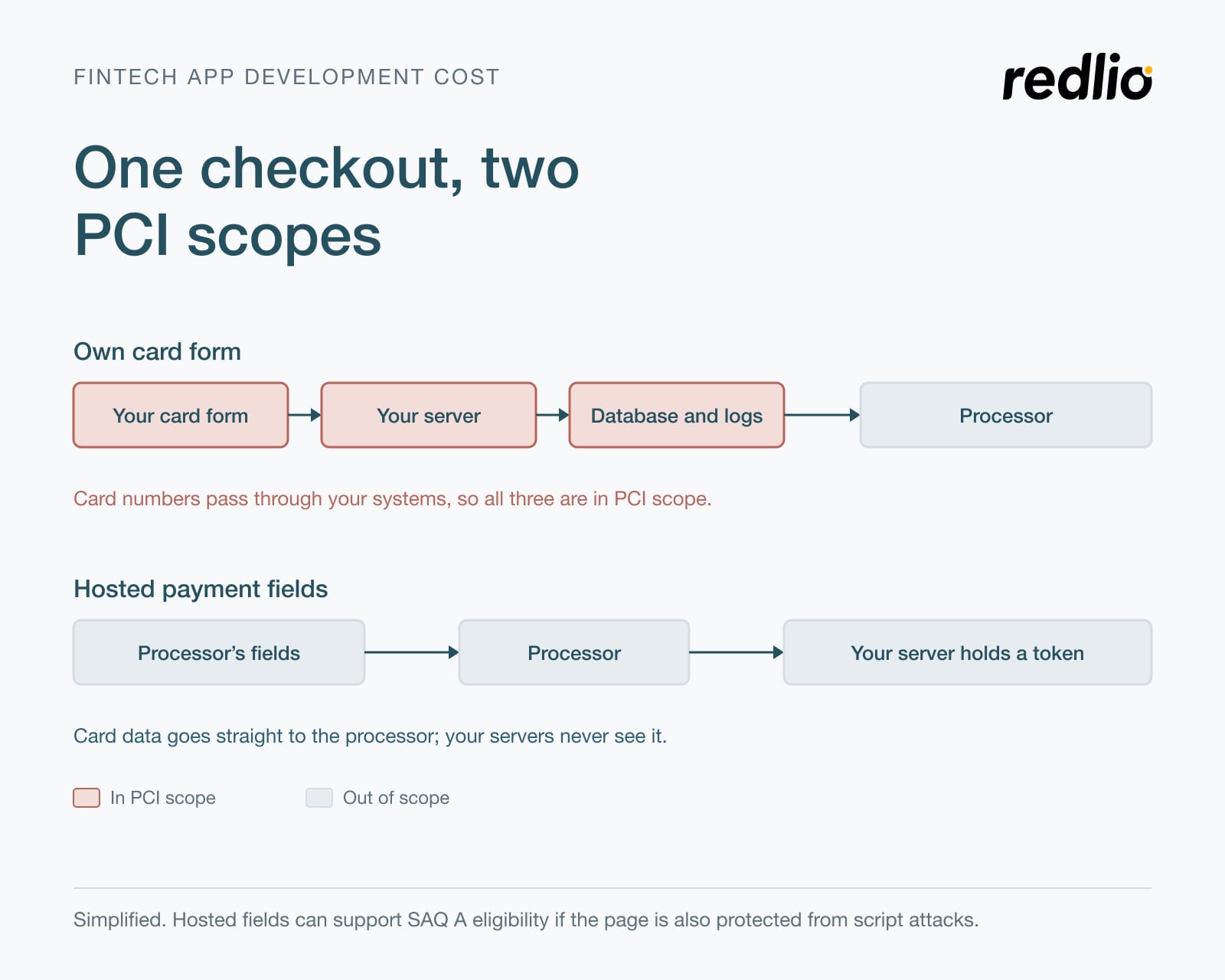
Take an invented subscription app. In the first design, the card form is the app’s own, posting card numbers to its server before they reach the processor. Every server, log and admin tool on that path is now in scope, and the assessment is far larger than SAQ A.
In the second design, the card fields come from the processor’s hosted page or embedded fields, and the app only ever holds a token. The app’s servers never see a card number. The remaining work is protecting the page that loads those fields, which is exactly what the 2025 condition asks you to confirm.
 (opens full size in a new tab)
Whose license the money moves under
If your app holds or moves customers’ money, someone needs the license to do it. Money services businesses must register with FinCEN whether or not a state licenses them, and most states require a money transmitter license on top. The Conference of State Bank Supervisors says 31 states have enacted its model law, in full or in part, to make those licenses more uniform.
Most early fintechs work under a bank partner instead, through a banking-as-a-service provider. The bank must run a written customer identification program under 31 CFR 1020.220, and the rule lets it rely on another regulated institution. In practice your onboarding flow has to meet the bank’s rules, so ask for its program before you design sign-up.
None of the ten ranking pages mentioned money transmitter licenses. For a payments or wallet product, the licensing route can shape the product, the timeline and the cost harder than a feature list ever will.
Payment, identity and data APIs
Third-party APIs replace a lot of build cost with running cost. Stripe’s standard US card price is 2.9% plus 30 cents per successful charge. Plaid publishes a pay as you go plan with no monthly minimum but lists per-product prices only through sales.
Model these per transaction and per verified customer, the way you would model a cost of goods. At low volume they are cheaper than building; at high volume the fees become a line worth negotiating.
Open banking rules are also unsettled. The CFPB’s personal financial data rights rule, which would make banks share data with authorized apps, had its compliance dates stayed by a court in October 2025. Build against the aggregator’s API, not against the rule’s timetable.
What the app stores require
Under Apple’s App Review Guidelines, banking and financial services apps must be submitted by the legal entity that provides the service, not an individual developer. Loan apps may not charge a maximum APR above 36%, including costs and fees, or require full repayment in 60 days or less.
Apps that let users create accounts must also let them delete accounts inside the app. None of this costs much to build, but a rejection after launch day is set costs weeks.
What a fintech build costs
Published ranges are wide because they price different products: a budgeting app, a lending platform and a card-issuing wallet carry very different rules. Whenever a fintech brief reaches me, I ask first what happens when money goes wrong. Think of a failed payment, a chargeback, a frozen account, or a customer disputing a transfer. Those paths are where fintech budgets grow.
Settle the PCI design, the licensing route, the bank partner’s identity rules and the store rules first, then price the screens. With a fintech product on your plan, send me what it does with customers’ money. Your reply arrives within 12 hours and an NDA precedes the call, on which our engineers point out the decision that cuts the most from your build.
Questions about fintech app development cost
How much does it cost to build a fintech app?
Ranking pages quote roughly $20,000 to over $700,000 without sources. The real drivers are PCI scope, the licensing route, identity verification rules, third-party API fees and app store requirements, more than how many screens it has.
How can I reduce PCI DSS compliance cost?
Keep card data out of your systems. With the processor’s hosted payment page or embedded fields, your servers only hold tokens. That can make you eligible for SAQ A, provided you also protect the page from script attacks.
Do I need a money transmitter license for my fintech app?
If your app holds or transmits customers’ money in its own name, you likely need FinCEN registration and state licenses. Many startups operate through a licensed bank partner instead. Ask your counsel which applies.
How much does Stripe or Plaid cost?
Stripe’s standard US card price is 2.9% plus 30 cents per successful charge. Plaid offers a pay as you go plan with no monthly minimum, but publishes per-product prices only through sales.
What does Apple require for finance apps?
Banking and financial apps must be submitted by the legal entity providing the service. Loan apps cannot exceed a 36% APR including fees or require repayment in 60 days or less, and apps with accounts must offer in-app deletion.
The author