Healthcare app development cost starts with a question about the FDA
Three rules shape healthcare app development cost more than features do. Does the FDA treat the app as a medical device, does HIPAA apply, and how does it connect to health records? Settle those before anyone quotes. The published price ranges run from $25,000 to over $2 million, and none of the ten pages I read says where its numbers come from.

The line the FDA draws through health apps
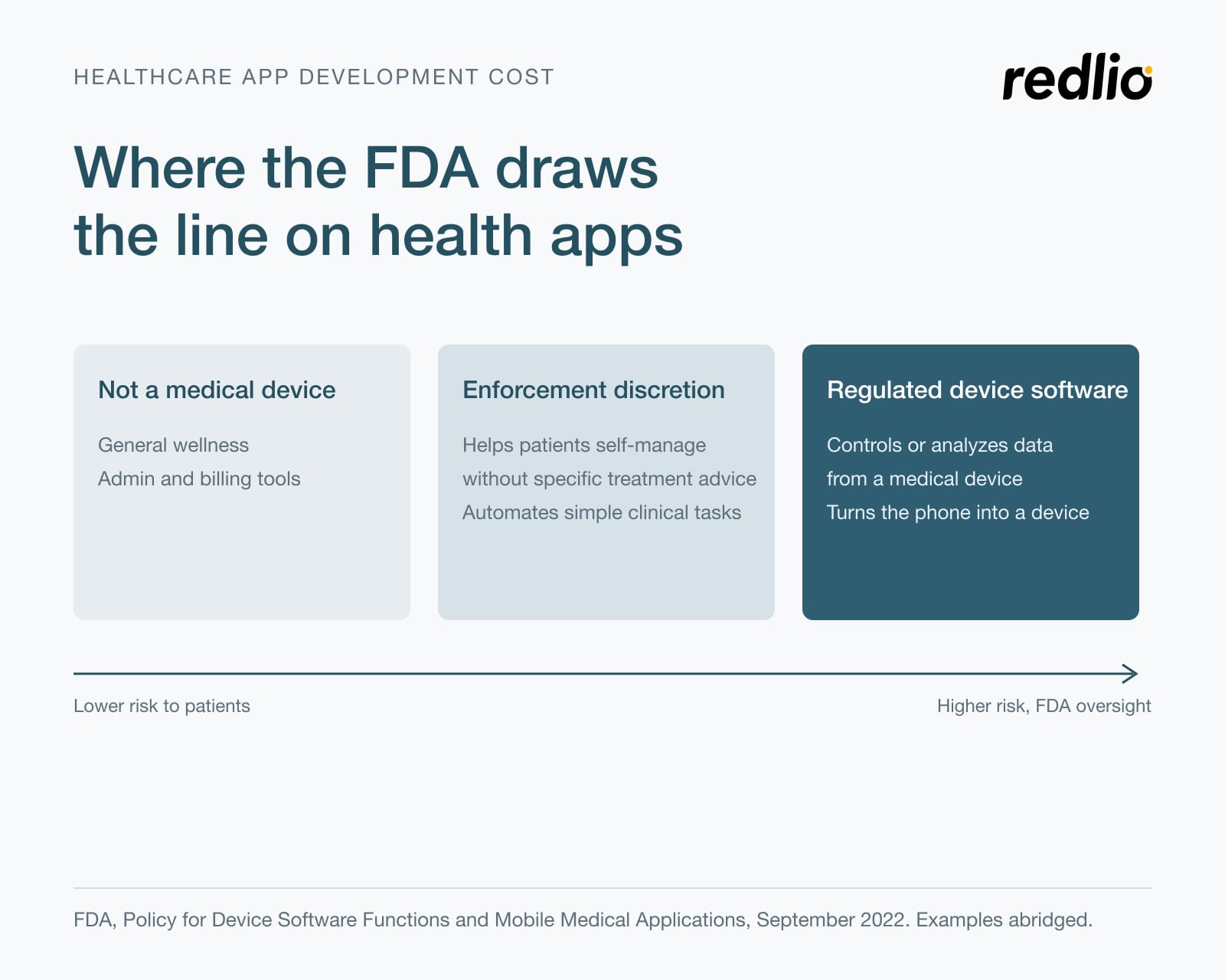
Two apps can look identical on a phone and differ in cost by a factor no feature list explains. The difference is usually what the FDA thinks they are. Its guidance on device software and mobile medical apps (September 2022) limits oversight to software functions that are medical devices. Those are the ones that could put a patient at risk if they failed.
The guidance draws the line with examples. Software that controls a connected device, such as an insulin pump, or analyzes data from one, is regulated. So is an app that turns the phone into a device through attachments or sensors, such as an ECG reader.
Apps that help patients manage a condition without suggesting specific treatment, or automate simple tasks for clinicians, fall under what the FDA calls enforcement discretion. The agency does not intend to enforce device rules on them.
 (opens full size in a new tab)
Just one of the ten pages ranking for this search put a price on FDA work, and none quoted where the line falls. I’d settle it before anything else, because it moves the budget more than any feature. I build software, not regulatory submissions, so on a borderline app I’d tell you to get a regulatory opinion before we quote.
What HIPAA adds, line by line
If the app handles protected health information for a covered entity, such as a clinic, insurer or health system, HIPAA applies. The cost is not a percentage. It sits in specific lines: hosting that will sign a business associate agreement, audit logs, encryption, access controls, and testing.
Every vendor that stores or processes that data for you must sign a BAA with you. On AWS, you accept the BAA in AWS Artifact and keep patient data in services AWS lists as HIPAA eligible. The agreement itself is not the expensive part; designing the system to stay inside those services is.
Penalties are real money. HHS kept its 2025 penalty levels for 2026: from $145 per violation at the lowest tier up to $2,190,294 a year for willful neglect left uncorrected.
The Security Rule may get stricter. HHS’s proposed update of January 2025 would require encryption, penetration testing at least every 12 months and vulnerability scans every six. It was not final at the time of writing, but I would build to it now rather than retrofit later.
When HIPAA doesn’t apply, the FTC still might
A consumer health app that no clinic or insurer stands behind is often outside HIPAA. It is not outside the law. The FTC’s Health Breach Notification Rule, updated in 2024, covers health apps HIPAA does not, and counts an unauthorized disclosure as a breach, not only a hack.
In practice that means your analytics and advertising tags need the same care as your database. Sending health data to an ad platform without permission is the kind of disclosure the rule now names.
EHR integration is cheaper to connect, not to finish
Connecting to health records is more standard than it was. Certified EHR systems must offer a patient and provider API built on HL7 FHIR Release 4 and the SMART App Launch framework, under the federal certification program. Epic says it offers over 750 no-cost APIs to developers.
None of the ranking pages mentioned SMART on FHIR or Epic’s free APIs. Their integration estimates started in the low thousands and passed $100,000. My view is that the code is now the smaller part. The cost sits in mapping each organization’s data, testing against their environment, and their own security review before they switch you on.
App store rules for health apps
Both stores have their own rules. Apple’s App Review Guidelines say apps may not store personal health information in iCloud or use health data for advertising. Google Play requires every developer to complete a health apps declaration, with proof of clearance for medical device apps on request.
These seldom add much cost, but a rejection a week before launch adds time. Read them during design, not at submission.
What a healthcare app actually costs
The ten ranking pages put healthcare apps anywhere from $25,000 to over $2 million. One vendor published figures from seven of its own recent projects; the rest gave no source. For context, Clutch’s pricing data across software projects of all kinds puts the average at about $132,000 over roughly 13 months, without a healthcare breakdown.
I don’t give a number before the scope is written, and nobody else should either. Four lines move a healthcare budget: the FDA status, whether patient data reaches a provider, the number of EHR systems, and the number of platforms.
One symptom tracker, scoped two ways
Here is an invented case. In the first version, patients log symptoms for their own use and see trends. No clinic is involved, so HIPAA likely doesn’t apply, but the FTC’s breach rule does. It falls under enforcement discretion. This is an ordinary app with careful privacy.
In the second version, the same log goes to the patient’s clinic, and the app suggests a dose change when readings cross a threshold. Now the clinic needs a BAA, the data lives in HIPAA-eligible hosting, it pulls records over FHIR, and the dose suggestion likely makes it regulated device software. Same screens, a different project.
If you are planning a health app, tell me what it does and who sees the data. Expect my reply inside 12 hours, with an NDA before we talk. My engineers will tell you which side of each line it sits on, and when to get regulatory advice before anyone prices it.
Questions about healthcare app development cost
How much does it cost to build a healthcare app?
Published ranges run from about $25,000 to over $2 million, mostly without a source. The real drivers are the FDA status, whether HIPAA applies, the number of EHR connections and the number of platforms.
Does my health app need FDA approval?
Only if it is device software whose failure could put patients at risk, such as software that controls or analyzes data from a medical device. Apps that help patients self-manage without specific treatment suggestions fall under enforcement discretion. Get a regulatory opinion on borderline cases.
How much does HIPAA compliance add to an app?
It adds specific lines rather than a fixed percentage: hosting under a business associate agreement, audit logs, encryption, access controls, and security testing. HHS has proposed yearly penetration testing, so plan for it.
Does HIPAA apply to every health app?
No. It applies when the app handles protected health information for a covered entity or its business associate. Consumer health apps outside HIPAA are covered by the FTC’s Health Breach Notification Rule.
How much does EHR integration cost?
The connection itself is more standard now, using FHIR and SMART on FHIR, and Epic offers many APIs at no cost. Most of the cost is mapping and testing each organization’s data and passing its security review.
The author