Telemedicine app development cost, counted per visit as well as per build
Telemedicine app development cost has two parts the published guides mix up: the build, and what every visit costs to run. Video itself is cheap, from about 7 to 16 cents for a 20-minute call at list prices, but a HIPAA agreement can add a fixed monthly fee. The bigger risks are rules with dates on them, such as the DEA prescribing flexibilities that run to December 31, 2026.


Two bills, and most guides show one
A telemedicine app costs money twice. Once to build, and then on every visit, through video minutes, hosting and the vendor agreements that HIPAA needs. Nine pages ranking for this search price the build between $25,000 and half a million dollars or more. Not one of them names a source.
Only one of them gave a per-minute video price, and none worked out what a visit costs to run. That second bill is the one a clinic feels every month, so this article starts there. The healthcare rules that apply to any patient app, from HIPAA to FDA device status, are in our healthcare app cost guide.
We build these apps at Redlio Labs, and I won’t name a build price until the scope exists on paper. What I can do is show you the running costs from published price lists, because those don’t depend on who builds it.
What a video visit costs at list prices
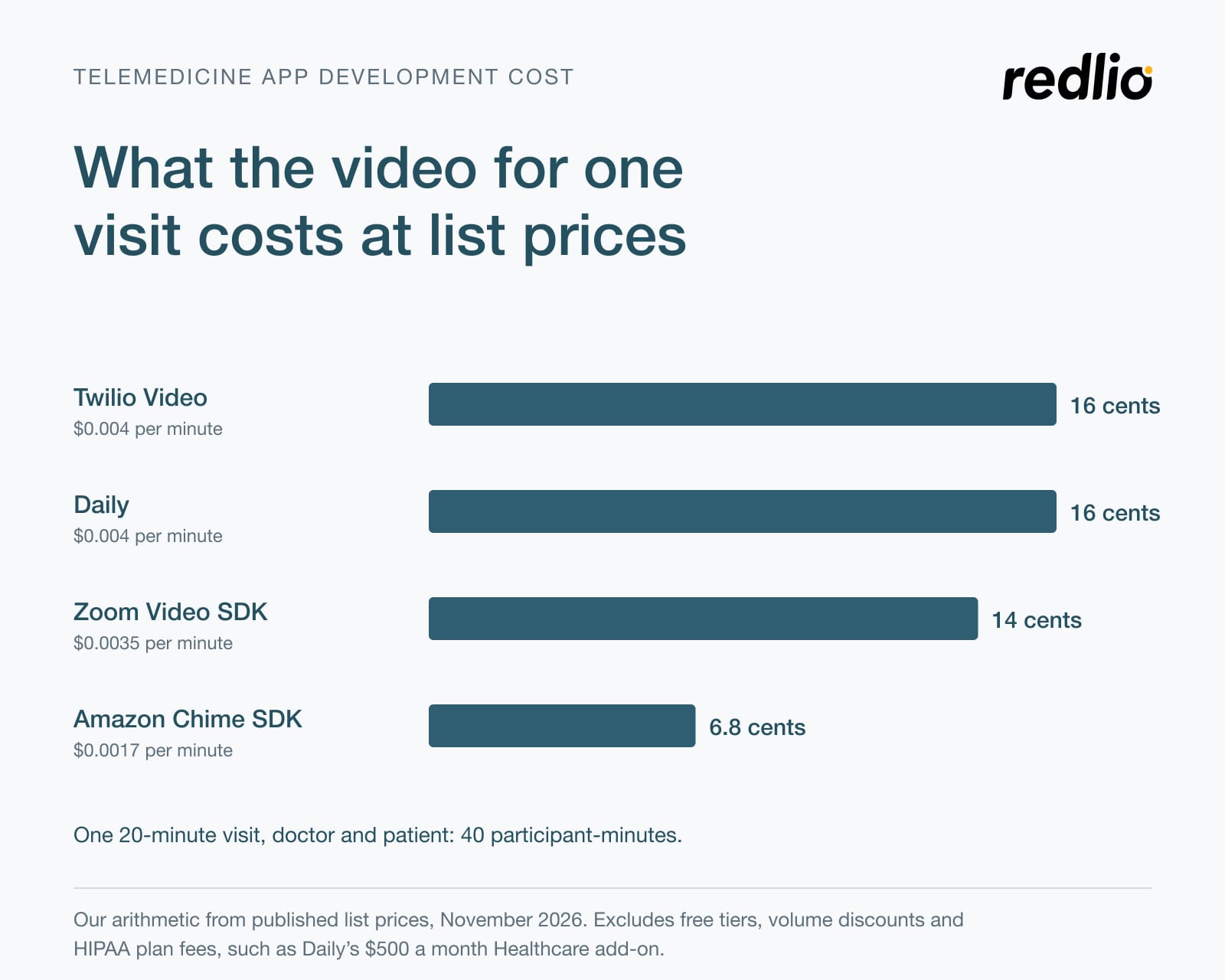
Video providers charge per participant per minute. A 20-minute visit between a doctor and a patient is 40 participant-minutes. At list prices that is about 16 cents on Twilio Video at $0.004 a minute, and 14 cents on Zoom’s Video SDK at $0.0035. On Amazon Chime SDK, at $0.0017, it is about 7 cents.
Scale that to 1,000 visits a month and video is roughly $70 to $160, before free tiers. Zoom and Daily each include 10,000 free minutes a month. Video is not where a telemedicine budget goes.
 (opens full size in a new tab)
Prices change, and volume tiers lower them. Check each list before you commit, and model your own visit length and number of participants, since an interpreter or a family member adds minutes.
The BAA is where video gets expensive
If the visits involve protected health information for a covered entity, the video provider has to sign a BAA with you. HHS’s pandemic leniency on non-compliant video tools ended on August 9, 2023, so consumer video apps no longer pass.
Providers price that agreement differently. Daily says it signs a BAA at no extra cost but requires its Healthcare add-on, listed at $500 a month. Twilio signs one only on its Security or Enterprise editions. Amazon Chime SDK is on AWS’s list of HIPAA eligible services, covered by the BAA you accept in AWS Artifact.
So at 1,000 visits a month, a $500 add-on can cost three or four times the minutes. Ask every provider which plan includes the BAA before you compare per-minute prices.
Rules with dates on them
Some of the biggest decisions in a telemedicine product depend on rules that are temporary. I would design for the date each one ends, not for today.
Prescribing controlled substances by video runs on a DEA flexibility. Its fourth extension runs through December 31, 2026, and the permanent special registration rule had not been published when I last checked. If your service prescribes controlled medicines, plan the in-person step now.
Medicare’s home telehealth flexibilities run through December 31, 2027, according to CMS’s telehealth FAQ. From January 1, 2028, most Medicare patients would again need to be in a rural medical facility, behavioral health aside.
Doctors also need a license in the patient’s state. The American Medical Association counts 44 states plus DC and Guam in the Interstate Medical Licensure Compact, which speeds up multi-state licensing but does not replace it. Your app needs to know where the patient is.
Where the build money goes
The video screen is the cheap part to build too. The work is in everything around the visit. Scheduling has to respect time zones and licenses, and intake, payments, insurance checks and e-prescribing all need building. Then the visit has to be written back to the clinic’s records.
My first question on any telemedicine brief is what happens when a visit goes wrong. The call drops, the patient turns out to be in a state where the doctor has no license, or the prescription won’t send. Those paths hold the cost and the risk, and first briefs almost never mention them.
Demand is steady rather than pandemic-sized. FAIR Health’s tracker put telehealth at 5.61% of commercial medical claim lines in April to June 2026, with mental health making up over half of telehealth diagnoses. That is a reason to build for a specialty, not for every kind of visit.
When a telemedicine service is on your roadmap, send me the specialty, the states and the systems it must connect to. Expect an answer within 12 hours. Our engineers will then model the per-visit running cost with you before anyone prices the build.
Questions about telemedicine app development cost
How much does it cost to build a telemedicine app?
Ranking pages quote $25,000 up to half a million dollars or more, with no sources. The build cost depends on scheduling, payments and insurance, e-prescribing, record integration and the states you serve, more than on the video itself.
How much does video cost per telehealth visit?
At list prices, a 20-minute two-person visit is 40 participant-minutes: roughly 7 to 16 cents depending on the provider. A HIPAA plan or add-on can add a fixed monthly fee that outweighs the minutes at low volume.
Do I need a HIPAA-compliant video API?
Yes, if the visits involve protected health information for a covered entity. HHS’s pandemic enforcement discretion for telehealth ended in August 2023, so the video provider has to sign a BAA with you.
Can doctors prescribe controlled substances through a telemedicine app?
For now, under a DEA temporary flexibility that runs through December 31, 2026. A permanent special registration rule had not been published as of late November 2026, so plan for an in-person requirement returning.
Are Medicare telehealth flexibilities still in place?
Yes. CMS says patients can receive telehealth anywhere in the US through December 31, 2027. After that, most must be in a rural medical facility again, with behavioral health the main exception.
The author